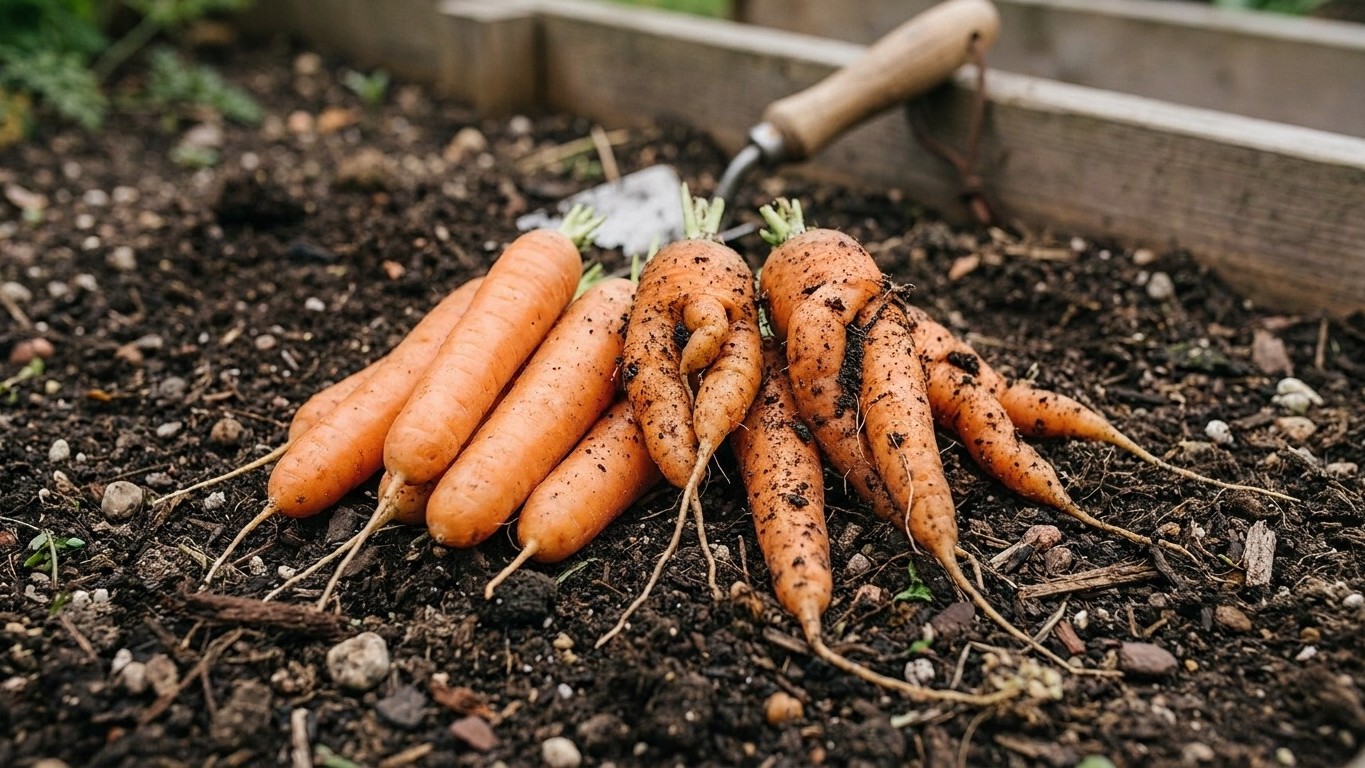

Pull carrots about 65 to 75 days after sowing, going by Clemson Cooperative Extension, though many seed packets quote 70 to 100 days depending on the variety. Carrots are seeded straight into the bed, so every count starts on sowing day. Once they are out of the ground, remove the tops, keep the roots near 33 °F with high humidity, and they will last far longer than they do on the counter. For the growing side, see Growing Carrots in Virginia.
Keeping them, and for how long
How do you know carrots are ready to pull?
The calendar gives a window, and the row gives the answer. Brush the soil from the top of two or three roots. The shoulder, the part just under the leaves, shows how thick the carrot has become. When it matches the width your packet describes, pull one and taste it. A carrot left far past maturity can crack or turn coarse, so a row that has hit its date should not be ignored for weeks.
Soil decides how easy the pulling is. Virginia’s state soil, the Pamunkey series, is a loam to silt with 50 percent sand, 11 percent clay and 39 percent silt. It is well drained and has a surface pH of about 6.2, which is slightly acid. Ground like that usually lets roots slide out with a gentle tug. That is the state’s representative soil, though, and a garden can differ a lot from it. Bottomland, hill country and any lot a builder has scraped or filled will behave differently.
A jar test shows what you actually have. Fill a quart jar one-third with garden soil, top it up with water, shake hard and let it settle. Sand drops out within a minute, silt over the next several hours, and clay stays cloudy for a day or longer. Utah State University Extension says carrots want deep, sandy, well-drained soil rich in organic matter, and that heavy or rocky soil makes the root fork. If your jar shows a thick clay layer, loosen the row with a garden fork before you pull. Will Carrots Fork in Virginia Soil? covers what to do for next season.
How long do carrots keep after harvest?
Clemson Cooperative Extension’s Home & Garden Information Center gives the storage conditions directly: “Store them at 33 °F and high humidity to prevent wilting. Bunched carrots (plants with tops on) can be stored for about 10 to 14 days.”
Treat that 10 to 14 days as a ceiling reached under ideal conditions. Anything short of 33 °F or high humidity shortens it. Roots that were nicked by a fork, chewed by pests or bruised in the pull will also go soft ahead of schedule. If a row has had trouble with root damage, check What Eats Carrot in Virginia, and When and eat the damaged roots first.
Why should you cut the tops off before storing?
The leaves keep pulling moisture out of the root after harvest, long after the carrot has left the soil. That is why bunched carrots hold for 10 to 14 days while trimmed roots can last for months when the conditions are right. Cut or twist the tops off the day you harvest, leaving a short stub at the crown.
Brush off loose soil and hold off on washing until you are ready to cook. Then pack the roots in a perforated bag or a lidded container with a slightly damp paper towel. The goal is air that stays humid without leaving water pooled on the carrots. A closed, dripping container invites rot, and an open shelf lets the roots shrivel.
Where in the house that actually is
The target of 33 °F, just above freezing, is colder than most rooms in a house and warmer than the freezer. Four spots are worth comparing:
- Refrigerator crisper drawer: the closest match in most homes, and the easiest to keep humid with a bag or container.
- Back of a lower refrigerator shelf: colder than the drawer or the door, so it can be nearer the target. It can also be cold enough to freeze roots that touch the back wall.
- Garage or shed: it swings with the weather, so it may be fine one week and frozen or warm the next.
- Kitchen, pantry or any heated room: far too warm for carrots.
The drawer and the shelf are where most people end up, but refrigerators vary. Dial settings differ, and a full fridge runs differently from a half-empty one. A drawer that feels cold to the hand can still sit well above 33 °F. Carrots kept near 50 °F lose their firmness and begin to sprout in a fraction of the time they would last at 33 °F.
Leave a plain thermometer in the spot where the carrots will go for a day or two before you trust it with a harvest. Read it after the door has been opened a few times, as it would be on a normal day. If it reads well above 33 °F, move the thermometer to a lower shelf and try again, or turn the dial colder in small steps. If you see frost on the carrots or an icy film in the bag, the spot is too cold.
A garage can work in a cold snap if it holds steady, but a thermometer that records the high and low is worth having. If it ever drops to freezing or climbs well above 33 °F, the carrots belong in the house.
Common questions
Can carrots stay in the garden instead of being stored?
Where winters are mild, many gardeners leave mature carrots in the ground under a thick layer of mulch and pull them as needed. The soil acts as the cold, humid storage. Pull the whole row before the ground freezes solid, because roots locked in frozen soil are hard to harvest. Mulch also gives voles and other root-eaters an easy place to hide.
Should carrots be washed before they go in the fridge?
Brush off the loose soil and wash them when you are ready to use them. Wet roots in a closed bag rot faster, and the damp paper towel in the container already supplies the humidity they need.
Do forked or twisted carrots store as well as straight ones?
Yes, as long as they are undamaged. Forking comes from heavy or rocky soil and does not change how the root keeps. Eat the odd shapes first, since they are harder to peel and pack. Next season, a raised bed or double digging with plenty of compost addresses the cause.
How can you tell stored carrots have gone bad?
Look for roots that feel soft or rubbery, a slimy surface, white sprouts at the crown or a sour smell. A carrot that has simply gone limp from drying out can often be revived in cold water for an hour. Slime or a sour smell means it should go to the compost.