
Carrots in Virginia get eaten at three stages. Seedlings vanish early, leaves get chewed mid-season, and roots are tunneled underground where nothing shows until harvest. The culprit differs by stage and by county, and your county’s Virginia Cooperative Extension office is the place to put a name on it. What follows sorts the damage by symptom and by days from seeding, since carrots are never transplanted. For the full crop picture, start with Growing Carrots in Virginia.
Which pests attack carrot in Virginia
Virginia Cooperative Extension, the state’s land-grant extension service, identifies garden pests county by county. It sorts carrot trouble into three groups based on where the damage happens: soil-dwelling feeders that work on the root, chewers that eat the foliage, and animals that nip seedlings or pull roots. Naming the exact species is a job for the county office, because the list shifts from the Tidewater to the Piedmont to the mountain valleys.
The first group does the most harm. Larvae that live in the soil feed on the root itself, scarring the surface or boring through it. Most of the damage stays hidden until you pull the carrot, and gardeners often blame the weather for a poor row when the real problem was under the surface for weeks.
The second group eats the tops. Caterpillars and beetles chew the feathery leaves and stems. A healthy carrot can lose a fair amount of foliage and still size up a root, but heavy defoliation on young plants slows them down. Aphids and other sap-feeders belong here too, and they show up as curled, sticky or distorted growth rather than holes.
The third group is animals. Rabbits, deer and voles are all common in Virginia yards, and any of them can clip tops or dig up roots. Their damage looks different from insect feeding: clean, angled cuts on stems, missing plants, or shallow holes beside the row.
One rule shapes everything else. Carrots are sown in place, and they take 70 to 100 days from seeding to reach harvest. That long stretch in one spot means the row sits exposed to each group in turn, with no chance to replace a damaged plant by transplanting.
When each one shows up, and what it does first
The calendar starts the day the seed goes in, not on a particular month. Carrots sown in early spring and carrots sown for fall meet different pests at different stages, so count from seeding and from the last spring frost. The timing logic is laid out in When to Sow Carrots in Virginia: Counting Back From the Last Frost.
Seedling stage, from germination until the tops are a few inches tall
The first symptom is gaps. A row that came up evenly looks thinner a few days later, with stems cut at the soil line or plants simply gone. Cut stems and a clean, angled snip point to an animal. Plants that wilt and collapse with the stem still attached and the root nibbled suggest something in the soil. If nothing ever emerged, check whether the soil crusted over, because a hard crust blocks tiny carrot seedlings as effectively as any pest.
Foliage stage, while the tops fill out
Here the first sign is ragged leaf edges, bare stems or leaves that curl and stick together. Chewing damage usually starts at the edges and works inward, while sap-feeders leave distorted growth and a tacky film on the leaves. Look under the leaves on a bright morning, when insects are slow and easier to spot.
Root-swelling stage, through harvest
This is when the root-feeders show themselves, and the first clue is often above ground. Tops that look stunted, reddish or yellow, or that wilt on a warm afternoon even after watering, can signal trouble below. The proof comes at harvest, when roots show tunnels, scars or rough brown channels. Clemson Cooperative Extension puts harvest at 65 to 75 days after planting, and every extra week in the ground is another week of feeding for anything living in the soil.
Telling the damage apart from everything else
Many carrot problems that look like insect work are something else. Forked roots, wilting tops and split skins all get blamed on pests, and the fix is completely different when the cause is soil or water. The table lists common symptoms, what they can point to, and the check that separates them.
| What you see | Possible causes | What settles it |
|---|---|---|
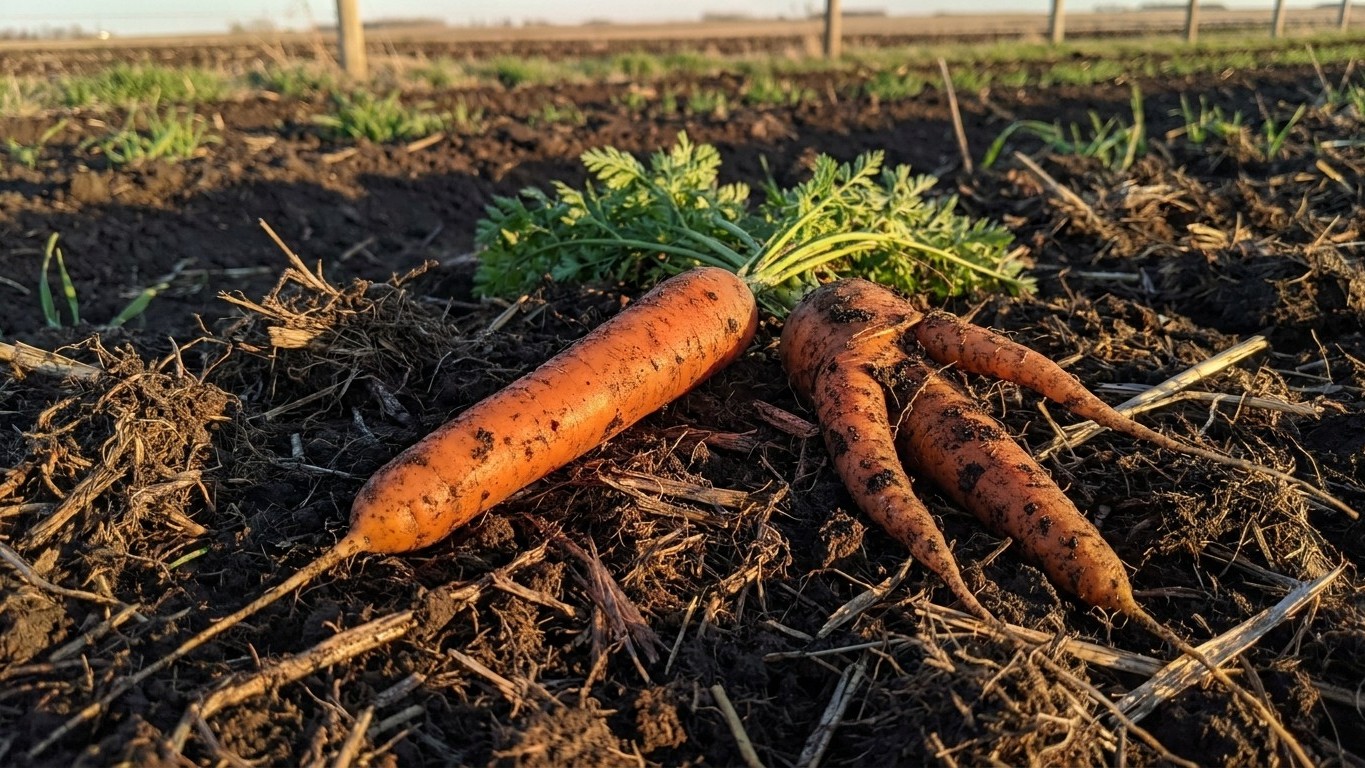
| Forked, stubby or hairy roots | Heavy, rocky or compacted soil. A buried stone or clod also splits the root. | Dig beside the row and check for stones, clods and a hard layer. Insect feeding leaves tunnels and scars, while forking leaves a smooth, branched root. |
| Tops wilt on warm afternoons | Dry soil, or damage to the root below. | Water deeply and look again the next morning. Tops that recover overnight point to water stress. Tops that stay limp over a damaged root deserve a closer look. |
| Yellowing leaves | Nutrient shortage, a dry or soggy spell, or feeding on the roots. | A soil test through your county extension office shows nutrient levels. Pull one carrot to check the root. |
| Cracked or split roots | Heavy rain or watering after a long dry stretch. | Check the weather and your watering history. Clean splits with no tunnels suggest water, while tunnels with soil or dark debris inside suggest feeding. |
| Seedlings missing | Animals, crusted soil, or seed that never sprouted. | Look for cut stems, tracks or digging. Check for a hard crust, and scratch the soil to find seed that failed to sprout. |
| Holes in leaves | Insect chewing, hail or wind whipping. | Look at the edges. Chewing leaves a ragged margin, while hail leaves torn, tattered patches across a whole planting. |
Soil often explains what the pests don’t. Virginia’s state soil is the Pamunkey series, a loam to silt with 50 percent sand, 11 percent clay and 39 percent silt, surface pH about 6.2, organic matter about 1.2 percent, and well drained, according to USDA NRCS Soil Data Access. That represents the state, not your yard, since a river bottom, a hillside or a lot a builder has scraped can differ completely. Utah State University Extension says carrots want deep, sandy, well-drained soil rich in organic matter, and that heavy or rocky ground makes the root fork. Our guide Will Carrots Fork in Virginia Soil? goes further into that question.
The test that settles it at home is cheap. Dig a hole, fill it with water and let it drain. Fill it again, and time the second draining. Slow draining or a pan of hard soil at the bottom means roots will meet resistance. A soil test from your county extension office gives your actual pH and organic matter in place of the state average. Never diagnose a pest from the leaves alone. Pull a root, and if the cause is still unclear, take it to the extension office.
What actually works here, and what is a waste of time
A physical barrier laid before the pests arrive beats any treatment applied after the damage starts. A lightweight floating row cover over the bed keeps egg-laying insects off the soil and the leaves. Lay it the day you sow, and bury or weight the edges all the way around, because a gap at the edge gives the insects a doorway. Carrots do not need pollinators for the root crop, so the cover can stay on. Fencing works the same way for animals: low wire or mesh around the bed, with the bottom edge buried to stop digging.
Timing carries the rest. Sowing at the right point relative to the last frost, as laid out in the sowing dates guide, shortens the window when young plants are most vulnerable. Harvest on time too, since a row left in the ground well past 65 to 75 days keeps feeding anything in the soil.
Rotation helps with root-feeders that overwinter in the ground. Moving the carrots to a different bed each year, away from where carrots or their relatives grew the season before, breaks the cycle. Sow thinly so you pull fewer seedlings.
Several common habits waste time. Spraying at the first ragged leaf rarely helps, because most damage is already done below ground and the larvae in the soil never touch the spray. Home remedies and companion plants have little evidence behind them as protection for a carrot row. And treating without an identification is a gamble that can kill beneficial insects along with the pest. What is legal to apply on a food crop varies by state, so the county extension office is the one to ask.
Where to check this for your own county
Your county’s Virginia Cooperative Extension office is the right place to take a damaged plant. Agents there know which pests are active in your part of the state and what is currently legal to use on a food crop. Virginia runs from the Coastal Plain through the Piedmont to the mountain valleys, and a pest that is common in one county can be rare a short drive away. The extension office can also test your soil, which matters because heavy, rocky or compacted ground forks carrots no matter what is feeding on them.
When you go, bring evidence. Take a whole damaged carrot, tops included, sealed in a bag, plus photos of the row and your dated notes from the weekly check. Tell them when you sowed and what the weather did afterward. Agents can narrow a diagnosis quickly when they have the timeline, and they can tell you whether a barrier, a change in sowing time or a different bed will help. Call or visit before your next sowing, not after the row has failed.
Common questions
How long until carrots are ready to pull?
Carrots are sown directly in the ground and take 70 to 100 days from seeding. Clemson Cooperative Extension puts harvest at about 65 to 75 days after planting, so check the seed packet for your type and begin checking root size near the early end of the range.
How should I store carrots after harvest?
Cut the tops off first, because the leaves keep pulling moisture from the root. Then store the carrots at 33°F with high humidity, per Clemson Cooperative Extension. Bunched carrots with the tops on keep only about 10 to 14 days. Sort out any roots with tunnels or soft spots before storing, since one spoiled carrot can spread decay.
Is a forked carrot a sign of insects?
Forking usually comes from heavy or rocky soil, according to Utah State University Extension. Insect feeding leaves tunnels, scars or chewed spots on the root. If a carrot is forked and also tunneled, both may be happening, and your county extension office can help sort out which.
Who can identify what is eating my carrots?
Your county’s Virginia Cooperative Extension office. Bring a damaged root, photos and notes on when you sowed and when the damage started. The office can name the pest in your area and tell you what is approved for use on food crops in the state.