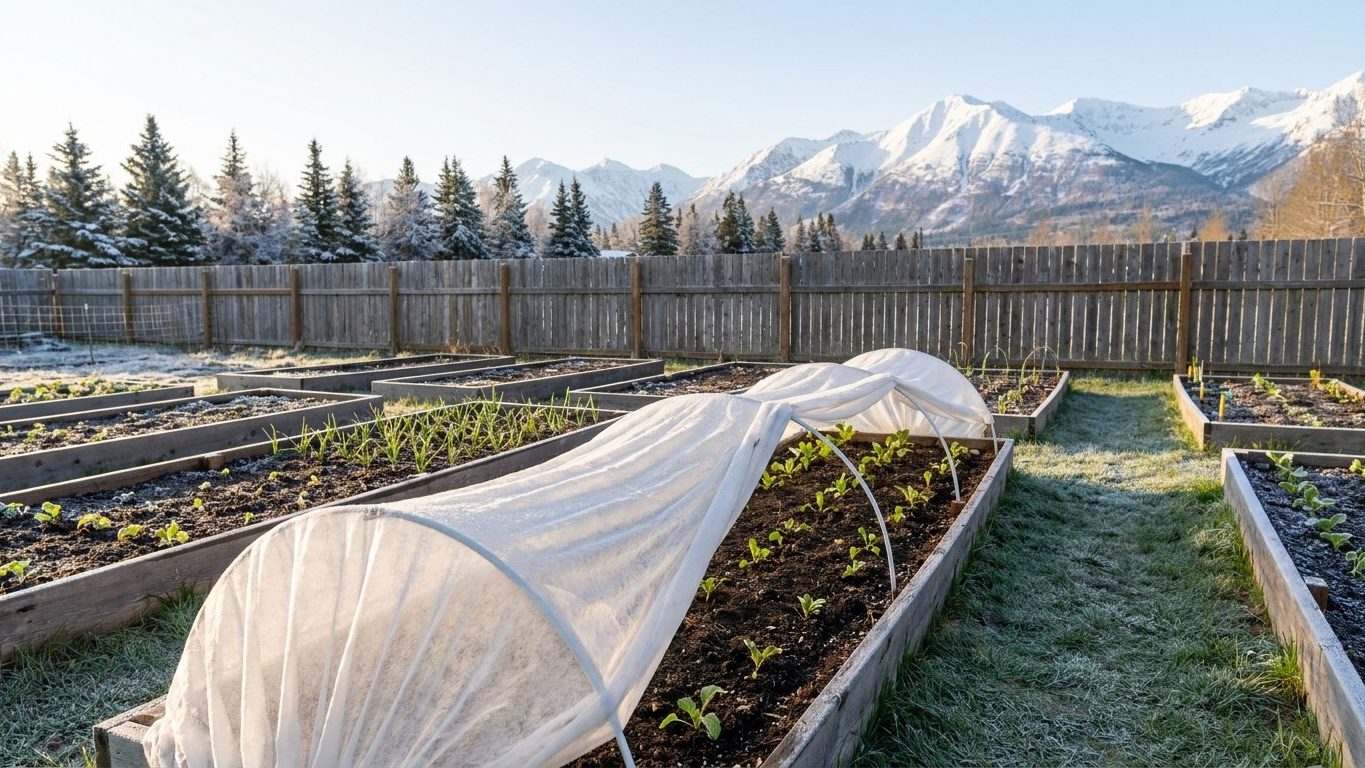

Cover plants on any night the forecast drops to 32°F or close to it. In spring that means from planting day until freezes stop, and in fall from the first freeze until the crop is done. Daytime matters too: covers come off or get vented when the sun warms the bed. The reference dates, and how far to shift them for your own garden, follow.
The short answer for North Dakota
Watch the forecast from early May through mid-May, then again from late September into early October. In Fargo, the reference city, the last spring freeze falls between May 4 and May 15, and the first fall freeze between September 25 and October 5. These are NOAA 1991-2020 normals for 32°F, and the dates mark the stretch when the odds of a freeze sit between 30 and 70 percent. After May 15 a freeze is less likely but still possible, and before September 25 the first one can still show up in a cold year.
Why do covers work on a frost night?
The ground soaks up heat all day and gives it back after dark. A cover traps part of that heat around the plants instead of letting it escape into a clear sky. That is why covers help most on still, clear nights, which are the nights frost likes best. A cover buys a few degrees of protection, which is enough for a light freeze and not enough for a hard one.
Which crops need covering, and when?
Tender crops are harmed by freezing temperatures. Hardy ones shrug off a light freeze and mostly need cover to grow faster or to survive a deeper cold snap. The table sorts the common ones.
| Crop type | Spring | Fall |
|---|---|---|
| Tender: tomatoes, peppers, squash, cucumbers, beans, melons | Cover every night near 32°F from planting until the freeze window has passed | Cover at the first freeze forecast to keep ripening fruit for a few more days |
| Half-hardy: lettuce, beets, carrots, potatoes | Plant earlier, cover on hard-freeze nights | Cover as nights get colder to stretch harvest |
| Hardy: spinach, peas, kale, radishes | Sow as soon as the soil can be worked, cover to speed growth | Cover through repeated freezes to keep picking |
Covers go on in late afternoon, before the air cools, and come off by mid-morning once the temperature is above freezing. Which material to use for which job is covered in Which Season Extenders Work in North Dakota.
What will not work here
Planting tender crops in early May and counting on one layer of fabric is the most common failure. The window above runs to May 15 at the airport, and farm and town gardens outside Fargo typically see the last freeze one to two weeks later. A cover that handles a light freeze will not handle a hard one, so a cold snap in the third week of May can still flatten tomato transplants that were set out early.
Can a cover save a slow crop in fall?
Only partly. With the first fall freeze arriving between September 25 and October 5 in Fargo, and often earlier in the country, a crop that still needs a month of warm weather will not finish under a cover. Fargo sits at 46.93 degrees north, so days shorten fast in October. Plants grow slowly then even when they stay above freezing. In fall a cover protects what is already nearly ripe, and it does not make a late planting catch up.
Will a cover carry plants through a North Dakota winter?
No, not for anything tender. The mean daily minimum in the coldest month at Fargo is 0.2°F. A floating row cover, a low plastic tunnel or a cold frame with no heat source will not hold the air inside anywhere near that. Hardy crops like garlic and some kale survive under mulch or snow cover, which insulates better than fabric does. Tender plants left out on the hope that a sheet will see them through simply die.
What goes wrong with plastic on sunny spring days?
Sealed plastic heats up quickly once the sun is out, even when the air outside is cool. A closed low tunnel on a bright April afternoon can cook seedlings that survived the night. Venting or removing it by mid-morning matters as much as putting it on at dusk. Fabric row covers run cooler and forgive more.
Wind is the other local hazard. Open prairie wind will lift an unsecured cover and drop it somewhere in the neighbor’s field. Weight the edges with soil, boards or landscape pins every time, and expect to check them after any breezy night. Flowering crops also need the cover off during the day, once blooms open, so pollinators can reach them.
What changes across North Dakota
The state does not have one growing season. The USDA Plant Hardiness Zone Map (2023, built on 1991-2020 normals) places it in zones 3a through 4b. That covers a wide spread in winter cold, and the spread carries over into spring and fall frost timing. There is no single answer for the whole state, so the Fargo dates serve as a reference rather than a rule.
How should a gardener in the north or at higher ground shift the dates?
Fargo is in the east, at 46.93 degrees north. A reader closer to the Canadian border is several degrees farther north, and one on higher ground in the west sits where cold air arrives sooner and lingers longer. In both cases the safe move is to push spring planting back and plan for covers earlier in fall. Shifting the spring window one to two weeks later and the fall window one to two weeks earlier is a sensible starting point for rural gardens, and more at elevation.
Low spots matter just as much as the compass. Cold air drains downhill on still nights, so a garden at the bottom of a slope can freeze while one higher up the slope stays warmer. A bed against a south-facing wall may escape a frost that hits the middle of the lawn.
Does your hardiness zone tell you when to cover?
No. The USDA system rests on a single variable, the average annual extreme minimum temperature, which tells you whether a perennial survives winter. It says nothing direct about the date of the last spring freeze. Two gardens in the same zone can have last-frost dates a couple of weeks apart. To find your own zone, look up your location on the USDA Plant Hardiness Zone Map rather than guessing from a neighbor’s or a relative’s. The broader picture of how season extension works across the state is in Extending the Growing Season in North Dakota.
Where to check this for your own county
The dates here describe one weather station at an airport. A county recommendation beats a state one every time, because the people who write it know the local soils, the local wind and the local frost pockets. NDSU Extension runs offices that serve the state’s counties, and that is the place to turn from a general rule to a specific one.
What should you look for from the county extension office?
Three things are worth asking for or looking up:
- The local planting calendar, with the spring and fall freeze dates measured closest to your county rather than at a far-off airport.
- The vegetable varieties that have been trialed in your county, since a variety that performs in the Red River Valley may fall short in a cooler western county.
- Advice on which row covers, tunnels or cold frames suit the local wind and snow load.
Checking this against your own garden
Your own observations outrank every date in a table. Three signals tell you more about your yard than any regional figure, and none of them needs a gadget.
How can you tell if the soil is warm enough?
Push your hand into the bed, a few inches down, in mid-morning. Cold soil feels cold against the skin and stays that way, and seeds and transplants sit idle in it. A bed against a south wall will usually feel noticeably warmer than one in open ground or at the bottom of a slope.
What do the first male flowers tell you?
Squash, cucumbers and melons open male flowers first, ahead of the female ones that set fruit. When the first males appear, the plant has settled in and is growing on its own schedule. If yours open well after a neighbor’s down the road, your site is running cooler, and you should plan on covers lasting longer into the season.
What do the first true leaves show?
Seedlings first put out a pair of seed leaves, then the true leaves that look like the mature plant. Where true leaves arrive on time, the air and soil are warming well. Where they stall, with seedlings sitting small and pale for weeks, the spot is staying cold, and a cover or a different bed will speed things up.
Write down the date of the last frost that blackens tender leaves in your yard, and the first in fall. After a few seasons your own dates will be more reliable than any airport’s.
Common questions
What temperature should I cover plants at in North Dakota?
Cover tender crops when the forecast calls for freezing, and consider covering on a clear, still night. Gardens outside town often run colder than the nearest weather station, so a forecast near freezing can still mean frost in a low spot. Hardy crops like spinach, peas and kale tolerate a light freeze and only need cover in deeper cold.
Can I leave row cover on all day?
Lightweight fabric row cover lets light and water through and can stay on during cool days. Plastic needs venting or removal by mid-morning because it overheats quickly in the sun. Once crops like squash and cucumbers start to flower, take covers off during the day so pollinators can reach the blooms.
Should I water before a frost night?
Moist soil holds and releases more heat than dry soil, so a watering earlier in the day can help. Water in the morning or early afternoon so the surface is not soaking wet at dusk. Watering helps a little and works best in addition to a cover, not in place of one.
When can I stop covering in spring?
The Fargo window for the last 32°F freeze is May 4 to May 15, and freezes after it are less likely but possible. Gardens in the country and at higher ground usually need one to two weeks more. Keep covers handy until the forecast shows nights staying well above freezing, and until your own county calendar says it is safe.