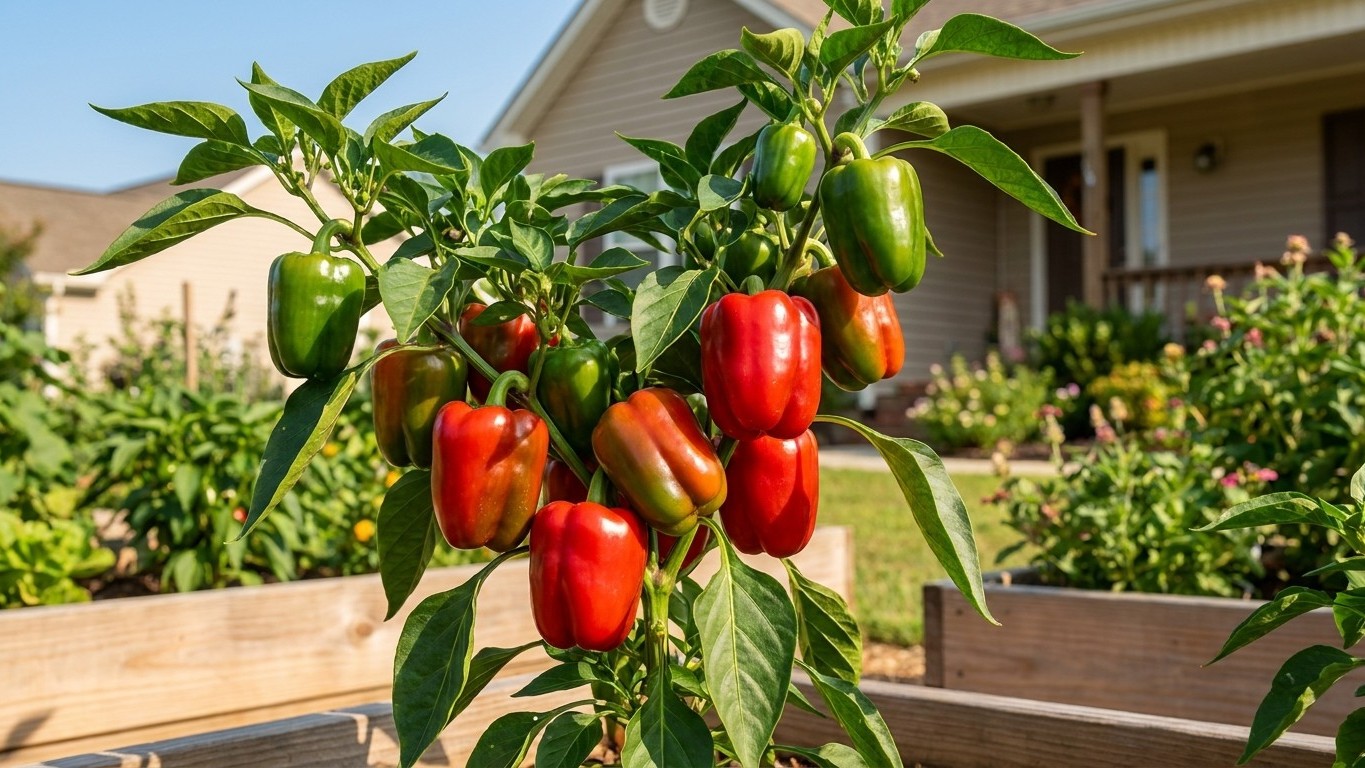

Pick peppers when they reach full size and feel firm and glossy, then keep them at 45 to 50 °F (about 7 to 10 °C) and out of the refrigerator. A household fridge runs colder than peppers tolerate, and below about 45 °F the skin pits and goes soft. On Prince Edward Island the harvest ends with the first fall frost. The spot you choose for storage decides how long the crop lasts after that.
When are peppers ready to pick in Prince Edward Island?
Clemson Cooperative Extension says peppers should be ready for harvest in about 70 to 85 days after transplanting. The count starts the day the seedling goes into the garden. Utah State University Extension adds that transplants need 8 to 10 weeks indoors, and that they go out when the soil reaches 60 °F (about 16 °C), after frost has passed.
Environment and Climate Change Canada puts the average last spring frost at Charlottetown A on May 16. That is a mean date, so in one year out of two the last frost comes later. Treat it as the middle of a window and never as a safe date. The station sits at the airport, and northern and upland districts on the Island run weeks behind it.
What does a ready pepper look like?
Size and texture give it away. Check these before you cut:
- The fruit has reached the full size expected for its variety, which the seed packet or plant tag describes.
- The wall feels firm when you squeeze gently, with no give near the shoulders.
- The skin is glossy and taut, with no wrinkling around the stem.
- Green peppers are ready at full size. Peppers that will turn red, yellow or orange can stay on the plant longer to color up.
Use pruners or scissors and leave a short piece of stem on each fruit. Twisting or yanking often snaps whole branches, and brittle pepper plants lose a lot of future flowers that way.
How does the first fall frost change when you pick?
Peppers are tender, and fruit still on the plant when a frost arrives gets damaged. When the forecast shows a frost night, pick every full-size fruit before it, whatever its color. Small fruit left behind will not size up in time. Utah State University Extension notes that the 35 to 45 days a pepper needs run from flowering, so a flower that opens in late summer has to beat the same frost on that clock.
Fruit set matters here too. According to the same extension source, it fails at both ends: nights below 55 °F (about 13 °C) or days above 90 °F. The hot end rarely bites on the Island. At Charlottetown A, Environment and Climate Change Canada counts 0.93 days a year above 30 °C and 0.03 days a year above 32 °C. Summer night lows vary from one garden to the next, so the cool end is the one to watch with your own thermometer. Flowers that drop in a cold spell are the reason some plants are slow to produce. The full story is in Why Peppers Fail to Set Fruit in Prince Edward Island, and the broader growing calendar is in Growing Peppers in Prince Edward Island.
Keeping them, and for how long
The clearest storage guidance comes from Clemson Cooperative Extension’s Home & Garden Information Center: “The optimal conditions for storage are temperatures of 45 to 50 °F and 80- to 90-percent relative humidity for two to three weeks.” That is 7 to 10 °C, in air humid enough that the skin does not shrivel.
The two to three weeks is a maximum under those ideal conditions. It does not promise that any pepper from your garden will last that long. A fruit that was ripe past its prime at picking, or that sat in a warm kitchen for a day first, will be done sooner.
Why is the fridge too cold for peppers?
A domestic refrigerator runs colder than the 45 to 50 °F range. Below about 45 °F peppers suffer chilling injury. The skin develops small sunken pits, the flesh softens, and the fruit rots quickly once it warms back up. Many gardeners put peppers in the crisper drawer by habit because that is where store-bought ones sit. The damage often does not show until a day or two later, which makes the fridge look innocent.
What shortens the storage life of a picked pepper?
Even in the right room, a few things cut the time short:
- Bruises and cuts, which let rot start in a single spot and spread.
- Stems pulled out rather than cut, which leave an open wound.
- Fruit nibbled by insects or slugs, which should be eaten first. What Eats Pepper in Prince Edward Island, and When shows what to look for.
- Fruit that has already started to soften or wrinkle at the shoulders before storage.
For humidity, a loosely closed perforated bag or a container with the lid slightly ajar holds moisture without trapping it. A sealed bag in a damp spot invites mold. Check the fruit every few days and use the softest first.
Where in the house that actually is
A house has spots at nearly every temperature, and only one or two of them land in the 45 to 50 °F range. Most Island homes keep the living space well above it, and the refrigerator sits well below it. That leaves the in-between rooms.
| Spot | What happens to peppers | Verdict |
|---|---|---|
| Refrigerator crisper drawer | Colder than 45 °F, so pitting and softening | Avoid for whole fruit |
| Heated kitchen counter | Too warm, so wrinkling and fast decay | Fine for a few days of use |
| Cool basement room or pantry on an outside wall | Often close to the 45 to 50 °F range | Best candidate |
| Attached garage or shed | Swings with the weather, warm in the afternoon and near freezing on a clear autumn night | Risky without checking |
A cool, unheated interior room with stable air, such as a basement corner away from the furnace or a pantry against an outside wall, comes closest in a typical Island house. It stays steadier than a garage, and the air is usually damper than upstairs. Check the room with a thermometer and choose a spot that holds steady near that range. The same spot in July may be too warm.
Do not trust your hand or your sense of the room. Leave a thermometer in the spot for two days before you commit a harvest to it, and read it morning and evening. If the low and the high both sit between 45 and 50 °F, it is a good place. If the reading drifts above 50 °F, the peppers will last a shorter time. If it dips below 45 °F, you have rebuilt the fridge problem in a different room. Setting a bowl of water beside the fruit or a damp towel under the container helps raise humidity if the air feels dry, but a basement is often damp enough already.
Common questions
Can I pick peppers while they are still green?
Yes, once they have reached full size and feel firm. A green pepper is simply an unripe one that is perfectly good to eat. If you leave it on the plant it can color up, but it will take more time, and on the Island that time is limited by the first fall frost.
Will peppers ripen after I pick them?
Fruit that has started to blush often finishes coloring indoors at room temperature. A fully green fruit may color slowly or stay green, and a fruit picked too small will not improve. Cold storage slows any ripening, so decide whether you want to eat them soon or keep them.
Is it ever okay to put peppers in the fridge?
Cut, cooked or chopped peppers belong in the fridge because they spoil quickly at room temperature. Whole fresh fruit is different. Injury builds the longer it sits below about 45 °F, and the pitting shows up once the fruit warms. If a fridge is your only cool option, use the peppers within a few days.
What should I do when frost is forecast and peppers are still small?
Pick everything that has reached full size and leave the rest. Small fruit will not mature in the time left, and a frosted plant drops what remains. A light cover over the plants can carry them through a single mild frost night, but it will not rescue them from a hard freeze. Your county or provincial agriculture office can tell you how late frosts typically run in your part of the Island, which can differ a lot from the airport station.