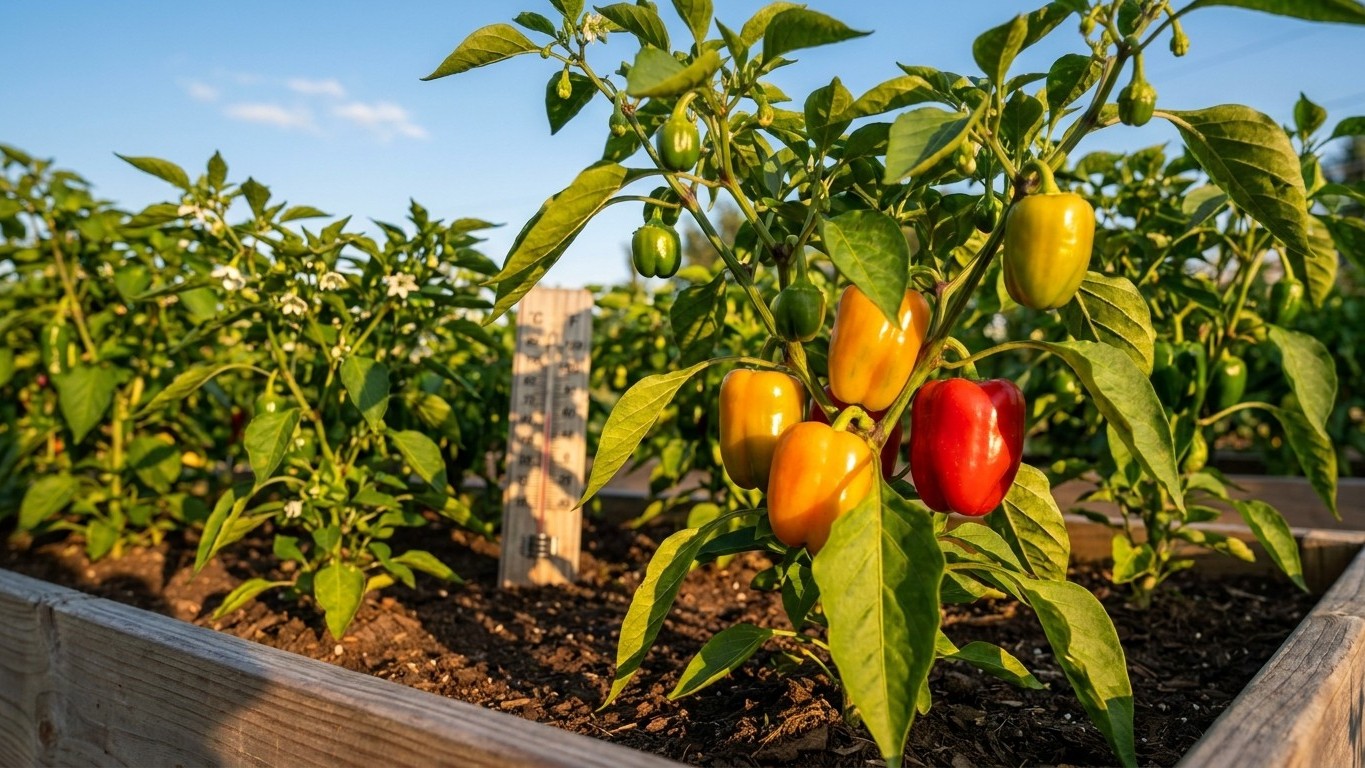

Pick peppers once the fruit is full size and firm, which Clemson Cooperative Extension puts at about 70 to 85 days after transplanting. Where frost comes early, bring in every full-size fruit before it hits. Then comes the step most gardeners get wrong: the refrigerator. It runs colder than peppers tolerate, and they pit and soften there. For a Nunavut harvest, a cool room does the job better. The full season picture is in Growing Peppers in Nunavut.
Keeping them, and for how long
Clemson Cooperative Extension’s Home & Garden Information Center gives the optimal storage conditions for peppers as 45 to 50 °F (roughly 7 to 10 °C) and 80 to 90 percent relative humidity, for two to three weeks. Treat the three weeks as a ceiling reached only under those ideal conditions. A spot that drifts warmer or drier shortens it. So does a pepper that was bruised on the way in or picked past its prime.
Why does the fridge ruin peppers?
Peppers are a warm-season crop, and their tissue is injured by cold well before it freezes. Below about 45 °F, the skin pits and the flesh softens. That is chilling injury. A domestic refrigerator sits below that line, so every pepper in the crisper drawer is in the damage zone. The sunken spots often show up after the fruit comes back to room temperature. By then, rot has a way in, and a pepper that looked fine on Tuesday is mush by the weekend.
The humidity number matters nearly as much. At 80 to 90 percent, a pepper holds its water. Ordinary room air is far drier, so fruit left on a counter wrinkles and goes limp even when the temperature is right.
How should you pick and handle them?
Choose fruit that is full size, firm and glossy. Cut the stem with pruners or scissors and leave a short stub on the pepper. Pulling snaps branches and tears the shoulder of the fruit. Handle gently, since every bruise becomes a soft spot in storage. Skip washing until you are ready to eat, because water left on the skin invites rot.
Check each fruit for chewing marks or soft patches. Damaged peppers should go to the kitchen first rather than into storage. If something has been feeding on your plants, What Eats Pepper in Nunavut, and When explains what to look for.
Cold works against you in the garden too. Fruit still on the plant during a run of chilly nights is already being chilled, and nobody can read that off a map. Watch your own nights, and pick early when the forecast turns cold.
Where in the house that actually is
Most homes have no room that sits at 45 to 50 °F by accident, so it helps to run through the usual candidates.
- The refrigerator is too cold, and chilling injury follows.
- Living areas and the kitchen are too warm. Peppers soften and shrivel faster there, and the humidity is too low.
- A garage, shed or unheated porch swings with the weather. A sunny afternoon can push it well past 50 °F, and a clear night can drop it far below.
- A cool interior room is the best bet.
In a northern house, a spare bedroom with the heat turned down and the door shut usually comes closest. So does a pantry or closet on an exterior wall, away from the stove, the furnace and any window that gets afternoon sun. An enclosed entry can work in the cooler part of the harvest. Check it before you trust it, though, because a space that only gets cold at night can sink below the safe range while you sleep.
Leave a thermometer in the spot for two or three days before you move the harvest in. Skipping that step means guessing, and a few degrees decide whether peppers keep or pit. A min-max model is ideal. Read the overnight low and the afternoon high, and aim to stay inside 45 to 50 °F. If the spot runs a little warm, plan to use the peppers sooner. If it dips under 45 °F, find another spot.
For humidity, a loosely closed container or a bag with a few holes poked in it, lined with a paper towel, holds moisture without sealing it airtight. A fully sealed bag collects condensation, and water droplets on the skin are where rot begins. A cheap hygrometer will tell you whether the room lands anywhere near 80 to 90 percent. Most will not, which is why the container matters.
Common questions
When is a pepper ready to pick in Nunavut?
Clemson Cooperative Extension counts about 70 to 85 days after transplanting. Fruit itself needs roughly 35 to 45 days from flowering, and that clock starts at flowering, not at sowing or transplanting. At Rankin Inlet A, the mean last spring frost is June 19. That is a midpoint, so in one year out of two the last frost comes later. Northern and upland communities can run weeks behind it. Plants that never set fruit have nothing to pick, and Why Peppers Fail to Set Fruit in Nunavut covers that problem.
Should I pick green peppers before frost?
Yes. Green peppers are edible, and a pepper left on the plant slowly gains color and sweetness. A frost will damage the fruit and the plant together, so a cold forecast is the time to bring in every full-size, firm fruit and eat or freeze the rest. Waiting for one more week of color is a gamble. Small, soft or thin-walled fruit will not improve much in storage, so use it first.
Does summer heat hurt peppers in Nunavut?
Fruit set fails at both ends, according to Utah State University Extension: nights below 55 °F and days above 90 °F. The hot end is not a concern in Nunavut. At Rankin Inlet A, Environment and Climate Change Canada counts 0.0 days a year at or above 32 °C, which is the same as 90 °F, and only 0.03 days a year above 30 °C. The cool end is the one to watch. Nights below 55 °F can stall flowering, and only your own thermometer can tell you how many nights your garden has.
What if I cannot keep a room cool enough?
Freeze them. Chilling injury matters most for peppers eaten raw, since pitting and softness are mostly a texture problem. Sliced or chopped peppers go into soups, stews and sauces with little loss, and a baking sheet in the freezer keeps the pieces from clumping. For raw use, the cool interior room is still the better option. If the fridge is your only choice, use the peppers within a few days rather than counting on the two to three weeks.