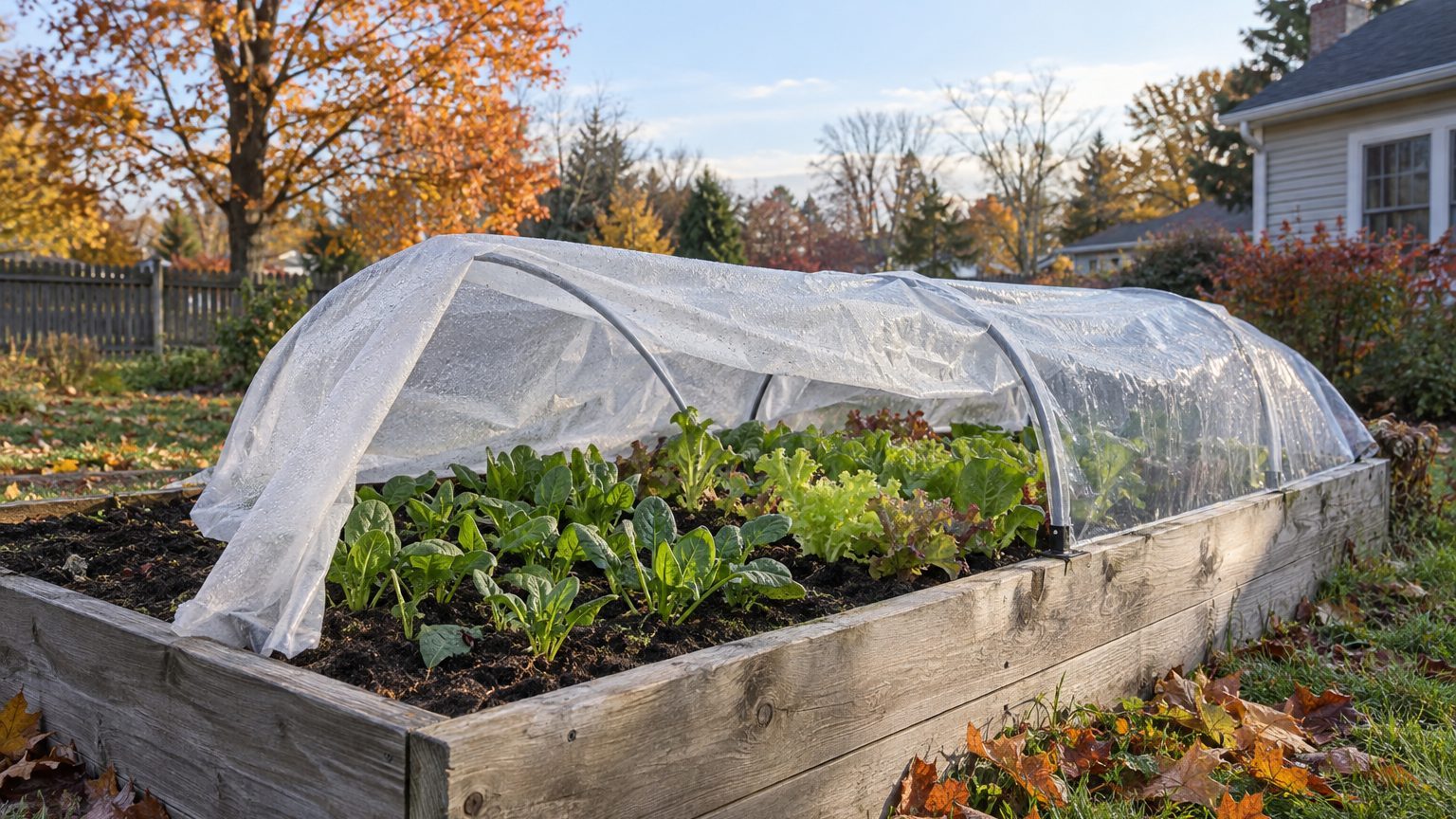

Season extension in Nunavut starts late and ends early. At Rankin Inlet A, the reference station, the mean last spring frost is June 19 and the mean first fall frost is September 13, which leaves about 86 frost-free days. Low tunnels, cold frames and raised beds can stretch that window at both ends, by an amount that varies with the weather. Everything below works inside it.
When the soil is warm enough in Nunavut
The mean last spring frost at Rankin Inlet A falls on June 19, according to Environment and Climate Change Canada’s 1981-2010 climate normals. That date is a midpoint. In one year out of two the last frost comes later, so June 19 marks the middle of a window and gives no safe planting date. Communities farther north, or inland and away from the Hudson Bay coast, run weeks behind this station. Canadian normals also cover 1981-2010, an older span than the 1991-2020 normals used for US stations.
Why does soil temperature matter more than the frost date?
Seeds and roots respond to the ground they sit in. The last frost tells you when freezing air stops, and the soil warms after the last frost has passed. A gardener who sows on the frost date is sowing into cold, slow ground. Cool-season crops such as lettuce, spinach, radishes and peas germinate in cool soil, so they go in first. Warm-season crops such as beans and squash need far warmer soil and are a long shot outdoors this far north. A raised bed filled with garden soil sits above the cold ground and warms faster than the ground around it.
A cover speeds this up through simple mechanics. Laid over a bed several days before sowing, a clear cover lets sun warm the soil underneath. That stored heat radiates back at night, and the still air under the cover slows its escape. A second layer, such as a light fabric draped inside a tunnel, adds another pocket of calm air. The gain is real but variable. It depends on the material, the night, the wind and whether the ground was already warm. The general rules for what a cover can and cannot do are laid out in Extending the Season: What a Cover Buys, and What It Cannot.
No cover makes a crop frost-proof. It moves the limit down a little, and a clear, calm night after a warm day can still freeze a bed beneath it. Keep a spare sheet of fabric or a second layer ready for those nights. Everything here is passive. No heaters, lamps or candles belong inside a covered structure, because of the fire and carbon monoxide risk.
How do you know the bed is ready to plant?
Push a soil thermometer to seed depth and read it in the morning, when the soil is at its coldest. Compare the reading with the minimum soil temperature on the seed packet. If the reading falls short, keep the cover on and wait a few more days. Ventilation matters as much as warmth. A closed cold frame in spring sun can cook its contents within an hour, and the June sun at this latitude is long and bright. Prop the lid open on every sunny day and close it again in the evening.
How long the season lasts here
The reference station has about 86 frost-free days between the mean last spring frost on June 19 and the mean first fall frost on September 13. The fall date is a midpoint too. In half of all years the first frost arrives earlier, and the window shrinks to match.
That length decides what you can plant. A window of 86 days leaves room for a single sowing of most crops. For direct-sown crops such as carrots, turnips, peas, lettuce and spinach, the days to maturity on the packet count from the day the seed goes in. A crop listed at 60 days uses most of the window before the coldest weeks arrive. The first sowing is usually the only one, so it deserves the warmest soil you can give it. Fast crops are the exception. Radishes and baby greens finish in a few weeks and can be sown again in staggered batches. The succession sowing guide lays out how far apart to space those batches.
Is transplanting worth it in a short season?
Starting plants indoors buys weeks before June 19, and that is the reason to bother. The cost is the root check. Transplanting damages fine roots, and a one-week setback eats roughly one-twelfth of an 86-day window. Harden seedlings off over several days, handle the root ball gently and plant under a cover to keep the setback small. Crops that dislike root disturbance, such as carrots, radishes and peas, are better sown as seed. For brassica and other transplants, the days on the packet count from the day they go into the bed.
A gardener with a far longer window, such as the one described in Extending the Growing Season in Delaware, can afford a failed first sowing and try again. In Nunavut a sowing that fails in early July often has no second chance, which is why bed preparation counts for more than any later fix.
Heat and water in Nunavut
Heat barely enters the picture. A day above 90 °F is a rarity on the Hudson Bay coast. A count from a single station describes that coast and says little about Baffin Island or the High Arctic. Here the governing facts are light and cold, working together.
Rankin Inlet A sits at 62.82 degrees north. Near midsummer the sun dips only briefly below the horizon and the sky never gets fully dark, so light is plentiful in June and July. After the solstice the days shorten fast, and at some point in late summer daylight falls below what plants need to grow. From that date a cover holds a crop alive rather than growing it. Harvest what is ready before then, and treat anything still small as a bonus. Nunavut spans many degrees of latitude, so a gardener in a more northern community should check the latitude of their own town. The farther north, the earlier that date arrives.
Does a cool, damp summer cause problems under cover?
Where summer stays cool and turns damp, a closed cover traps humidity. The result is mildew, slow ripening and leaf disease, since foliage stays wet in still air. Vent covers every day, water at soil level in the morning so leaves dry before evening, and give plants room for air to move between them. Covers also shed rain, so check moisture at root depth before you water a covered bed. Cool soil slows ripening, which is another reason to start with the earliest types.
Is a light fabric enough in Nunavut?
The coldest month at Rankin Inlet has a mean daily minimum of -34.3 °C (-29.8 °F). Natural Resources Canada’s plant hardiness site places the city in Canadian zone 0a. That system draws on seven climate variables and does not convert to a USDA zone. In practice nothing tender overwinters in open ground, every crop is an annual, and covers serve spring and fall nights rather than winter.
Light fabric alone handles a mild frost and breaks the wind, which is plenty for hardy greens in a decent week. Through the cold nights of early June and late August, a framed structure with a second layer inside gives a deeper buffer. Anchor whatever you use well, because open tundra wind lifts loose fabric easily.
Which season extension suit Nunavut
Choose by type. A short season favors the earliest types: quick radishes, leaf lettuce, spinach, kale, early peas and hardy roots that finish in the weeks before the first fall frost. Heat is not a worry, so shade at the root matters little. Airflow still matters, because a cool, humid summer makes disease resistance the first thing to look for in any variety.
Which cover type fits a short Arctic season?
- Fabric laid straight on the bed warms the soil before sowing and shields seedlings from wind and light frost. Lift a corner on warm days.
- A low tunnel over hoops gives more still air than loose fabric. Open the ends on sunny days.
- A cold frame with a clear lid suits early sowings and hardening off. Prop the lid open on every sunny day, because a closed frame overheats fast.
- A framed structure with a second layer inside gives the most protection on cold nights, and it needs ventilation at least once a day.
Which varieties should you grow in Nunavut?
Naming a variety here would mislead you. A variety that matures fast at Rankin Inlet can fail in a colder community, and a list written from afar means little to a bed on the tundra. The only recommendation worth following comes from varieties trialled in your own community. Ask Agriculture and Agri-Food Canada for what has been tested in northern conditions, then check with local growers who have worked the same ground. Start with a small bed of two or three early types and keep notes on sowing date, cover and harvest.
Neighbors facing a similarly short window will find a different frost calendar in Extending the Growing Season in Northwest Territories, which is useful for comparing notes.
Common questions
When can you plant outside in Nunavut?
The mean last spring frost at Rankin Inlet A is June 19, but the soil warms later. Check the soil with a thermometer at seed depth and sow hardy crops first. Half of all years see frost after the mean date.
Does a cover make plants frost-proof?
No. A cover traps heat from the soil and holds still air around the plants, which shifts the frost limit by a variable amount. A hard freeze on a clear night can still damage a covered bed.
How many frost-free days does Rankin Inlet have?
About 86 days fall between the mean last spring frost on June 19 and the mean first fall frost on September 13. In half of all years the fall frost comes sooner.
Do you need to vent a cold frame in the Arctic?
Yes. Spring and summer sun at this latitude is strong and long, and a closed frame can overheat within an hour. Prop the lid on sunny days and close it in the evening. Never put a heater, lamp or candle inside.