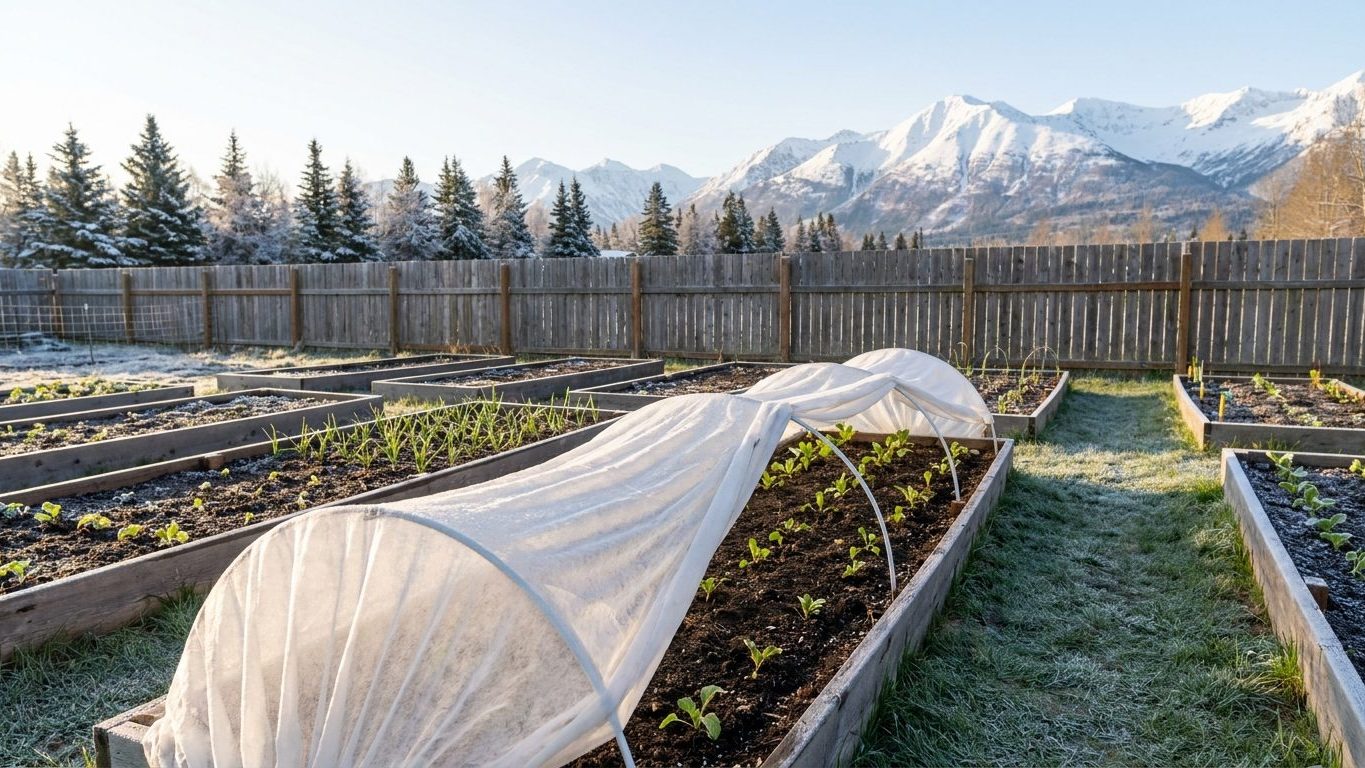

Cover the garden at both ends of the season. In spring, protect plants for the weeks around the last frost. In late summer and fall, cover again once clear nights start sliding toward freezing. Between those windows, most beds do fine without help. The dates below come from Saskatoon, so shift them to match your own district.
The short answer for Saskatchewan
Put covers on tender transplants the day they go into the ground, and keep them handy through the first week or two of June. Bring them out again from late August. Saskatoon’s average last spring frost is May 18 and its average first fall frost is September 18. That leaves about 123 frost-free days between them.
Both dates are means from Environment and Climate Change Canada’s 1981-2010 normals for the Saskatoon station. A mean sits in the middle of a spread. In one year out of two, the last spring frost falls after May 18. In one year out of two, the first fall frost arrives before September 18. Treat each date as the middle of a window, never as a safe date. (US figures elsewhere cover 1991-2020, so the two sets aren’t a perfect match.)
In spring, hardy crops such as peas, spinach, lettuce and radishes can be seeded as soon as the ground is workable, with fabric over them to blunt the cold snaps. Tomatoes, peppers, cucumbers, squash and beans are different. They go out after the average last frost date has passed, and they still get covered on any night the forecast dips near 0 °C. A cover buys you a few degrees, which handles a light frost. A hard freeze goes straight through it.
In fall, the job runs the other way. Start checking the overnight forecast in the last week of August. On a clear, calm evening, drape the cover before sunset so it traps the heat the soil stored during the day. Frost on the prairies tends to arrive on exactly those still, cloudless nights. A cover thrown on at 10 p.m. after the ground has already cooled does much less.
For a closer look at fabric, low tunnels, cold frames and the rest, see Which Season Extenders Work in Saskatchewan.
What will not work here
Waiting for May 18 and calling it safe fails about half the time. In those years frost comes later, and anything tender that went out on the average date is exposed. Covers on hand are cheap insurance, and a flat of replacement transplants is not.
The slowest approach to extending the season, sowing long-season crops outdoors and hoping covers will make up the difference, loses to the arithmetic. With a short frost-free stretch on average, and fewer in a cool year, melons, sweet potatoes and slow peppers can’t be carried to ripeness from outdoor seed. A cover adds a few degrees on a cold night. It cannot add the heat a cool June never delivered. Start those crops indoors, and choose short-season varieties.
Winter is the other wall. The mean daily minimum of the coldest month at Saskatoon is -20.7 °C (-5.3 °F). Lightweight row fabric and thin plastic don’t carry plants through that. They also tend to collapse or tear under snow load and wind. Use season extenders to stretch spring and fall, and plan for dormant perennials to rely on snow cover and proper hardiness for the winter itself.
Wind defeats a lot of homemade setups too. Open prairie wind lifts unanchored fabric, shreds it along the edges, and can drag hoops out of the soil. Bury the edges, or pin them down with boards, soil or heavy staples, and brace the hoops. Where gusts are routine, a loose cover that flaps all night can do more damage to seedlings than the frost it was meant to stop.
A sealed cover also fails on a sunny spring day. Under clear plastic or a closed cold frame, temperatures climb quickly even when the air outside is cool, and seedlings cook. Vent plastic in the morning, or switch to breathable fabric for tender transplants. Leave the cover off during warm afternoons, then put it back before the evening chill.
What changes across Saskatchewan
The province is not one garden. Saskatoon is classed in zone 3a on the Canadian hardiness system (Natural Resources Canada, 1991-2020 normals). That is the zone of the reference city, not of the province, and it does not convert to a USDA zone. The Canadian map weighs seven climate variables, and the USDA map weighs one. Natural Resources Canada itself says there are no simple conversions between the two.
Saskatchewan stretches from open southern grassland to northern boreal forest, so the zone shifts as you travel. There is no single answer for the whole province, and the frost dates move with the zone. The 52.17 degrees north latitude belongs to Saskatoon. A reader far to the north or the south should check their own latitude, since day length and season length both change with it.
Northern and upland districts run weeks behind the Saskatoon dates in spring and tend to see frost earlier in fall. If that describes your garden, push the first outdoor planting of tender crops later, keep covers on longer in early summer, and have them ready earlier in August. Short-season varieties matter more the farther north you go, because the cover only helps at the edges of a season that is already short.
To find your own zone, use the map at Canada’s Plant Hardiness Site and look up your municipality. The broader picture of how season extension fits into a prairie garden is in Extending the Growing Season in Saskatchewan.
Where to check this for your own county
Start with Saskatchewan Agriculture, the provincial government’s farm and garden information service. Look for two things there. The first is a local planting calendar that gives frost dates and sowing windows for your part of the province. The second is the list of varieties that have been trialled in your area, since a tomato that ripens near Saskatoon may not finish a few hundred miles north.
A recommendation for your own county or rural municipality beats a provincial one every time. The dates on this site are one reference station’s averages. They give a sound starting point, but a district with different elevation, soil or lake influence can differ by weeks.
When you find a local frost date, check whether it is an average or a risk level. An average leaves you with a coin-flip, so treat it the way you would treat the Saskatoon numbers, as the middle of a window. If the local source offers dates tied to a 10 percent or 30 percent chance of frost, those give you more room to plan.
Local gardeners are a useful second check. Neighbors with similar soil and exposure know when their own beds thaw, which low corners collect frost, and which varieties come through a cold June.
Checking this against your own garden
Your own observations outrank every date above. Three things are worth watching.
- Soil warmth by feel. Push your hand a few inches into the bed in the morning. If it feels cold, beans, squash and cucumbers will sulk in it. A bed that warms early, such as one beside a south wall, can be planted ahead of a shaded one in the same yard.
- The first flush of male flowers on squash and cucumbers. Male blooms open before the females. When they appear, your plants have gotten enough warmth to start flowering, and the time to ease back on covers is near. A late flush tells you the bed runs cool.
- The first true leaves. These are the second set of leaves that appear after the seed leaves. Seedlings that hold at the seed-leaf stage for weeks under cover are telling you the nights are still too cold. Quick, steady true-leaf growth says the spot is warm enough.
Write down what you see and the date. After two or three seasons you will have a calendar that fits your own yard better than any average.
Common questions
When is the last spring frost in Saskatoon?
On average, May 18, from the 1981-2010 normals at the Saskatoon station. In half of all years the last frost comes later, so keep covers within reach into early June.
Do I need to cover plants every night?
No. Cover them on nights when the forecast is near freezing, and remove the cover on warm, sunny days. Breathable fabric left on a few extra nights does less harm than plastic left on a sunny afternoon.
Can covers let me plant before the average last frost?
For hardy crops such as peas, spinach and lettuce, yes. Tender crops like tomatoes, peppers and squash should wait until after the average date, and still carry covers into early June.
When should I start covering in fall?
Start watching the forecast in late August. The average first fall frost at Saskatoon is September 18, and in half of all years it comes earlier. Northern districts typically see it sooner.