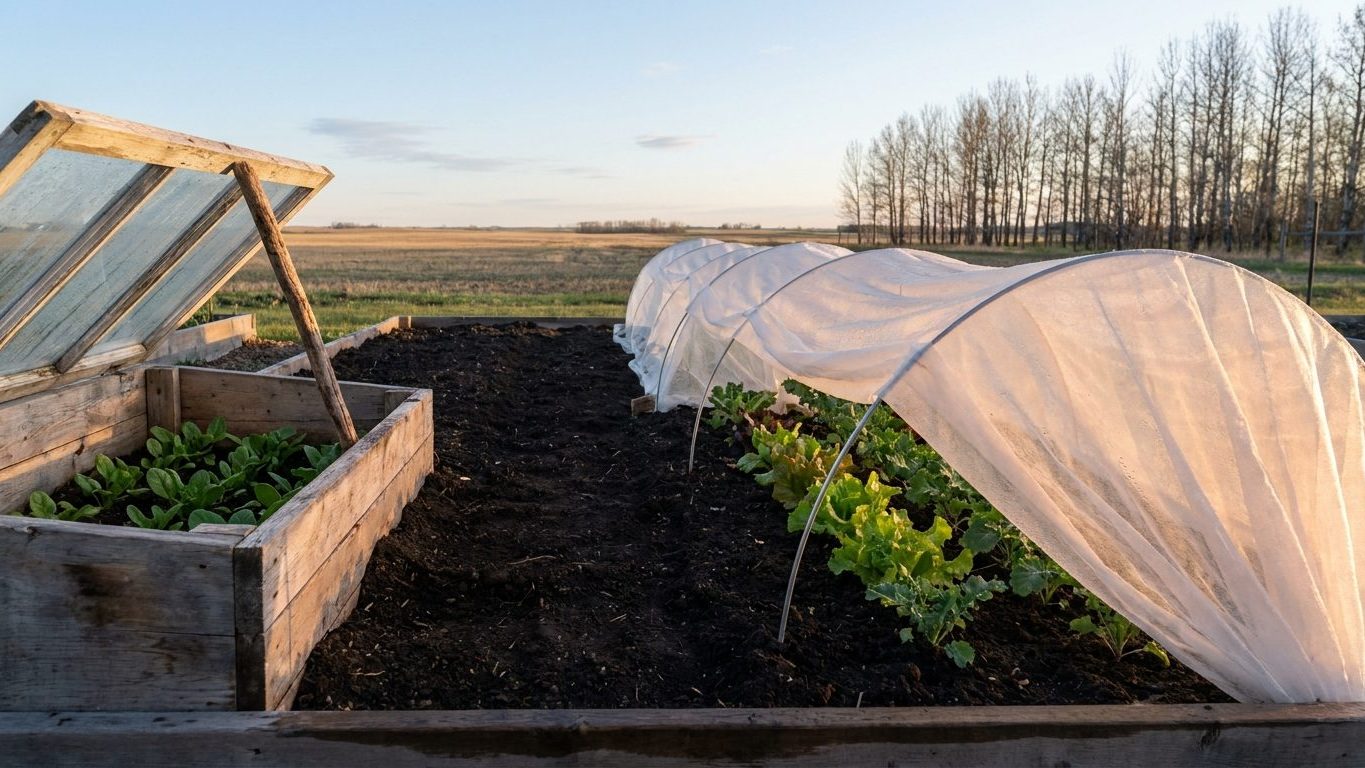

Floating row cover, low tunnels and a cold frame do the most for a Quebec garden, and they pay off at both ends of the season. Near Montreal the mean last spring frost is May 6 and the mean first fall frost is October 5, so light covers can add a few weeks on each side. Heavy gear and slow crops are where gardeners tend to waste money.
The short answer for Quebec
Start with floating row cover and hooped low tunnels, then add a cold frame for hardening off seedlings and holding fall greens into winter. Gardeners who want tomatoes and peppers to ripen well before October can step up to an unheated high tunnel. Each tool protects against a different kind of cold, so the right choice depends on which end of the season you are trying to stretch.
How long is the growing season near Montreal?
The Montreal/St-Hubert A station has about 152 frost-free days, between a mean last spring frost on May 6 and a mean first fall frost on October 5 (Environment and Climate Change Canada, 1981-2010 normals). Both dates are averages. In one year out of two the last frost falls after May 6, and in one year out of two the first fall frost arrives before October 5. Read each date as the middle of a window several weeks wide. The mean daily minimum of the coldest month is -14.1 °C, which is why winter protection here means hardy crops under cover.
Which season extenders earn their place?
| Extender | Best use | Limit |
|---|---|---|
| Floating row cover | Light frost nights in spring and fall, insect barrier | Gains a couple of degrees at most; no match for a hard freeze |
| Low tunnel (hoops with fabric or plastic) | Early transplants, lettuce and spinach into late fall | Needs venting on sunny days; hoops can fold under wet snow |
| Cold frame | Hardening off, fall greens held into winter | Growth slows sharply as days shorten |
| Water-filled cloche | One early tomato or pepper transplant | Covers a single plant |
| Unheated high tunnel | Earlier and later tomatoes and peppers | Cost, anchoring, snow load |
The cheapest layer is also the most useful. Fabric laid over hoops warms the soil in spring and blocks a light frost on a clear night in October. Because the frost dates are midpoints, the safest habit is to have the cover at the garden before the date arrives. The timing of that call is covered in When to Cover Your Garden in Quebec.
What will not work here
Which crops run out of season even under cover?
A cover holds heat in. It does not create the weeks of warmth a slow crop needs. With about 152 frost-free days at the reference station, and a first fall frost that comes before October 5 in half of years, a variety that needs the whole window from transplant to ripe fruit has no margin. Sweet potatoes, melons and long-season peppers are the usual casualties. Choose early varieties, start them indoors, and warm the soil with black plastic before they go out.
Planting by the calendar fails for the same reason. Setting tomato transplants outside on May 6 with no cover bets on a coin toss, because frost arrives later than that in half of years. Tender transplants need a night forecast that stays above freezing, or a tunnel over them until it does.
Why won’t row cover alone carry a garden through a Quebec winter?
A single layer of fabric gains a couple of degrees. When the coldest month averages -14.1 °C at night, a couple of degrees leaves the soil and plants deeply frozen. Fabric is a tool for frost nights in the shoulder seasons. Lettuce under it in January is lost, and a cold frame with no extra layer inside is not much better for anything tender.
Short days limit winter growing as well. Montreal sits at 45.47 degrees north, so the darkest weeks of winter bring so little light that even hardy greens barely grow. Sowing in late September and hoping a frame will grow a crop through December does not work. Plants must be close to full size before the days shorten, and the frame then keeps them in good condition for picking.
What goes wrong with plastic and snow?
Spring swings from frosty nights to sunny afternoons, and a sealed clear plastic tunnel can overheat seedlings by midday. Vent it on any bright morning, even when the air still feels cold. Low hoops are also a poor match for wet snow, which settles heavily on shallow arches. Either take them down before the first big storm or build them steep enough to shed snow.
What changes across Quebec
The reference city, Montreal, sits in Canadian hardiness zone 5b (Natural Resources Canada, 1991-2020 normals). That is the Canadian system, which is built on seven climate variables and does not convert to a USDA zone. The frost dates above come from the 1981-2010 normals, so the two figures cover different periods. Neither describes the whole province.
Quebec runs from the St. Lawrence lowlands to northern and upland districts, and it spans far more than one zone. There is no single answer for the province. Northern and upland gardens run weeks behind the St-Hubert frost dates, and the same cover buys a different number of days there. Look up your own zone on the Canada’s Plant Hardiness Site map rather than borrowing one from a neighbouring town.
If you garden north of Montreal or at altitude, shift your plans in a few ways:
- Start tunnels and covers later in spring, and set them over beds earlier in fall.
- Rely more on hardy greens and roots, and less on tomatoes and peppers.
- Build structures for heavier snow, and expect less light in winter.
The latitude of 45.47 degrees north belongs to Montreal. A reader well north of it has shorter winter days still, so check your own latitude before copying a sowing date. More on the full toolkit is in Extending the Growing Season in Quebec.
Where to check this for your own county
For local planting calendars and trial results, start with Quebec’s agriculture ministry, MAPAQ, then look for a regional agronomy advisor, a local horticultural society or a master gardener group near you. Ask for two things. The first is the planting calendar for your own area, with a last-frost window for your township. The second is the list of varieties that have been trialled near you, which matters more than any catalogue claim about “early” maturity.
A recommendation from your own county or region beats any provincial rule of thumb, including the one above. Everything here is built on one station southeast of Montreal and on a province-wide view of cover types. A valley bottom that collects cold air and a south-facing slope a few miles away can differ by weeks.
When you talk to a local advisor, ask which extenders growers in your area use and how they handle snow. Ask also when they pull covers off in spring. Their answers carry years of local frost and wind history that a provincial average cannot.
Checking this against your own garden
Your own observations outrank every date on the calendar. Three are worth watching, and none needs an instrument.
The first is soil warmth by feel. Push your hand into the bed at planting depth on a bright morning, once under cover and once in an uncovered patch. If the covered soil feels clearly milder and the open soil still bites, the cover is working. If both feel cold, wait. Cold soil stalls seedlings even when the air is mild.
The second is the first flush of male flowers on squash and cucumbers. They open before the female flowers, and when they appear under a tunnel earlier than on a neighbour’s open bed, your spot is a warm one. If you see none by the time you expected them, the site runs cool, and early varieties become more important.
The third is the first true leaves on your seedlings. Cotyledons are the seed leaves. The true leaves that follow are what make a plant ready for hardening off. Seedlings that reach this stage in the cold frame sooner than expected tell you the frame holds heat well. Slow ones suggest shade or a cold pocket nearby. Write down the dates for a year, and your own record will soon be more accurate than any average.
Common questions
Can floating row cover let me plant tomatoes before May 6?
Fabric protects against a light frost, not a hard one. Because May 6 is a mean, frost falls after it in half of years. Hold tender transplants until nights stay mild, or use a low tunnel or water-filled cloche for added warmth, and keep the cover ready.
Can I grow vegetables through the winter in a cold frame?
Hardy greens such as spinach, kale and mâche can be held in a cold frame well into winter. In the darkest weeks they barely grow, so plant early enough that they are near full size by then. Against a mean coldest-month minimum of -14.1 °C, add a second layer of fabric inside the frame on the coldest nights.
Is Canadian zone 5b the same as a US zone?
No. The Canadian system uses seven climate variables and Natural Resources Canada says there is no simple conversion to USDA zones. Use the Canadian map for Quebec, and be wary of American plant tags and charts.
When should I put covers on in fall?
Before the first frost, which in half of years arrives earlier than October 5 near Montreal. Check the night forecast, and put the cover on in the afternoon, before the temperature falls. Fall timing is explained in When to Cover Your Garden in Quebec.