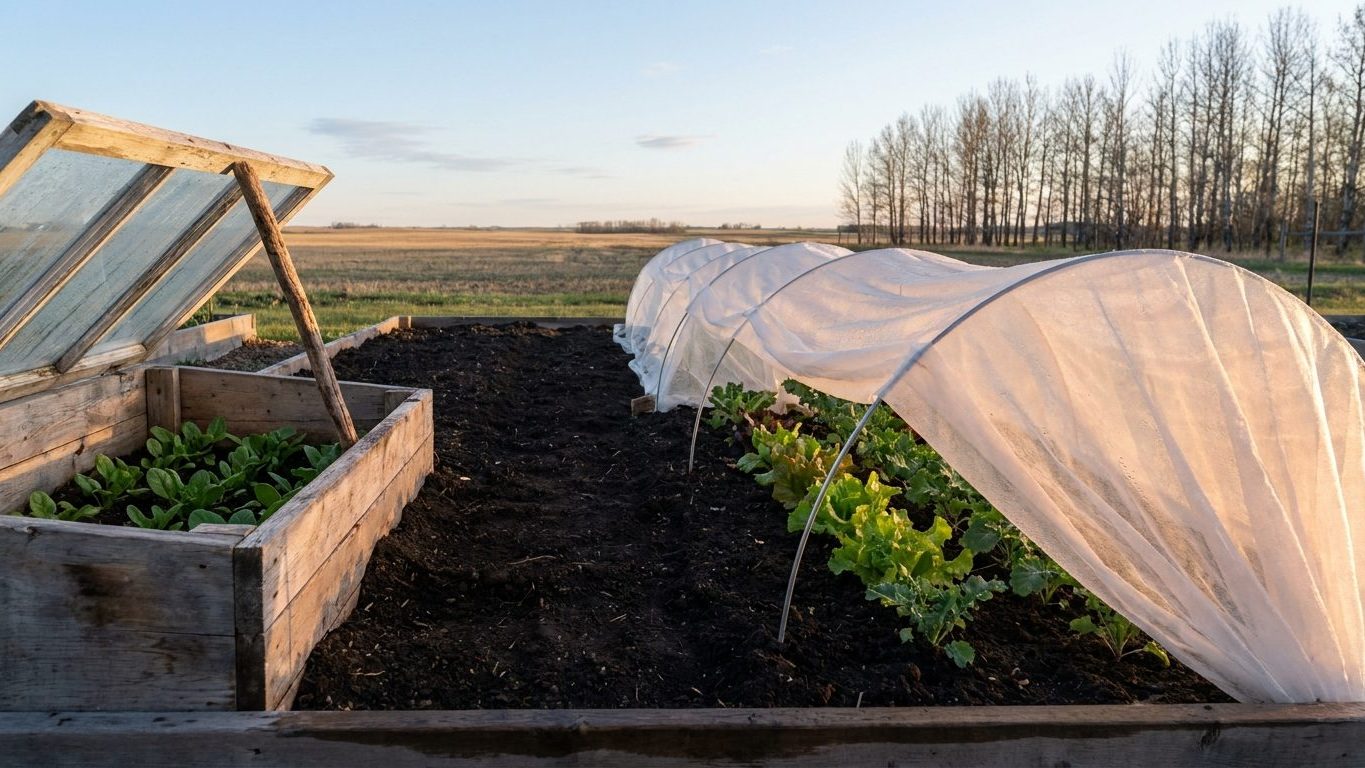

Floating row cover, low tunnels, and cold frames are the season extenders that earn their keep in Tennessee. They push fall harvests past the first freeze and let spring crops go out a couple of weeks early. Heated greenhouses and sealed plastic rarely pay off. The state’s long, mild shoulder seasons reward cheap, ventable covers. For the wider picture, start with Extending the Growing Season in Tennessee.
The short answer for Tennessee
Use lightweight row cover for frost nights, a low tunnel for fall and winter greens, and a cold frame for seedlings and salad crops. Those three handle nearly everything a home gardener here wants from extension. The reason is in the Nashville numbers. In the NOAA 1991-2020 Climate Normals, the last spring frost falls between March 31 and April 12, and the first fall frost between October 28 and November 8. Those dates mark the band where the chance of a 32°F freeze sits between 30 and 70 percent. A freeze can show up before or after them in any given year.
The coldest month averages a daily minimum of 30.1°F at that station. Winter nights hover right around freezing, so hardy crops under a thin layer of protection get through most winters. Cover moves a plant’s tolerance down a few degrees. That is plenty for an average night and not enough for a deep cold snap.
What works in fall and winter?
Fall is where extension pays best. Spinach, kale, collards, lettuce, and carrots sown in late summer keep producing well past the first freeze under a low tunnel or in a cold frame. Many of them taste sweeter after cold nights. Planting needs to happen early enough that the crop is nearly full-size before the shortest days arrive, because growth slows sharply in midwinter whatever the cover.
What works in spring?
In spring, row cover protects transplants through a late freeze, and a cold frame lets you harden off seedlings or start greens weeks ahead of open ground. Covers do not warm cold soil much. Tomatoes and peppers still wait for soil to warm, so use the cover as insurance against a late freeze rather than as permission to plant in March. The When to Cover Your Garden in Tennessee guide covers the timing side.
| Extender | Best job | Limit |
|---|---|---|
| Lightweight row cover | Frost nights in spring and fall | Little help in a hard freeze |
| Low tunnel | Winter greens, early spring crops | Must be vented on sunny days |
| Cold frame | Seedlings, salad crops, hardening off | Small footprint, needs opening and closing |
| Hoop house | Larger plantings, tall crops | Cost, wind and snow load |
What will not work here
A sealed plastic tunnel left shut through a sunny March or April afternoon will cook what is inside. Spring days here can swing from frost at dawn to warm by lunch, and trapped air heats fast. Every plastic structure needs ends or sides that open, and someone has to open them. If you are away all day, choose breathable row cover instead.
Can you grow tomatoes into December under cover?
No. The first fall frost window of October 28 to November 8 is late enough to tempt people, but fruit ripening depends on warmth and light, and both fall off quickly by November. A cover can buy a few extra weeks of ripening after the first frost. It cannot hold summer in place through the winter. The same goes for peppers and eggplant. Frost-sensitive crops are a short-term rescue, so pick the greens and roots that handle cold on their own.
Why do heavy covers and tight spacing backfire?
Summers are hot and humid, and the cool seasons are often damp too. Covers left on for weeks with crops packed together trap moisture around the leaves. That invites gray mold and leaf spots on lettuce and spinach. Space plants a little wider under cover than you would in the open, and pull the cover back on mild, dry days.
Thin row cover will not protect against the worst nights either. The 30.1°F figure is an average of daily lows. Cold snaps run well below it, and the hardiness map reflects those extremes. When a hard freeze is forecast, layer a second cover or add a tunnel over the row cover.
On the Cumberland Plateau and in the mountains, wet snow can collapse light hoops. Use sturdier hoops there, and brush off heavy snow. And skip a heated greenhouse for a typical home garden. For the weeks it adds, the equipment and fuel cost more than a hoop and a roll of cover.
What changes across Tennessee
Tennessee has no single answer. The USDA Plant Hardiness Zone Map (2023, built on 1991-2020 normals) spans 5b to 8a across the state. That is a spread of about four zones, and it is measured on one variable, the average annual extreme minimum temperature. A gardener at the top of that range and one at the bottom are working with different winters.
The Nashville figures above describe Middle Tennessee. East Tennessee and the Cumberland Plateau are cooler and run later in spring. A reader there should push spring covering dates later and check with the local county extension office about fall freezes. Higher elevation compresses the season on both ends, which makes fall protection more valuable and early spring planting riskier. In the Plateau’s higher ground, assume a cold frame will do more work than it would in Nashville, and plan on sturdier structures.
Latitude matters too. The 36.12 degrees north figure belongs to Nashville. Gardeners near the Kentucky line sit farther north, and those near the Georgia, Alabama, and Mississippi lines sit farther south. Day length is what tells onions to stop making leaves and start bulbing, and it also sets how fast winter greens grow. A reader near the edge of the state should check their own latitude rather than trust Nashville’s.
To find your hardiness zone, use the USDA Plant Hardiness Zone Map and enter your ZIP code. Do not guess from the state average. Zones can shift within a single county where elevation changes.
Where to check this for your own county
Start with University of Tennessee Institute of Agriculture Extension. Every county has an office staffed by agents who know local soil, microclimates, and the frost dates people actually see. Two things are worth asking for. First, the local planting calendar, which gives spring and fall dates for your county instead of a state band. Second, the varieties that have been trialled in your county. Those matter most for cool-season crops under cover, where variety choice decides whether a winter lettuce survives or collapses.
Ask about the first and last frost dates they use for your area, and whether they recommend a particular row cover weight or tunnel style for your elevation. Agents often know which fall planting dates have worked locally for spinach, kale, and carrots, and they can tell you how wet or windy the local winters tend to run.
A county recommendation beats a state one. The statewide band here runs across three very different regions and about four hardiness zones. An agent in a Plateau county will give a different answer than one in Nashville, and the local answer is the one to follow.
Checking this against your own garden
Your own observations outrank every date above. Three are worth watching, and none needs any equipment.
Soil warmth by feel. Push your hand into the bed to a few inches deep on a mid-morning. If the soil feels cold and damp, it is too early for warm-season transplants whatever the calendar says. A bed that feels warm sooner than a neighbor’s shaded one is a pocket worth using for early plantings.
The first male flowers on squash. Male blooms usually open a little ahead of female ones. Their arrival tells you that your spot has warmed enough to move into the main summer crops, and a late arrival points to a cool or shaded site.
The first true leaves. Seed leaves come up first, then the true leaves that look like the mature plant. If seedlings under cover reach that stage promptly, the cover is working. If they sit for weeks, the site is cold or too shaded, or the cover is too heavy.
Note the dates for a season or two, then compare them with the county calendar. Low spots where cold air settles will frost earlier than a south-facing wall, sometimes by a week or more. After a year of notes, you will know your own garden’s frost pockets and warm corners.
Common questions
Do I need a hoop house in Tennessee?
Most home gardeners do not. Row cover and low tunnels handle the average frost and winter nights around Nashville, where the coldest month’s daily minimum averages 30.1°F. A hoop house makes sense for larger plantings, taller crops, or higher elevations with harsher winters.
Which row cover should I use for a hard freeze?
Use a heavier-weight cover or double up lightweight layers, and put them over hoops so the fabric does not rest on the leaves. Thin cover works for frost but gives little help when a deep freeze arrives.
Can I grow greens all winter?
In much of the state, yes, with a cold frame or low tunnel. Spinach, kale, collards, and lettuce hold through most winters. Growth nearly stops in midwinter, so plant early enough in fall that the crop is close to harvest size before the shortest days.
How long should I leave row cover on?
Leave it on for frost nights and cold stretches, and pull it back on mild, dry days. Crops left covered for weeks in humid weather are prone to mold and leaf spots, and warm-season plants need open air and pollinator access once flowers appear.