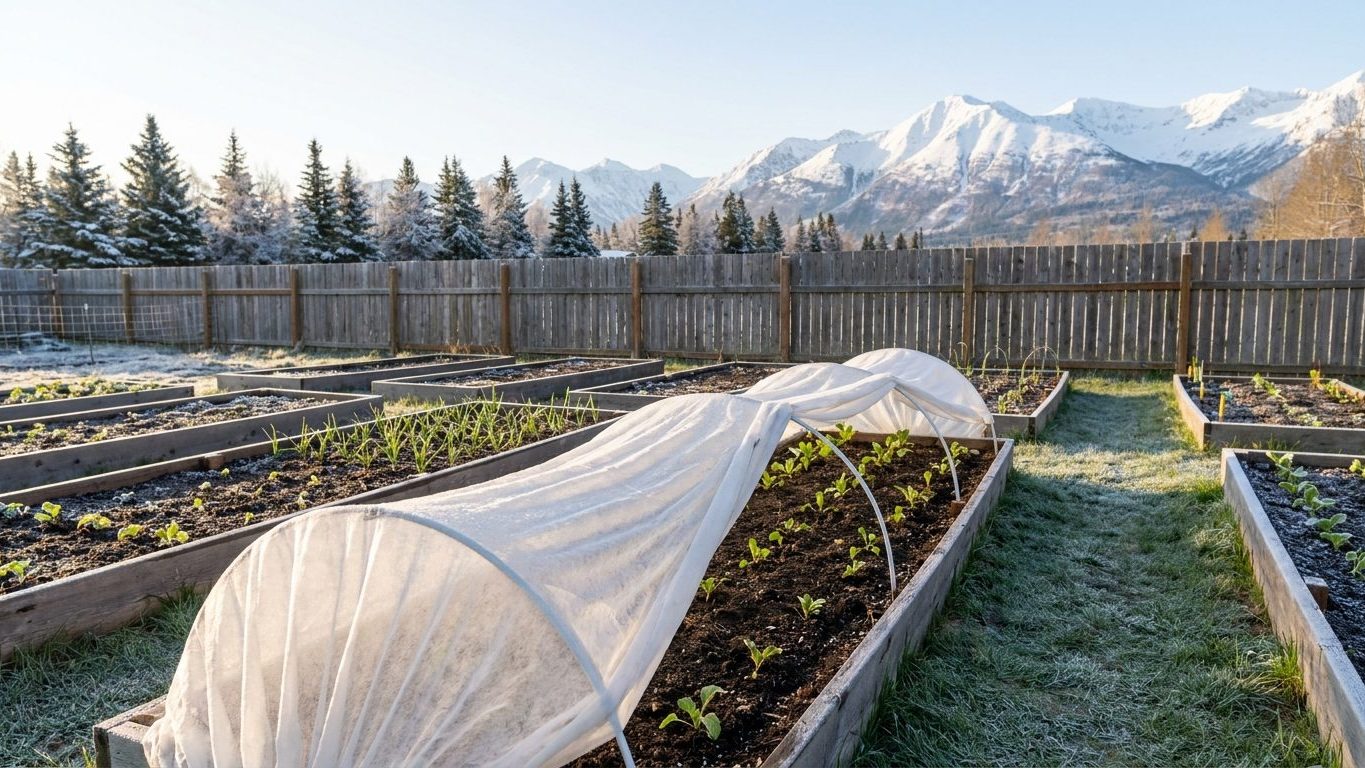

Cover the garden on any night the forecast low reaches 32°F. In the Salt Lake City valley, the last spring frost falls between April 12 and April 29, and the first fall frost between October 18 and October 29. Hardy greens and peas can go out under cover before those spring dates pass. Tender crops wait until the spring window closes, with a cover ready for a late cold snap.
The short answer for Utah
Cover plants on nights when the forecast low is at or near 32°F, in spring until the last frost has passed and in fall once frost is forecast. The reference dates come from NOAA’s 1991-2020 Climate Normals for the Salt Lake City station: last spring frost April 12 to April 29, first fall frost October 18 to October 29. Salt Lake City sits in a mild valley. Most of Utah is higher and colder, and southern Utah is warmer.
Each date range is the 30 to 70 percent band of 32°F freeze probabilities. A frost date marks the chance of a freeze, and some years bring one outside the window. That is why a cover belongs on the fence post even after the date you planted by.
When do you cover plants in spring in Utah?
Peas, spinach and lettuce can go in under fabric or a low tunnel weeks ahead of the tender crops. On nights forecast near 32°F, the cover goes on in the evening and comes off the next morning once it warms. Tomatoes, peppers, squash and basil are different. Set them out after the April 12 to April 29 window, and keep a cover handy, because a late freeze still happens in some years. The guide to which season extenders work in Utah covers fabric weights, hoops and cloches.
When do you cover plants in fall in Utah?
Start watching the overnight forecast in early October, ahead of the October 18 to October 29 window. A cover on tomatoes, peppers and beans buys a few extra weeks of harvest through the first light freezes. Hardy crops such as kale, carrots, beets and lettuce keep going well past that under a low tunnel. The broader picture is laid out in Extending the Growing Season in Utah.
What will not work here
Planting tender crops on April 12 because it is the early end of the range fails. On that date a freeze is still a real possibility, and a single sheet of fabric adds only a few degrees. A hard freeze after transplanting will beat it. The cover is a margin of safety for a light frost. It does not stand in for patience on a night that drops well below 32°F.
Can one layer of fabric carry crops through a Utah winter?
No. The mean daily minimum of the coldest month at Salt Lake City is 24.2°F, so plenty of nights run colder than that. A lone layer of fabric on the bed will not hold tender plants through nights like those. Even hardy greens usually need a tunnel with an extra layer or a cold frame to stay in good shape. Anyone gardening above the valley floor sees colder nights still, so those numbers are a best case.
Do covers help late sowings in October?
Less than people hope. At 40.78 degrees north (Salt Lake City’s latitude), days shorten quickly after the autumn equinox. A cover holds heat but adds no daylight, so a late sowing under plastic or fabric mostly sits there and waits for spring. Crops need to be well along by early October to benefit. Anything that has not sized up by then will not finish.
What goes wrong with covers on sunny days?
A closed tunnel can get hot fast on a clear day, even in cold months, and cooks seedlings if nobody vents it. Fabric and plastic also keep rain and irrigation off the soil. In Utah’s dry air, the ground under a cover can dry out while the surface looks fine. Check by pushing a finger a couple of inches into the soil, and water at the base of the plants as needed.
What changes across Utah
Utah has no single answer. The USDA Plant Hardiness Zone Map (2023, built on 1991-2020 data) puts the state anywhere from zone 4a to zone 9a. That rating rests on one number, the average annual extreme minimum temperature, so it tells you what winters a perennial survives. It does not give frost dates. Even so, a spread that wide means a garden in the mountains and one in the far south of the state live in different climates.
The dates above belong to Salt Lake City, a mild valley. A garden at altitude or in a cold northern valley should plan on a later last frost in spring and an earlier first frost in fall. In practice that means planting tender crops later, getting covers out sooner in September, and expecting covers to stay on beds longer into spring. Southern Utah is warmer, so the spring window opens earlier and the fall one closes later. Frosty nights still happen there, just on a different calendar.
Latitude moves things too. The 40.78 degrees north figure belongs to Salt Lake City. A reader near the northern border or in the far south should check the latitude of their own town. Day length, not warmth, tells onions to stop making leaves and start making bulbs, and it shapes how quickly fall growth fades.
To find your zone, use the USDA Plant Hardiness Zone Map and enter your ZIP code. The map is the place to settle which zone a given address falls in.
Where to check this for your own county
Utah State University Extension is the state’s land-grant extension service and has offices across the counties. Start there for a local planting calendar, since a calendar written for your county accounts for your elevation and typical cold snaps. Look for two things. One is the local frost dates and recommended planting windows for your county. The other is the vegetable varieties that have been trialled in your county, not just in the state’s best-known gardening spots.
A county recommendation beats a state one. Dates built on the Salt Lake City station are a sensible starting point for the Wasatch Front valleys, but they say little about a garden a few thousand feet higher or several hours south. If your county office publishes a local calendar, follow it over any statewide date. If you cannot find one, call or visit the county office and ask what the typical last frost and first frost are for your town, and what the local growers cover and when.
Checking this against your own garden
Your own observations outrank every date here. Three things are worth watching, and none needs an instrument.
- Soil warmth by feel. Push your hand a few inches into the bed in the morning. If it feels cold and clammy, tender transplants will sit and stall, whatever the calendar says. A bed that warms sooner than the one next to it, perhaps against a south wall, is a warmer pocket where you can start earlier.
- The first true leaves. On seedlings, watch for the first leaves that look like the real plant. If they come on slowly in one corner, that corner is cooler or shadier than the rest, and it should be covered longer.
- The first male flowers on squash. Watch the blooms to tell the male ones from the female ones. Their arrival tells you the warm season has taken hold in your yard, and the date they appear varies from one garden to the next.
Write down the dates you see each year. A few seasons of notes will tell you more about your own frost pockets and warm corners than any statewide table.
Common questions
Should I cover plants every night in October?
No. Cover when the forecast low is near 32°F, and on clear, still nights, which are the ones that chill the most. On mild nights, leave the cover off so plants get air and light.
Can I plant peas and spinach before the last frost date?
Yes. Both can go in under fabric or a low tunnel weeks before the tender crops. The cover shields them on the coldest nights and warms the soil.
Is April 12 safe for tomatoes in Salt Lake City?
No. April 12 is the early end of the last-frost range, so a freeze is still possible. Wait until the April 12 to April 29 window has passed, and keep a cover ready for a late cold night.
When should I take covers off?
Take them off, or vent them, on the morning after a cold night once the air warms, particularly plastic tunnels, which heat fast in sun. Put them back on in the evening if the forecast calls for frost.