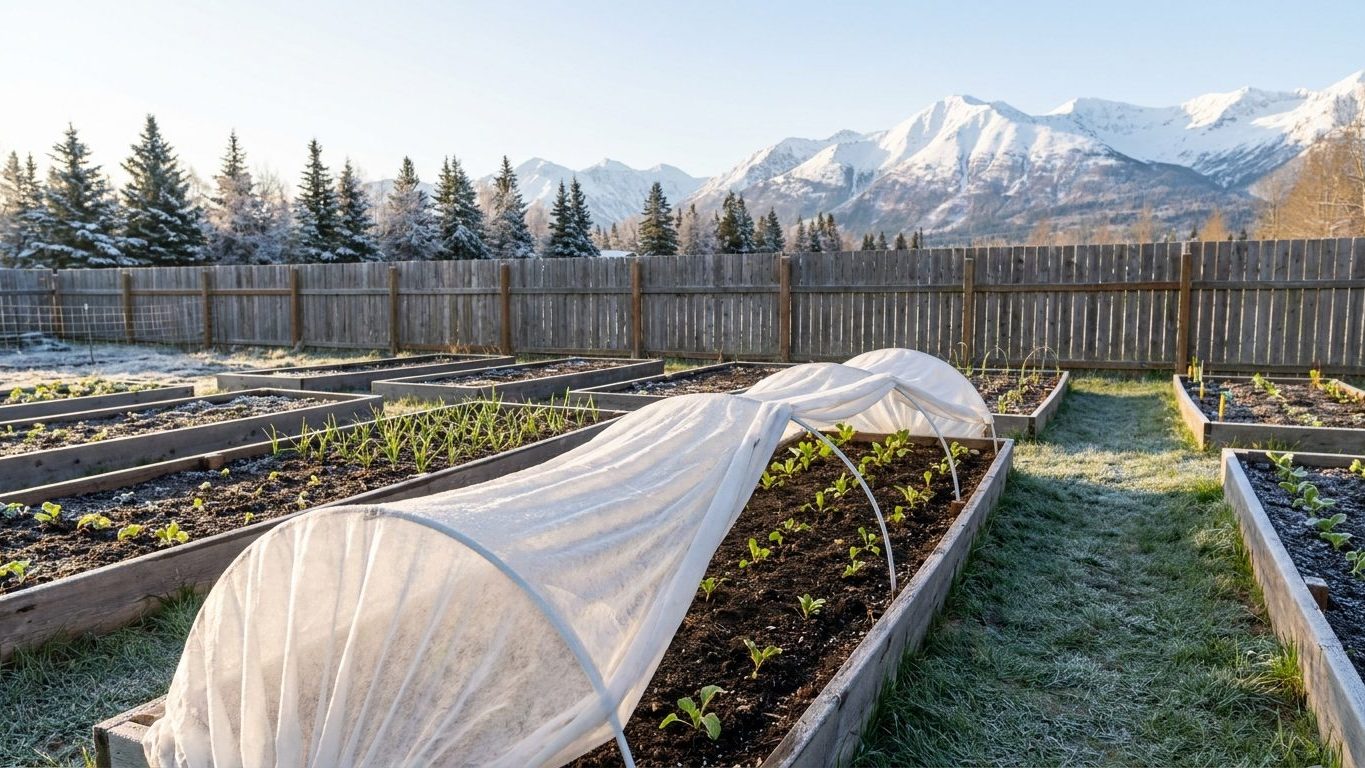

In Yukon, put covers on beds in late May, ahead of the average last spring frost of June 5, and have them ready again by mid-August, before the average first fall frost of August 25. Both dates are midpoints for Whitehorse. In one year out of two the spring frost comes later than June 5, and in one year out of two the fall frost comes earlier than August 25.
The short answer for Yukon
Lay the cover on the bed about two weeks before June 5 so the soil has time to warm, and keep it within reach for the rest of the summer. The Whitehorse A station has about 81 frost-free days between the mean last spring frost (June 5) and the mean first fall frost (August 25). Those are Environment and Climate Change Canada normals for 1981-2010. Each date sits in the middle of a spread of years, so frost can fall on either side of it.
When do covers go on in spring?
Cold soil holds back seeds and roots long before a frost does. Clear plastic or row fabric traps the heat the ground gives off and slows the loss of warmth overnight. In late May, cover the bare bed so it starts warming. Hardy crops such as peas, spinach, radishes and lettuce can be sown under the cover at that point.
Tender transplants, squash for example, can go in around June 5 only if the cover stays folded at the edge of the bed. In half of all years a frost still arrives after that date, and an uncovered young plant has no second chance.
When do covers go back on in August?
From mid-August, cover on clear, still evenings when the forecast sits near freezing. Those are the nights frost forms. Cloud and wind keep the air mixed and a little warmer, so a cloudy, breezy night is a lower risk.
A light cover buys a few degrees. That is enough to carry beans, squash and late greens past one early frost and into several more weeks of sun. Take the cover off the next morning once the frost has melted. Heat builds quickly under plastic in a bright sky, and a closed tunnel at midday can cook the plants it was meant to protect.
What will not work here

Waiting for a frost warning before covering anything is the most common mistake. By the time a forecast says frost, the soil has already lost the early weeks that a short season cannot spare. With about 81 frost-free days, a bed that warms two weeks late is a bed that finishes two weeks late.
Slow crops are the second casualty. Melons, sweet corn and long-season winter squash need more warm days between sowing and harvest than the average summer offers. A cover in August cannot add weeks to the calendar. It protects what is nearly ripe, and it does nothing for a crop that is still green and small when the nights turn cold. Pick varieties with the shortest days to maturity, and see Which Season Extenders Work in Yukon for the covers that suit them.
Treating June 5 as a safe planting date also fails. It is a midpoint. Tender plants set out uncovered on that day will be hit by frost in roughly half of all years.
Winter is another limit. The mean daily minimum of the coldest month is -19.2 °C (-2.6 °F), and single nights run colder. Season-extension fabric is made for the growing months and does little against that kind of cold. Perennials get through the winter on their own hardiness and on snow cover. Piling thin fabric on them in January adds weight and little warmth.
Long June days create a different problem. Lettuce, spinach and other leafy crops bolt readily when days are long and the air under a cover gets hot. A closed tunnel in the June sun can speed bolting up. Vent the cover on bright days and shade the bed if the greens begin to stretch.
Unanchored covers go next. Wind lifts light fabric off a bed in minutes, and a flapping cover can tear young leaves. Weigh the edges down with boards, soil or stones.
What changes across Yukon
The territory is not one garden. Whitehorse, the reference city, falls in Canadian hardiness zone 1b according to Natural Resources Canada’s 1991-2020 normals. That is the Canadian system. It is built on seven climate variables and does not convert to a USDA zone, so do not carry a US zone number across the border. The Canada’s Plant Hardiness Site map shows where your own municipality falls.
How much does the zone vary inside Yukon?
There is no single answer. Valley floors, south-facing benches, high ground and communities farther north all land at different readings on the map. A low pocket where cold air settles can be a full zone colder than a slope a few hundred yards away. The Whitehorse reading is one point on that range.
How should northern or high-elevation gardeners shift the dates?
The dates run weeks behind in northern and upland districts. Move the spring cover and first sowing later, and keep covers within reach earlier in August. Latitude matters too. Whitehorse sits at 60.71 degrees north, and day length at that latitude shapes bolting and bulbing in some crops. A gardener well north or south of it should check their own latitude, because the daylight they get differs.
For the territory-wide picture, start with Extending the Growing Season in Yukon.
Where to check this for your own county
Yukon has no counties, so the working unit is your own valley or community. Start with Agriculture and Agri-Food Canada, the federal department, and then ask Yukon’s own agriculture branch what it advises for your area. A local recommendation beats a territorial one.
Look for three things there:
- A planting calendar for your community, with frost dates from the nearest climate station
- Varieties trialled in your district, with their days to maturity
- Advice on which covers and tunnels have held up in your local wind and snow
Check which years the frost dates cover before you compare sources. Canadian normals run 1981-2010, while US figures run 1991-2020. A gap of a decade or so means the numbers will not line up neatly across the border. A district calendar with a closer station will often beat the Whitehorse figures for your yard.
Checking this against your own garden
Your own observations outrank every date above. Three are worth watching, and none needs equipment.
First, soil warmth by feel. Push a hand a few inches into the bed in the morning. If it aches within a few seconds, the soil is still too cold for tender roots. Do the same on a covered and an uncovered bed. The gap shows how much heat your cover holds and how much sun the spot gets.
Second, the first flush of male flowers on squash. Male blooms open before female ones, and their date tells you how far ahead of, or behind, the Whitehorse calendar your garden runs. Open or lift the cover once they appear so pollinators can reach the plants.
Third, the first true leaves on seedlings under cover. The seed leaves come first. True leaves mean roots have taken hold and the plant can handle more air and cooler nights. If they appear late on one side of the yard, that side is the cold one.
Write the dates in a notebook for two or three seasons. A single airport station averaged over 1981-2010 will be beaten by a patient gardener’s own record.
Common questions
Can I put covers on before June 5?
Yes. Late May is a good time to cover bare soil so it warms, and hardy crops can be sown underneath. Wait on tender transplants until around June 5, and keep the cover ready.
Is June 5 safe to leave covers off?
No. It is the average last frost at Whitehorse A. In one year out of two the last frost comes later, so tender plants need a cover handy past that date.
How cold does a Yukon winter get?
At Whitehorse the mean daily minimum of the coldest month is -19.2 °C (-2.6 °F). Individual nights go lower, and perennials rely on hardiness and snow cover to get through.
Does Canadian zone 1b match a USDA zone?
No. The Canadian system uses seven climate variables and the USDA system uses one, and the two have no simple conversion. Use the Canadian map for Canadian plant ratings.