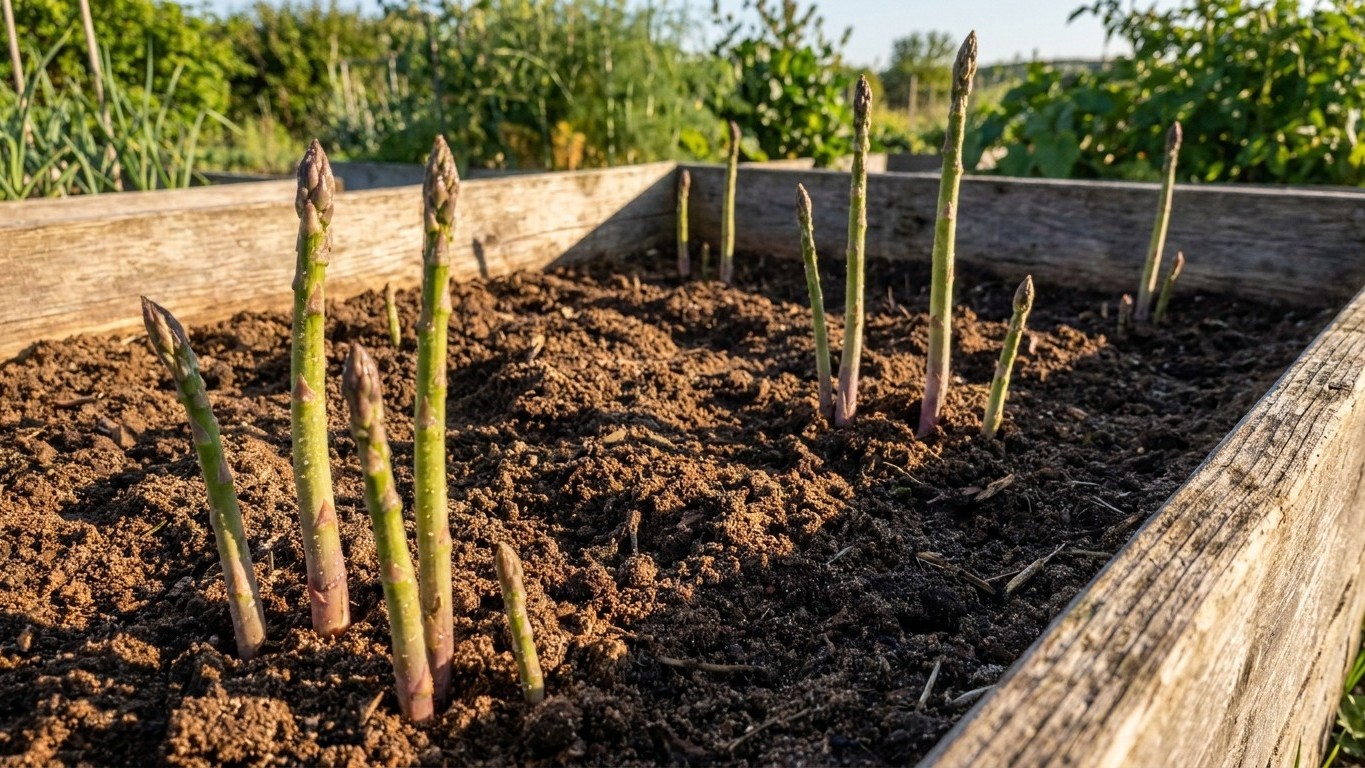

Stop cutting when most of the spears coming up are thinner than a pencil. That signal matters more than the calendar. Once it shows, the bed goes to fern, and the crowns refill their reserves for next spring. The spears you already cut keep best in air just above freezing and close to saturated with moisture, with the cut ends in water. Both halves are below, and the full planting-to-harvest picture is in Growing Asparagus in Colorado.
When do you stop cutting asparagus each season?
Utah State University Extension is blunt about the early years. Crowns go into 8-inch furrows in early spring, and nothing is harvested until year 3. Not a few spears to sample, nothing. After that the bed produces for 10 to 15 years. During the planting year the furrow is backfilled gradually, so it is not filled all at once.
Those weeks cap the season. The spears decide whether it is over. Every spear you cut is a stem that never becomes fern, and the fern is what feeds the crown for the following year. Keep cutting after the crown has spent its stored energy and the new spears come up thinner each spring.
How do you tell the season is over?
Use a pencil as the gauge. Early in the season the spears are thick, and a few skinny ones among them mean little. Toward the end, check the bed every couple of days. When most of what comes up is thinner than a pencil, stop. Let every spear after that grow into fern, even the thick ones that show up late.
Frost sits on the other end of the season. At the Denver reference station, NOAA NCEI puts the last 32°F freeze, in its 30 to 70 percent probability band, between May 1 and May 11. Denver sits at 5,280 feet on the plains. Mountain towns run much shorter seasons and can frost in July, and the western slope differs again. A frost-nipped spear goes limp and water-soaked. Snap it off and compost it, and new spears follow. Your county extension office can tell you what a normal start looks like where you live.
What does the bed need after the last cut?
Water, mostly. Over June, July and August, the Denver reference station normally collects about 5.7 inches of rain: 1.94 in June, 2.14 in July and 1.58 in August, the driest of the three. The year as a whole brings 14.5 inches. Those are long-term normals for one station, so treat them as what you can usually expect. A rain gauge on your own plot settles it.
Soil and heat change what the rain is worth. A sandy bed lets an inch drain through within the day, while clay holds it for a week. Days at or above 90°F pull water back out fast, and a single summer thunderstorm tends to run off rather than soak in. The soil USDA lists as representative of Colorado, the Seitz series, is a well-drained loam to silt (42 percent sand, 21 percent clay, 37 percent silt). Yours may look nothing like it, especially in a river bottom or on ground a builder has scraped or filled. A bed that stays in place for fifteen years needs drainage settled before planting, which Will Colorado Soil Hold an Asparagus Bed for Fifteen Years? covers in detail. A soil test gives you your own number.
Ferns that stand all summer also give pests a place to feed. What Eats Asparagus in Colorado, and When is worth reading before they fill out.
Keeping it, and for how long
Asparagus does not wait around once it is cut. The spear keeps respiring, losing water and turning fibrous. Cold slows all of that, and the UC Davis Postharvest Technology Center gives the target in its produce fact sheet on green asparagus.
What temperature and humidity keep asparagus spears?
The optimum temperature is 32°F to 35.6°F (0°C to 2°C). The optimum relative humidity is 95 to 100 percent. UC Davis calls high humidity essential to prevent desiccation, the drying out that leaves a spear shriveled and limp. Air that holds nearly all the moisture it can hold is a long way from the air in a kitchen or the dry circulating air of a refrigerator.
What goes wrong at either edge of that window?
The window is narrow, and both sides bite. Above 50°F (10°C), UC Davis reports, spear toughening occurs rapidly. A bundle left on the counter or in a warm car goes stringy in a matter of hours, and no amount of cooking brings the tenderness back. At the cold end, freezing injury shows up at 30.9°F (-0.6°C) or lower. The spear takes on a water-soaked look and turns extremely soft once it thaws. Cold enough to freeze is as bad as too warm.
The sheet lists no storage time in days, so treat any shelf life you read as a ceiling reachable only under those ideal conditions. It is not a promise for a refrigerator at home. Spears chilled soon after cutting and kept inside the window last longest. Spears that sat warm for a few hours, or sat dry, have already used up part of their time. Judge by the spear itself. Tips should be tight and closed, cut ends moist, and the stem should snap when bent rather than flex. A mushy tip or a dried, pale end means they are past it, and the soonest meal is the best one.
Where in the house that actually is
A domestic fridge usually runs warmer than the optimum, and the door runs warmer still because it swings open and meets room air each time. The target of 32°F to 35.6°F sits at the cold edge of what a household appliance does. A cheap appliance thermometer, left on the shelf for a day, shows you where your own refrigerator really sits.
Which fridge shelf is coldest for asparagus?
Cold air sinks, so the lower shelves toward the back usually come closest to the target. The door is the worst spot for spears. The upper shelf near the light is not much better. Keep the bundle off the back wall if you see frost or ice crystals forming there, because that is where spears can drop below the freezing-injury line. If the thermometer reads at or under 31°F anywhere, move the bundle or turn the dial up a notch.
How do you get high humidity in a home fridge?
Refrigerator air is dry, and 95 to 100 percent humidity has to be built around the spears. Spears lose water through the cut ends faster than anywhere else, so the ends are where to start. Stand the spears upright with the cut ends in water, like a bouquet in a jar or a tall glass. Skip that step and the ends dry out first, and the dryness works up the stem within a day or two.
Drape a loose plastic bag over the tips to hold humidity around the top of the bundle, and leave it open at the bottom so air still moves. A damp paper towel wrapped around the cut ends is a decent second choice if the jar will not fit. Re-wet it when it dries out. The crisper drawer, with its humidity vent set to high, adds a little help but does not replace water under the ends.
Common questions
Can I cut asparagus the year I plant it?
No. Utah State University Extension says a bed is not harvested until year 3. Cutting earlier takes away the fern the crowns need to build up for a 10 to 15 year run. The first harvest lasts 4 weeks, then 6 the next season and 8 after that.
Does the variety change when I stop cutting?
Nothing about flavor, yield or a different harvest end comes with those names, so the pencil rule applies to every one of them.
Can I leave fresh spears on the counter for a day?
Warmth does the damage. Above 50°F, spears toughen rapidly, and a warm kitchen is well above that. If dinner is hours away, put them in the fridge with the cut ends in water. A short wait in cold, humid air costs far less than the same wait at room temperature.
Why did my spears go soft and watery in the fridge?
Most likely they got too cold. Freezing injury, a water-soaked look followed by extreme softening, appears at 30.9°F or below. The usual culprit is a shelf pressed against the back wall or sitting in front of a vent. Move the bundle toward the front of a lower shelf, check the temperature with a thermometer, and keep the setting above the freezing line.