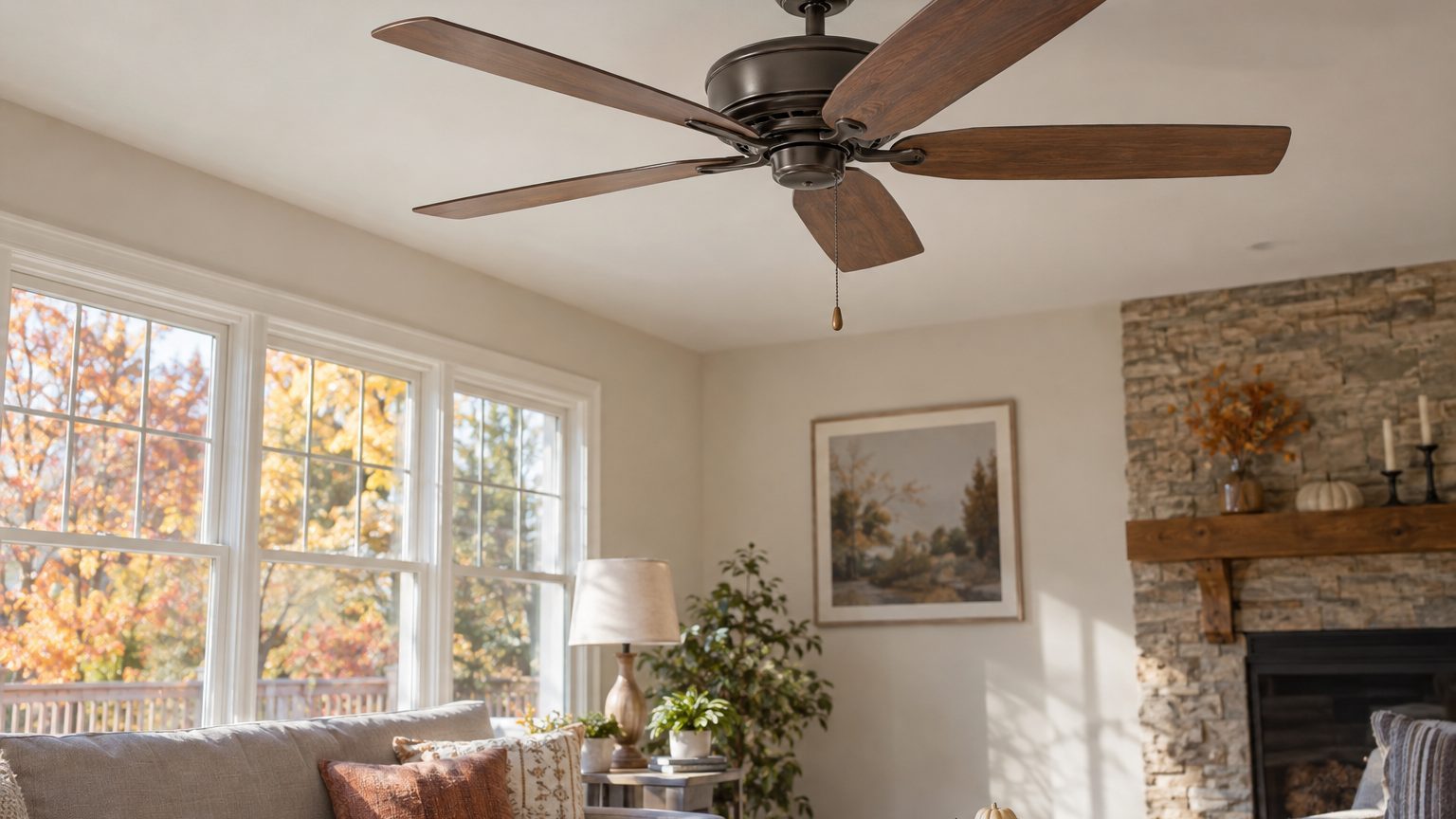

Clockwise blades in winter produce a gentle updraft that forces warm air near the ceiling down into the occupied space. In winter the fan should turn clockwise, on low speed. Stop the fan, find the reverse switch, flip it, and restart the fan on its lowest setting.
Clockwise, on low

ENERGY STAR’s installation and usage tips say it plainly: in the winter, reverse the motor and operate the ceiling fan at low speed in the clockwise direction. The agency explains the result as a gentle updraft that forces warm air near the ceiling down into the occupied space. The blades pitch so that, turning this way, they produce a gentle updraft that forces warm air near the ceiling down into the occupied space.
Why the warm air is up there to begin with
NOAA’s explanation of parcel theory notes that warm air has lower density compared to cooler air, and that as temperature increases, the density of air decreases. Lighter air rises. In a heated house, the air your furnace or heat pump warms drifts upward and settles against the ceiling, while the air around your ankles stays cooler. Rooms with tall or vaulted ceilings show this most, because there is more space above you for warm air to collect in.
A fan turned the wrong way works against you here. Counterclockwise rotation drives air straight down, which is useful in summer and unpleasant in winter. You feel the moving air as a draft, and the warm layer above stays where it is.
Why low speed matters
The goal in winter is to stir the room, not to blow on anyone. Low speed is what ENERGY STAR specifies, and it fits the purpose. A slow updraft nudges the warm layer along without creating a breeze you can feel on your skin. If you sit under the fan and notice a distinct draft, something is off. Either the fan is still turning the summer direction or the speed is higher than it needs to be.
This is a habit for the heating season, so it makes sense to flip the switch once when you first turn the furnace on and leave it until spring.
Where the switch is
On most fans the control is on the lower, or switch, housing. ENERGY STAR’s purchasing guidance describes a motor reversing switch on the lower, or switch, housing. Look for the motor reversing switch on the lower, or switch, housing.
Flip it with the fan stopped
Let the blades come to a complete stop first. Once the blades are still, move the switch, then start the fan again on low. Use a sturdy stepladder if you cannot reach the housing from the floor, and turn the fan off at the wall before you climb.
Not every fan follows this layout. Some fans are labeled differently, some put the reversal on a remote, and others use a wall control. Check the fan’s own manual if you cannot find a switch on the housing. If you have lost the manual, check the fan’s manual.
And in summer
ENERGY STAR says that in the summer you should use the ceiling fan in the counterclockwise direction. The airflow creates a wind-chill effect, making you “feel” cooler. The two seasons use the same fan for opposite jobs.
| Season | Direction | What it does |
|---|---|---|
| Winter | Clockwise, low speed | Gentle updraft pushes warm air from the ceiling down into the room |
| Summer | Counterclockwise | Wind-chill effect makes you feel cooler |
Does it save on heating?
It helps, but the claim needs care. The U.S. Department of Energy says the ceiling fan won’t change the temperature in the room, but it will help keep you warm. The fan moves heat that is already in the room. It does not create any.
The “up to 15%” figure
Energy.gov’s page for renters says this practice can potentially save you up to 15% on your winter energy bills and up to 30% on your summer energy bills. Read the words “up to” and “potentially” as the real content. That is a ceiling, not a promise. Your result depends on your house, your ceiling height, how much warm air actually pools overhead, and how you run your thermostat. A low-ceilinged room with a well-mixed temperature will gain less than a tall living room with a cold floor.
Fans cool people, not rooms
ENERGY STAR puts it this way: ceiling fans cool people, not rooms. If the room is unoccupied, turn off the ceiling fan to save energy. The same logic holds in winter. A fan running in an empty room uses electricity and helps nobody, so switch it off when you leave.
The savings only show up if you adjust the thermostat
The Florida Solar Energy Center at the University of Central Florida studied the summer side of this. Their finding is that if the thermostat is not adjusted at all for fan use, cooling energy use may increase by 15%. A fan running while the thermostat stays where it was just adds a load. The same principle applies in winter. The fan can make a room feel more comfortable, but the bill only drops if you actually act on that comfort, which means a modest change at the thermostat rather than leaving it where it was.
If you notice dampness on the glass while the fan runs, that is a separate matter. Air movement does not remove moisture from the house, and the page on window condensation in winter covers what to do about it.
What saves more heat than a fan
A fan redistributes the heat you have. It does nothing about the heat you lose. Gaps around windows, doors, attic hatches and penetrations let warmed air escape, and finding air leaks is the first job that pays off, because sealing them keeps heat in the house instead of moving it around inside. A fan can only circulate what is still there.
The second job is the building envelope itself. Good insulation in the attic and walls slows the flow of heat through the structure, which is the root of the problem the fan is working around. Treat the fan as the finishing touch, not the main plan. Leaks sealed and insulation in place come first, and the clockwise setting then helps with whatever warm air is left under the ceiling.
Common questions
Which way is clockwise on a ceiling fan?
Clockwise is the direction a clock’s hands turn when you look up at the fan from the floor. If you are unsure, watch the blades from below after the fan reaches low speed and compare with a clock face. Check your manual too, because some fans are labeled differently.
Can I run the fan on high in winter?
ENERGY STAR’s winter guidance is low speed in the clockwise direction, so that is what to use. A higher speed moves more air and is more likely to feel like a draft on you, which defeats the purpose of the winter setting.
My fan has no reverse switch. What now?
Look in the manual first. The switch may be on a remote or a wall control rather than on the motor housing. If the fan truly has no reversing function, you cannot change its direction, and the maker or the model label is the place to confirm that.
Does the fan help with condensation on my windows?
Not directly. The fan stirs air but does not take moisture out of the house. The page on window condensation in winter explains the causes and what to change.
Rules, guidance and product features can change, so confirm the current advice with ENERGY STAR, the U.S. Department of Energy and your fan’s manufacturer before acting. Canadian readers should check Canadian guidance where it differs.