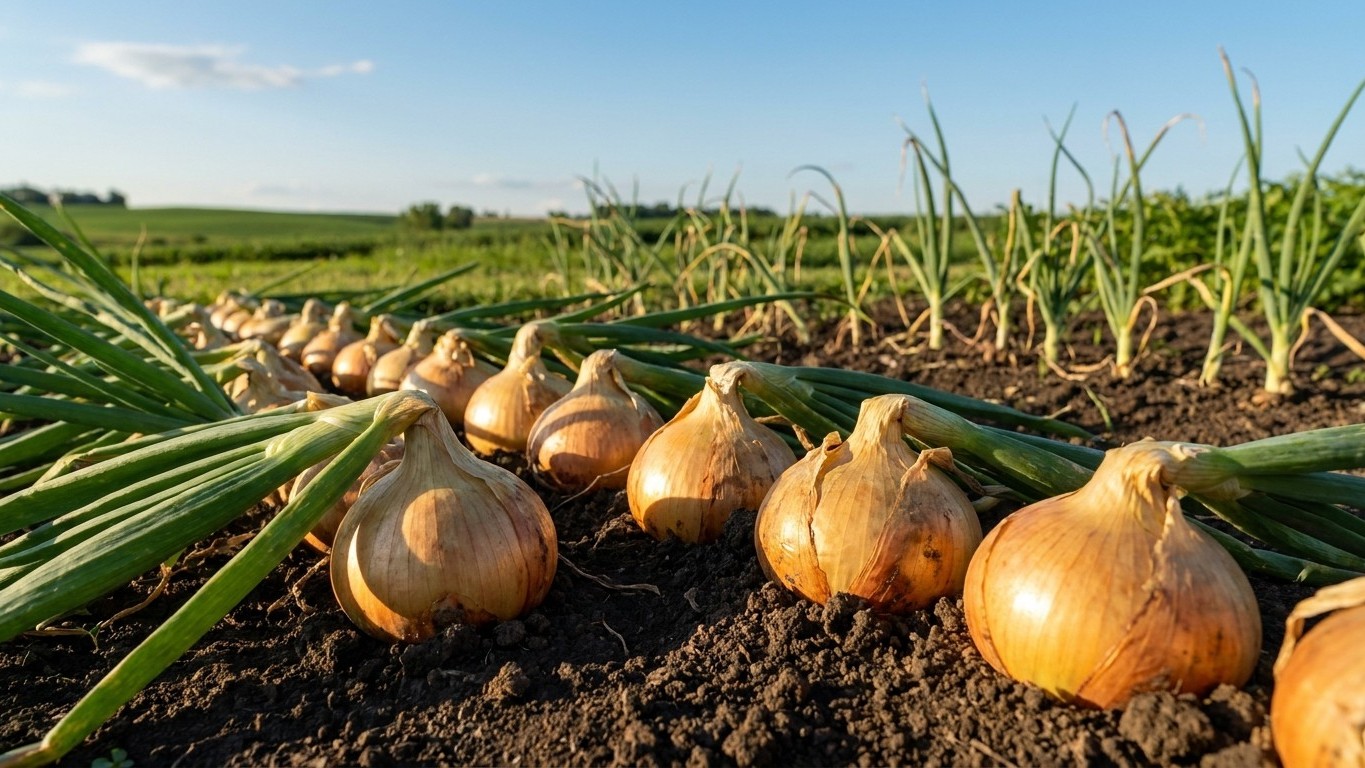

Lift onions when most of the tops have flopped over and turned yellow, which in Wisconsin means late summer, with the week set by variety and planting date. Pull them on a dry day and cure them before storing. Curing is done when the necks are tight and the skins are papery. Bulbs that pass that test and are pungent long-day types will keep through winter in a cool, dry spot. Sweet ones will not.
Keeping them, and for how long
Clemson Cooperative Extension’s Home & Garden Information Center puts ideal onion storage at between 45 °F and 55 °F, and 50 to 60 percent humidity. That is a narrow target, and the humidity half surprises people who store carrots, beets and potatoes. Those roots want damp air. Onions want it dry, because moisture invites sprouting and rot at the neck. A single cellar corner cannot hold both well, so plan on two storage spots, or store the roots in the damp place and the onions somewhere else.
How long they last depends on the onion and on how close you get to those numbers. Any duration you read is a ceiling for sound, well-cured bulbs in ideal conditions. Pungent long-day onions grown in a northern garden can keep you in onions into March when everything goes right. A bulb with a thick green neck, a bruise, or scarring from insect feeding will give out weeks earlier, and it can start a soft spot that spreads to its neighbors. Check the stored pile every couple of weeks and pull out anything soft or sprouting. If you had trouble with thrips or maggots, What Eats Onion in Wisconsin, and When explains which damage means a bulb belongs in the kitchen pile rather than the storage crate.
Why do sweet onions not keep?
University of Missouri Extension (publication G6355) states it plainly: “As a rule, ‘sweet’ onions do not store as well as the more pungent types.” The reason is chemical. The bite of an onion comes from volatile sulfur compounds, and those same compounds help protect the bulb while it sits in storage. A sweet variety carries fewer of them. That makes it better raw and worse in March. No amount of careful curing turns a sweet onion into a winter keeper, so eat sweet types first, in the weeks right after harvest. If you want bulbs that last, The Best Onion Varieties for Wisconsin sorts the keepers from the fresh-eating types.
Does day length decide which onions store well in Wisconsin?
It decides when the bulb forms, and that lines up with keeping quality. Onions start bulbing in response to day length, not warmth. Short-day varieties begin at about 12 hours of daylight, according to Clemson Cooperative Extension, so they bulb early and tend to run sweeter. Long-day varieties wait for 14 to 16 hours and tend to keep longer. Milwaukee sits at 42.95 degrees north and gets 15 h 10 of daylight on the longest day, so it clears the long-day bar easily. A short-day variety there starts bulbing long before the days peak and ends up small. If your garden is near the far northern or southern edge of the state, check your own latitude, since day length shifts by several minutes for every degree. The northern end gets more summer daylight, which favors long-day onions even more. More on how the state’s climate shapes the crop is in Onions in Wisconsin.
Where in the house that actually is
A kitchen thermometer reading of 45 °F to 55 °F is hard to find in an ordinary house. Start by ruling out the obvious places. A domestic refrigerator runs below that range, and the crisper drawer is built to hold humidity, the opposite of what onions need. A heated living area runs warmer than 55 °F all winter, which wakes the bulbs and pushes them to sprout. An attached garage is the worst swing of all. It can be hot in September, cool in November and below freezing in January, and onions that freeze turn to mush as they thaw.
The room that usually comes closest in a Wisconsin house is an unheated interior space: a closet on an inside wall, a back bedroom with the vent closed, or a basement corner that stays cool. Basements need a second look, because many run damp through humid summers and a damp basement works against onions. A concrete wall that sweats or a musty smell tells you the air is too wet before any gauge does. Mesh bags, slatted crates or a shallow open basket on a shelf all let air move around the bulbs. A sealed plastic tub holds moisture and is the wrong choice.
The only reliable way to know is to measure. Put a thermometer and a humidity gauge on the shelf for a week before you load it, and check the lowest and highest readings, not just a single glance. Skipping that step is how a crop gets lost: a spot that felt cool in October can drift above 55 °F by midwinter, and the onions sprout or go soft by January. If the air is too damp, run a small dehumidifier or move the crate upstairs. If it runs too warm, move it lower in the house, closer to an outside wall.
Where should onions cure before they go into storage?
Curing comes first, and it happens in a different place than storage. After pulling, spread the bulbs in a single layer somewhere shaded, dry and breezy, with the tops still attached. A covered porch, an open garage with a fan, or a barn aisle all work. Keep them out of rain and out of strong direct sun, which can scald the bulbs. Brush off loose soil by hand and skip washing entirely. The bulbs are ready when the necks are tight and dry, and the outer skins rustle like paper. Rain or cool, humid weather stretches that out, so be patient. Then trim the tops to about an inch and move the bulbs to the cool, dry place you tested. Bulbs moved straight from the ground into a crate trap moisture in the neck, and that is where rot starts.
Common questions
How do I know it is time to lift onions in Wisconsin?
Watch the tops. When most of them have fallen over and begun to yellow, the bulbs have stopped growing. Stop watering at that point, let the soil dry, and loosen the bulbs with a garden fork on a dry day. Pulling earlier leaves thick, wet necks that rarely cure well. Waiting too long through a wet spell risks rot in the field.
Can I keep onions in the refrigerator?
You can for a short while, mostly for cut or sweet onions you plan to use soon. For whole winter storage, the fridge is too cold and too humid. Whole, cured onions do better in the 45 °F to 55 °F range at 50 to 60 percent humidity, in a spot with moving air.
What if it rains while my onions are curing?
Move them under cover as soon as the rain starts. A porch, a garage or a shed will do, as long as air can still move around the bulbs. Wet bulbs that stay wet are likely to rot at the neck, so a fan in a dry garage helps. Curing will take longer in damp weather, and it is finished only when the necks are tight and the skins are papery.
Which onions should I eat first?
Eat the sweet varieties right away, since they hold fewer of the sulfur compounds that protect pungent onions in storage. Next come bulbs with thick necks, bruises, or insect scarring. Save the firm, pungent, well-cured bulbs for last, since they are the ones that can stretch toward March.