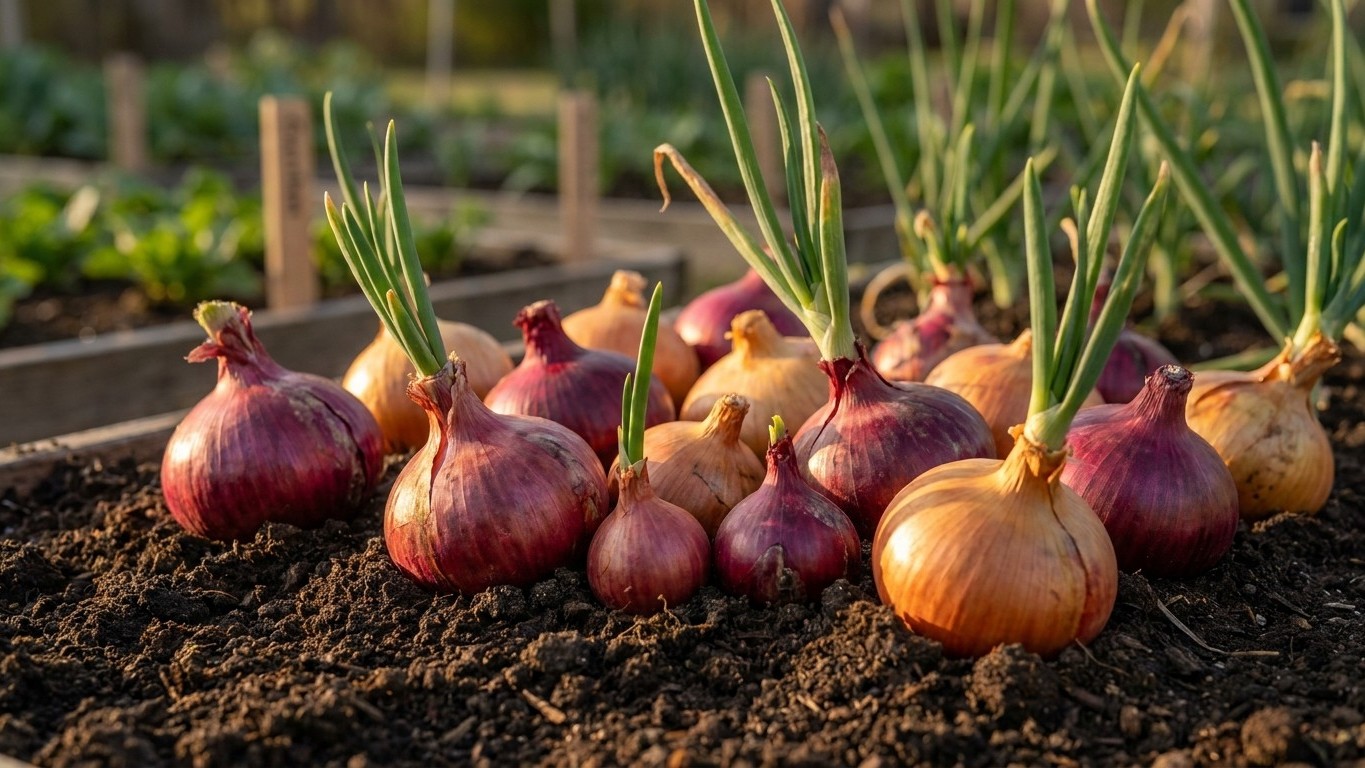

Two pests do most of the damage to Wisconsin onions, and they arrive months apart. Onion maggots go after seedlings and sets in spring, tunneling into stems and young bulbs. Onion thrips show up in summer, rasping the leaves just as bulbs begin to swell. Neither follows the calendar exactly. Both follow the plant, and the plant follows the length of the day. That is why the daylight figures below tell you as much about your pest calendar as your planting date.
The short answer for Wisconsin
The reference point is Milwaukee, where the climate station sits at 42.95 degrees north. On the longest day of the year the sun is up for 15 h 10. That figure is geometric, and atmospheric refraction adds roughly seven minutes of real daylight that it does not count. What matters is where it lands: Wisconsin is long-day onion country, and long-day onions spend a lot of the season looking like a salad bar to insects.
Bulbing is triggered by day length, not by warmth. A short-day variety starts to bulb at about 12 hours of daylight, according to Clemson Cooperative Extension. A long-day variety waits for 14 to 16 hours. Milwaukee’s 15 h 10 sits inside that window, so the long-day group has the daylight it needs, and the gardener’s job is to give the plant as many weeks of leaf growth as possible before the trigger fires. Every one of those weeks is a week a pest can feed on it.
Spring: maggots and the seedling window
Onion maggot flies lay eggs at the base of young plants, and the larvae chew the roots and the base of the stem. A seedling with a pencil-thin stem has no margin; a few larvae can kill it. Sets and transplants are most exposed in the cool weeks after planting, when growth is slow and the plant cannot outpace the damage. Planting in the same bed year after year, or leaving cull onions lying around, keeps the problem close to home.
Summer: thrips and the bulbing window
Thrips are tiny, slender insects that hide between the leaf bases near the neck and rasp the tissue, leaving silvery streaks. Hot, dry stretches favor them. They matter most when the plant is bulbing, because the leaves are feeding the bulb at that point and each lost leaf is lost bulb size. Exact emergence dates for Wisconsin are not published here, and they shift from year to year, so your local extension office is the place to confirm timing. More on that near the end. The planting side of the story is in When to Plant Onions in Wisconsin.
What will not work here

At this latitude, the long-day group has the daylight it needs, so the failure that hits southern gardeners (all leaves, no bulb, then rot) is not the Wisconsin problem. The Wisconsin failure runs the other way. Days here are already longer than 12 hours by the time the soil can be worked, so a short-day onion gets its bulbing signal almost at once, when the plant is still tiny. The bulb forms at whatever size the plant has reached, and that size is small.
Timing follows the same rule. Planting late does not delay the harvest, it shrinks it. Whatever size the plant has reached on the day the long days trigger bulbing is the size of the bulb, and no amount of fertilizer or watering after that point adds much. A late planting also leaves a small, soft plant sitting in the window when maggots and thrips are active. Here is what to leave out:
- Short-day types, such as Granex and Texas Grano: they bulb at about 12 hours, which Wisconsin passes early, so you get golf-ball bulbs from a full season of space.
- Southern sweet onions sold as Vidalia-style: these are short-day types, so they share the same small-bulb problem, and they do not store.
- Sets or transplants put in late in the season: they have too few leaves when bulbing starts, so the bulb is small, and the weak plant is an easy target for maggots.
- Onions replanted in last year’s bed: maggots overwinter near where they fed, so the new seedlings meet the flies at the worst moment.
Seed packets rarely say “short-day” in large print. Check the day-length group before you buy, and read The Best Onion Varieties for Wisconsin for the long-day types that suit the state.
What changes across Wisconsin
The figures here belong to Milwaukee, at 42.95 degrees north, and Wisconsin runs several degrees of latitude from the Illinois border to the Lake Superior shore. A gardener in Superior is not growing onions under the same sky as a gardener in Kenosha. The north gets more summer daylight, which is why long-day onions are the northern standard, and it also gets a later spring, which pushes planting and the maggot window later. The south has slightly shorter solstice days, but still well inside the 14 to 16 hour range.
| Where | Latitude | Day length at the solstice | What it changes |
|---|---|---|---|
| Far north (Lake Superior shore, Northwoods) | Higher than 42.95; look up your own | Longer than 15 h 10 | Later thaw, later planting, and later pest activity; long-day types are the only sensible group |
| Milwaukee (reference station) | 42.95 degrees north | 15 h 10 | The baseline for every figure on this page |
| Far south (Illinois border counties) | Slightly lower than 42.95 | A little shorter, still within 14 to 16 hours | Earlier planting, earlier maggot flights, and a longer thrips season |
Wisconsin does not reach the latitudes where an onion would belong to another day-length group, so the advice on varieties does not flip at the edges. What moves is the schedule. A reader in the far north may plant about two weeks later than the Milwaukee schedule suggests, and one near the Illinois line may plant earlier. I will not put a firm date on either, because the frost dates are not published here. For the full picture, see Onions in Wisconsin.
Sweet now, or onions that last
Gardens in the south lean sweet and short-keeping. Gardens in the north lean sharp and long-keeping. The reason is chemistry, not luck. The bite of an onion comes from volatile sulfur compounds, and those same compounds are what protect the bulb in storage. A sweet variety carries fewer of them, so it is better raw and it will not last the winter. University of Missouri Extension puts it this way: “As a rule, ‘sweet’ onions do not store as well as the more pungent types.”
Short-day types run sweeter and long-day types keep longer, and Wisconsin’s long-day onions are the sharp, storing kind. Here is what your pantry looks like in March. A gardener who grew pungent long-day onions, cured them properly, and stored them well still has firm bulbs on the shelf. A gardener who grew sweet types ate them in the fall and early winter, then watched the last ones soften. You cannot get a sweet onion that stores, so decide which one you want before you plant.
Clemson Cooperative Extension gives the target for storage: “Ideal conditions are between 45 °F and 55 °F, and 50 to 60 percent humidity” (Clemson HGIC). Onions want it dry, which is the opposite of carrots and other root crops, so one cellar cannot hold both well. Curing comes first: bulbs go into storage only when the necks are tight and the skins are papery, never straight from the ground. Pest damage matters here too. A bulb with a maggot tunnel or a soft neck rots, and it takes its neighbors with it.
Checking this against your own garden
Everything above is anchored to one weather station in Milwaukee. A state-wide figure does not apply to every garden in it, and that includes this one. Before you plan around it, check these things this week:
- Your latitude. Look it up if you are far from Milwaukee, especially in the Northwoods or along the Lake Superior shore. A higher latitude means a longer solstice day than 15 h 10.
- Your last spring frost and first fall frost dates. This page does not publish them, so get them from a local source for your county.
- Your county extension office. Call or check their website for when onion maggot flies and thrips are active in your area, and ask which varieties perform locally.
- Last year’s onion bed. If onions grew there, plant somewhere else this year, because maggots overwinter close to where they fed.
- Your storage space. Measure the temperature and humidity where you plan to keep cured bulbs, and compare it with 45 °F to 55 °F and 50 to 60 percent humidity.
Common questions
When do onion maggots show up in Wisconsin?
In spring, when seedlings, sets, and transplants are small and growing slowly. Exact dates are not published here and they vary by year and by how far north you garden, so your county extension office is the right source for the local window.
Do thrips ruin the bulbs?
Heavy thrips feeding cuts the leaf area that feeds the bulb, so the bulbs finish smaller. Hot, dry spells make it worse, and the damage matters most while the plant is bulbing, since that is when the leaves are working hardest.
Is it safe to plant late to dodge the maggots?
No. Planting late does not delay the harvest, it shrinks it, because the plant’s size when the long days trigger bulbing sets the size of the bulb. A small, late plant is also a weaker target when thrips arrive.
Can I grow sweet onions in Wisconsin and store them?
You can grow some sweet types, but they will be small if they are short-day varieties, and sweet onions do not store as well as pungent ones. Eat them first. Keep the pungent long-day onions, cured and dry at 45 °F to 55 °F, for the long winter, and sort out any bulb with a soft neck or maggot tunnels before it goes into storage.