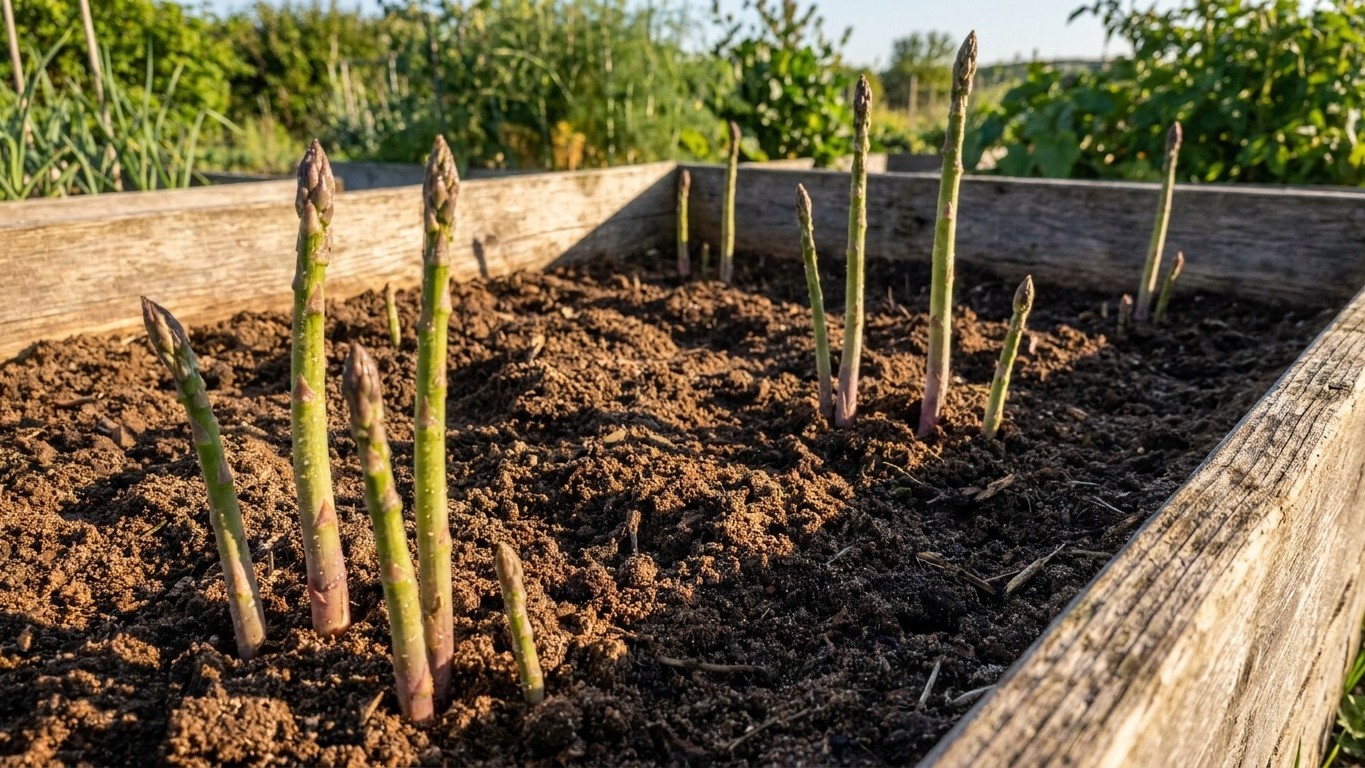

Stop cutting asparagus when most of the spears coming up are thinner than a pencil. That object is the signal, and it matters more than any calendar date. Before it comes a longer wait: no cutting at all until the bed’s third season, then a harvest window that lengthens each year. Once a spear is cut, it needs cold, wet air to stay tender, and an ordinary refrigerator only gives it that if you set it up right.
Keeping it, and for how long
The UC Davis Postharvest Technology Center sets the optimum temperature for fresh asparagus at 0°C to 2°C, which is 32°F to 35.6°F. It pairs that with an optimum relative humidity of 95 to 100 percent, and says high humidity is essential to prevent desiccation. That is a band less than four degrees wide, with air close to saturated.
Both edges of the window do damage. The same UC Davis sheet says spear toughening occurs rapidly above 10°C (50°F). At the other end, freezing injury will likely result at -0.6°C (30.9°F) or lower, showing up first as a water-soaked look and ending in extreme softening. A spear that has frozen collapses once it thaws, and no amount of cooking brings it back.
| Temperature | What happens to the spears |
|---|---|
| 30.9°F or lower | Freezing injury: water-soaked look, then extreme softening |
| 32°F to 35.6°F | Optimum range, with 95 to 100 percent relative humidity |
| Above 50°F | Spears toughen rapidly |
Any storage life quoted for asparagus is a ceiling. It describes spears held in that ideal cold room with near-saturated air from the first minutes after cutting. A kitchen rarely matches those conditions, so plan on a shorter clock and cook the spears soon after you cut or buy them.
Your eyes and fingers will tell you more than a day count. Good spears have tight, closed tips, firm shafts and cut ends that still look moist. Wrinkled shafts point to water loss, and limp or slimy tips mean the spears are past their best.
A warm hour matters more than most people expect. Spears left in a hot car on the way home, or on a sunny counter while the rest of dinner comes together, can toughen well before they ever reach the fridge. The toughening threshold is only 50°F, which is an ordinary room on a cool day, so the sooner the spears get cold the better. Cold is only half the job. The other half is the water in the air around them, and that is where most home storage goes wrong.
Where in the house that actually is
A domestic fridge runs warmer than the 32°F to 35.6°F optimum, and the door runs warmer still, because it swings open all day and its shelves sit closest to the room. Asparagus belongs nowhere near it. The shelf that comes closest to the target is the lowest one, toward the back, where cold air settles.
There is a catch at the very back wall. In many fridges it can get cold enough to push a spear toward the 30.9°F freezing edge. An inexpensive appliance thermometer, left on that shelf for a day, shows you where yours sits. If it reads close to freezing, slide the spears forward a few inches.
The humidity target is harder to hit than the temperature. Fridge air is dry, and the cut end loses water faster than any other part of the spear. In practice, 95 to 100 percent humidity means keeping the spears wet and enclosed. Stand the spears upright with the cut ends in water, and skipping that step is what turns firm spears into wrinkled ones.
Three setups work, from best to simplest:
- Upright in a jar or tall container with water under the cut ends, and a loose bag over the tips.
- Laid flat with the cut ends wrapped in a damp paper towel, then sealed in a bag.
- Wrapped whole in a damp towel inside a bag, with the cut ends touching the dampest part.
Change the water if it clouds, and re-wet the towel if it dries. Keep the bag loose around the tips so they are not crushed. Cover the jar, or the whole jar and spears in a bag, so the fridge’s dry air does not pull water off the tips. If your crisper drawer holds humidity well and sits low in the fridge, it can serve as the container for the jar. Check the temperature in there first, since drawers differ from model to model.
How many weeks can you cut asparagus each year?
Utah State University Extension describes the timeline plainly. Crowns go into 8-inch furrows in early spring, and the bed is not harvested until year 3. After that it produces for 10 to 15 years. No cutting before the third season is a firm rule, and a “few spears” in year 2 is not a safe compromise. The crowns are still building the root mass that will feed the next decade of harvests.
When cutting does begin, the window starts short and grows:
| Season of the bed | Harvest window |
|---|---|
| Years 1 and 2 | None |
| Year 3 | 4 weeks |
| Year 4 | 6 weeks |
| Year 5 and after | Up to 8 weeks |
Those weeks are the longest you should cut, and the spears can end the season sooner. The stop rule is an object, so use it in every year of the bed: once most of the spears coming up are thinner than a pencil, put the knife away and let the rest grow into ferns.
Spring frost shapes when the cutting starts. At the reference weather station for New Hampshire, NOAA NCEI’s climate normals put the last spring frost between April 16 and April 27. Suburban and rural gardens typically see it one to two weeks later, and higher ground later still, so your county extension office can give a closer date. A spear that has frozen turns water-soaked and soft, the same injury UC Davis describes for stored spears.
For the whole bed, from crowns to year 3, see Growing Asparagus in New Hampshire.
What should you do once you stop cutting asparagus?
Let every remaining spear open into a fern, and keep the bed watered. The summer water picture at the reference station is generous on paper: about 10.7 inches of rain across June, July and August, out of 40.4 inches over the year. June brings 4.04 inches, July 3.3 and August 3.35, which makes July the driest of the three.
Rainfall alone does not decide how often to water. The state soil, the Marlow series, is a sandy, well-drained Spodosol, with a representative surface of 57 percent sand, 38 percent silt and 5 percent clay. Ground like that lets rain through within the day, so a wet summer can still call for watering. Heat adds to it, since days at or above 90°F speed up evaporation, and a single thunderstorm often runs off instead of soaking in. These are normals for one station, not a forecast. A rain gauge on your own plot tells you what actually lands.
Keep the furrow in mind as well. It is backfilled gradually as the plants grow, and not all at once. Adding soil in stages keeps the new shoots from being buried too deep.
A bed that must last 10 to 15 years needs a spot that drains well. The Marlow series is a starting point, but river bottoms, hill country and ground a builder has scraped or filled can behave completely differently. A soil test and a look at Will New Hampshire Soil Hold an Asparagus Bed for Fifteen Years? settle it for your yard. Beetles and other feeders also work on the ferns through summer, and What Eats Asparagus in New Hampshire, and When covers what to watch for.
Common questions
Can I cut a few spears in year 2?
No. Utah State University Extension says asparagus is not harvested until year 3. In year 3 the window is 4 weeks, then 6, then 8.
What date should I stop cutting?
No date applies. Stop when most spears are thinner than a pencil, or when you hit your week limit for that year, whichever comes first.
Why did my asparagus go tough in the fridge?
UC Davis reports that spear toughening occurs rapidly above 50°F. Spears that sat warm before refrigeration, or on a door shelf, often toughen first. Dry air also shrivels them, so keep the cut ends in water.
Does the variety change the stopping rule?
The pencil check works on any variety.