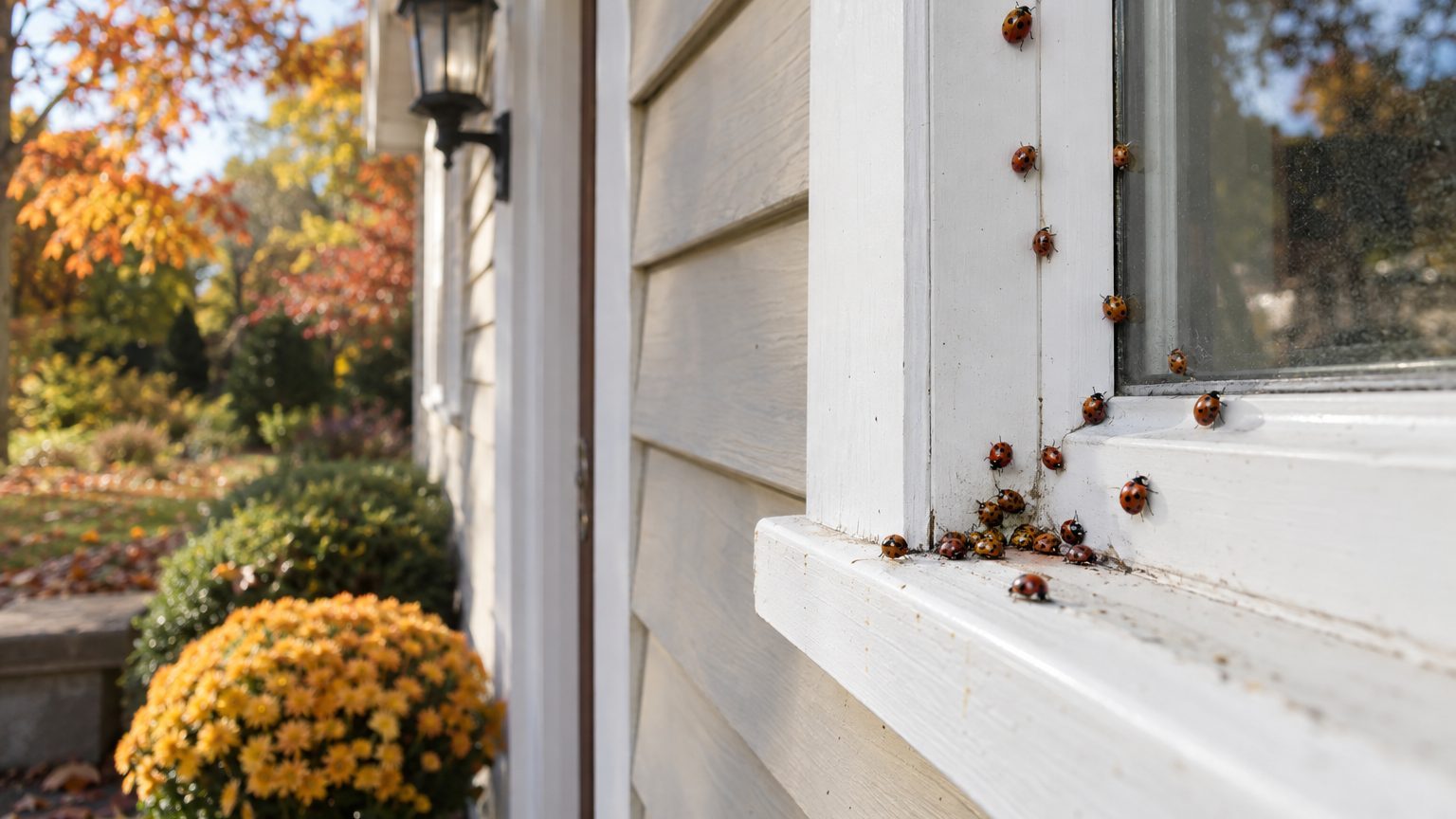

Orange beetles crawling over a sunny window are not a sign that something is wrong with your house. They are looking for a winter hiding place, and a crack gave them one. Vacuum or sweep up the ones inside, then fix the openings that let them in. Start by walking the south and west walls and marking every gap you can see.
Seal the gaps before they come, vacuum the ones inside

Iowa State University Extension and Outreach says that sealing exterior gaps and cracks around windows, doors, eaves, roofs, siding and other points of access before the beetles appear can prevent unwanted entry. For beetles already in the house, the same source calls the most practical control to vacuum or sweep them up and discard them. Those two steps do most of the work, and neither needs a product.
Why they are on your walls
University of Illinois Extension notes that multicolored Asian lady beetles often aggregate on buildings in search of somewhere to overwinter. Your house is not special to them. It is a tall, warm surface with plenty of seams. The Illinois guidance adds that they usually form aggregations on walls with a western or southern exposure, which are typically warmer.
That detail tells you where to look first. A wall that soaks up afternoon sun draws the beetles, and every gap on that wall becomes a doorway. Check the trim around windows, the joints where siding meets a corner board, the soffits under the eaves, and the places where cables, pipes or vents pass through the wall.
What to do first
Work in this order and you will not have to repeat yourself:
- Vacuum or sweep up the beetles that are already inside.
- Mark exterior gaps on the sunny walls, starting with windows and doors.
- Seal them, and fix screens and weatherstripping where they are worn.
- Look at the roofline and eaves, since beetles do not only use ground-level cracks.
Sealing is the part that lasts. Sweeping clears today’s beetles, but the opening stays open until you close it, and the next group on the wall will find it the same way the last group did.
What they do and do not do indoors
Iowa State Extension and Outreach states that the beetles do not feed or reproduce indoors, and that they cannot attack the house structure, furniture or fabrics. In other words, the beetles in your window are a nuisance, not a population that is building up inside your walls. You are not dealing with an infestation that grows through the winter.
The mess is the real complaint
The same Iowa State page warns that lady beetles may leave a slimy smear, and that they have a distinct odor when squashed. So do not swat them against walls or curtains. A crushed beetle on pale paint is harder to deal with than a live one on the glass. Lift them off with a vacuum hose or a sweep into a dustpan and dispose of them.
Making sure you have the right beetle
University of Illinois Extension points to an M-shaped pattern on the pronotum, the plate just behind the head, as one characteristic used to identify them. It also cautions that this pattern is not always present. If a beetle lacks the M, you cannot rule it out on that alone. Look at several beetles from the same cluster, and if you are still unsure, take one to your county extension office.
Sealing the house
Sealing works best when you treat it as a short inspection of the whole envelope, not a one-gap fix. The cheapest items come first.
Screens and weatherstripping
University of Illinois Extension advises you to make sure window screens do not have any holes in them. A small tear is enough, and screens that look fine from inside can have frayed corners where the frame meets the mesh. Patch the holes or replace the screen before the beetles gather.
NC State Extension says that if large numbers of these insects continue to invade a house, it probably means that the weatherstripping around the doors and windows needs repair. Press on the seals and look for compressed, cracked or missing sections. Our guide to weatherstripping doors and windows covers how to replace it. If you cannot tell where the air is getting in, the steps for finding air leaks will show you the openings you missed, and those same openings cost you heat all winter.
One repair, several pests
Beetles are not the only visitors that use these openings. Mice can squeeze through gaps around pipes and foundations, which is why why mice come inside in fall is worth reading before you finish. A single afternoon of caulking and weatherstripping answers several problems at once. Iowa State also lists eaves, roofs and siding among the places to seal, so do not stop at the doors and windows.
Vacuuming, and why not to spray indoors
Vacuuming is the method the extension services keep returning to. University of Illinois Extension says that to avoid staining, lady beetles can be vacuumed, and that bags should be emptied to prevent beetles from escaping. Take the bag or canister outside straight away and dispose of the contents. If you leave it in the closet, the beetles inside may crawl back out.
Why indoor spraying is the wrong move
Illinois Extension states that pesticides are generally not recommended to manage multicolored Asian lady beetles indoors because the beetles are typically overwintering in inaccessible areas. That means wall voids, attics and spaces behind trim, which you cannot reach with a spray. The product would go on surfaces you can see, while the beetles you are worried about stay where it does not go. Skip the indoor aerosol and rely on the vacuum.
Outside sprays, if sealing is not enough
The University of Wisconsin–Madison Division of Extension says that if lady beetles cannot be excluded by pest proofing, there are a number of insecticide sprays that can be applied to the outside of buildings. That is a second line of defense, after sealing, not a substitute for it. If you go that route, follow the label on whichever product you choose, and ask your county extension office, or the provincial agricultural or environment ministry if you are in Canada, which products are allowed where you live.
Fall brings another invader into many homes at the same time, and it needs a different approach. Our page on how to get rid of cluster flies explains it.
Common questions
Why do the beetles keep coming back after I vacuum?
Vacuuming removes the beetles but not the way in. NC State Extension says that large numbers continuing to invade usually points to weatherstripping around doors and windows that needs repair. Check seals, screens and exterior cracks on the sunny walls.
Should I spray inside the walls or attic?
No. University of Illinois Extension says pesticides are generally not recommended indoors, since the beetles are typically overwintering in areas you cannot reach. Spraying a space you cannot see or ventilate is a poor trade for a small nuisance.
Can I use the same vacuum for everything afterward?
Yes, but empty it outdoors. Illinois Extension says bags should be emptied so beetles do not escape. Because squashed beetles leave a smear and odor, according to Iowa State, a bagless canister is easiest to rinse and wipe down.
Is every orange ladybug in my house the Asian kind?
Not necessarily. Illinois Extension says the M-shaped mark behind the head is often used for identification but is not always present. If you have doubts, show a few beetles to your county extension office before you plan a response.
Rules and product approvals change, so confirm current guidance with your state or provincial extension service and the product label before you spray anything.