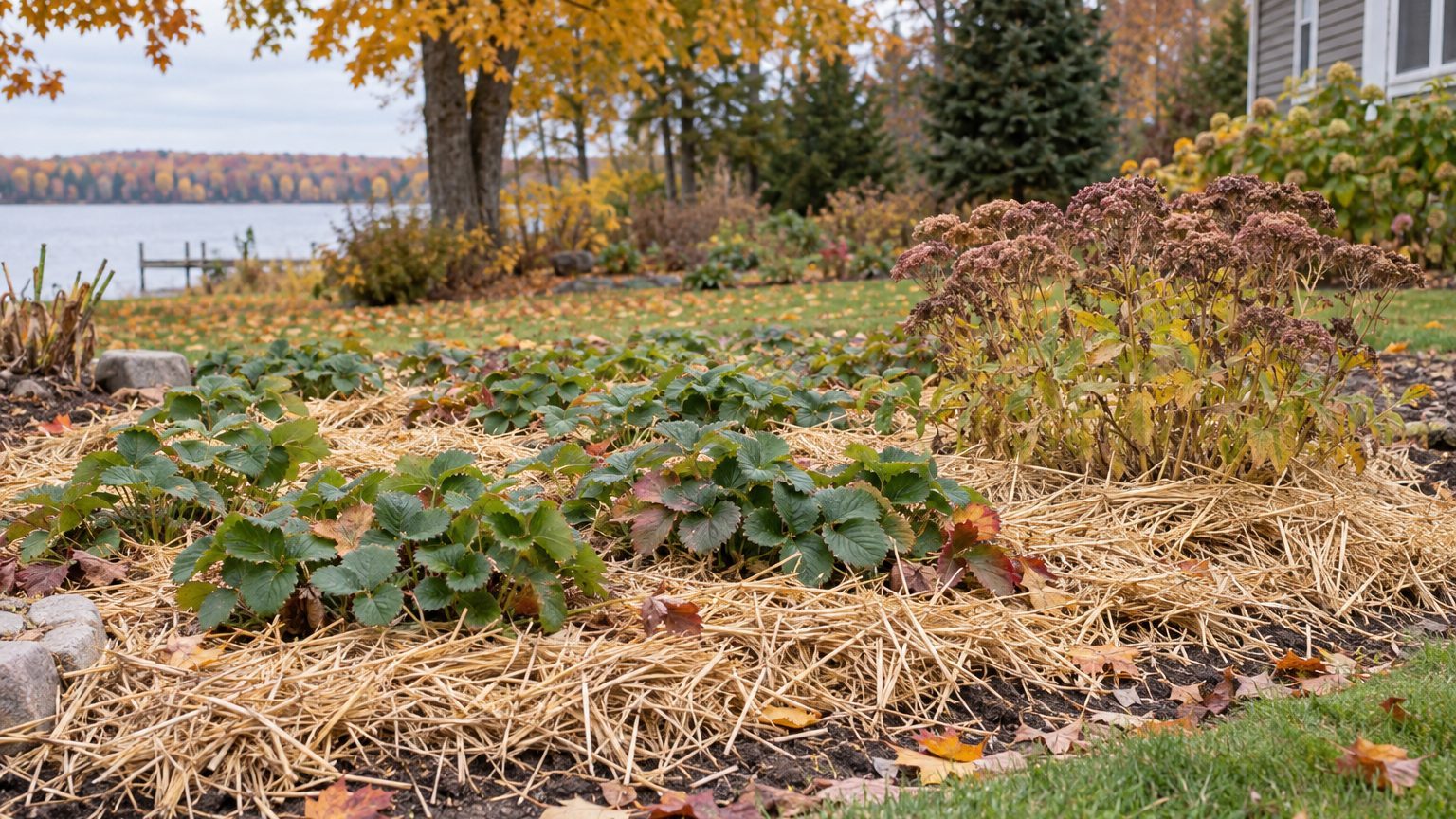

Winter mulch goes on after the first hard freezes, which is later than most gardeners expect. At the Jackson airport station, NOAA’s 1991-2020 Climate Normals put the first fall frost between November 7 and November 22 (the 30 to 70 percent freeze-probability band). Spread clean straw over strawberries, and a thin ring around borderline perennials, once a few freezing nights have followed that window. In the northern part of the state, move the job earlier on the calendar.
When to put winter mulch down in Mississippi
In cold country, mulch keeps soil frozen once it has frozen, so the ground stops thawing and refreezing around roots. It does not warm anything. Spread on soil that is still mild, it holds moisture against the crowns and gives mice a snug place to settle in. That is why the timing rule runs backward from what most people assume.
Mississippi changes the picture. NOAA NCEI’s 1991-2020 Climate Normals for Jackson show a mean daily minimum of 36.6°F in the coldest month. The average night in midwinter stays above freezing, and the soil seldom stays frozen for long, although individual nights do dip below 32°F. Here, winter mulch works as a moisture keeper, a weed blanket and a cover you can pull over crowns on a frost night. Frost heave can lift shallow-rooted plants when the ground freezes and thaws, so check your local county extension office for how much of a concern it is where you garden.
Now the window. The first fall frost at Jackson falls between November 7 and November 22, according to the same NOAA normals. A first frost is a skin-deep event, and the soil underneath is still holding summer heat. The date to write down: wait for a few hard freezes to follow the November 7 to November 22 first-frost window, then spread the mulch. Suburban and rural gardens usually see that first frost one to two weeks earlier than the airport does, and higher ground sees it earlier still. Your county’s own dates are in First and Last Frost Dates in Mississippi, and your county extension office can tell you how local cold pockets behave.
Do you need winter mulch at all in Mississippi?
For established, hardy perennials, a layer is optional. It saves moisture and holds down winter weeds, but the plants will usually get through without it. Strawberries and plants near the edge of their hardiness are different. Both gain from a cover that can go on before a cold snap and come off when the weather turns.
How can you tell the ground is ready for mulch?
Strawberries
A strawberry plant keeps its growing point in the crown, right at the soil surface. Nothing protects it from the air above. Bare cold can injure those crowns, and where soil freezes and thaws in turns, the swelling soil can push the whole plant partway out of the ground and snap its roots. In the colder northern counties of Mississippi, that is the risk worth guarding against. Around Jackson, where the coldest month averages a nightly low of 36.6°F (NOAA NCEI 1991-2020), the cover matters most on the occasional hard-freeze night, and for the moisture it saves.
What mulch works for strawberries, and how deep?
Clean straw is the standard choice. It is light, it lets water through, and it settles into a loose blanket. Hay is a poor substitute because it carries seed that can sprout into weeds. For depth, NC State Extension’s Gardener Handbook (chapter 11) says: “A 2-inch to 3-inch layer of mulch suppresses most annual weed seeds and makes it easy to hand-pull any that do germinate.” That range is a good target for strawberry beds too. Straw fluffs up when you spread it and compacts as it gets wet, so aim for a loose layer at that depth and check it after the first heavy rain. More than that traps wetness around the crowns.
Cover the whole bed, tucking straw between and over the plants so the crowns sit under it. Spread it in the window after the first hard freezes, as described above. Keep a spare bale, or a pile of straw, off to the side. If a late warm spell has you wondering whether you jumped the gun, you can rake it back and re-cover it later. More on the crop itself is in Growing Strawberries.
When do you pull the straw back in spring?
Uncovering is as important as covering. Strawberries that stay under straw after growth starts turn pale and spindly, and damp straw can invite gray mold on the first flowers. Check the bed every week or so as late winter turns to spring. The decision to write down: pull the straw off the crowns once new leaves start pushing up pale yellow, and rake it into the walkways between rows. Leave it nearby, because a late frost after the blossoms open can still take the crop. The last spring frost is typically later on higher ground and in the north of the state, so those beds can stay covered a little longer.
Perennials and borderline plants
The USDA Plant Hardiness Zone Map (2023, built on 1991-2020 normals) places Mississippi between zones 7b and 9a. That zone system is built on a single measure, the average annual extreme minimum temperature, so it tells you how cold the worst night gets and says little about how long the cold lasts. Most perennials sold locally are comfortable across this range. The ones that benefit from winter mulch fall into a few groups.
| Plant group | Winter mulch? | What it does |
|---|---|---|
| Perennials planted this fall | Yes | Roots are still settling in, and mulch evens out moisture |
| Plants whose hardiness label sits near your zone (rosemary, salvia, lantana) | Yes, after the hard freezes | Buffers a cold snap and protects the crown |
| Established hardy perennials | Optional | Saves moisture and suppresses winter weeds |
| Evergreen perennial herbs | Thin layer only | Avoids wet crowns that rot in damp winters |
Herbs deserve their own note. Many of them grow in poor, lean soil in the wild and sulk when kept damp. Getting Perennial Herbs Through the Winter covers which ones want cover and which want only good drainage.
How should you lay the mulch around a perennial?
Build a ring, not a mound. Spread the mulch around the plant and leave a bare gap at the crown, wide enough that you can see the stems where they meet the soil. A pile against the stems holds moisture on the bark and crown tissue, and that is where rot starts. For depth, NC State Extension’s handbook says to “provide a 3-inch layer of mulch to reduce water loss and maintain uniform soil moisture and temperature around roots,” and gives 2 to 3 inches for weed control. Use the same order of depth for perennials: 2 to 3 inches, applied after the hard freezes, with no extra for good measure. The details of keeping a ring from turning into a volcano are in Mulching Without Killing the Plant.
Shredded leaves, pine bark and straw all work for perennials. Whole leaves mat into a soggy sheet, so shred them first or choose something coarser. Gardeners in colder states time all this differently, as the winter mulch guides for South Carolina and Virginia show.
What goes wrong
What happens if you mulch too early?
Early mulch goes on warm, damp soil. The crowns sit in a humid layer for weeks, and that is when crown rot and fungal spotting get a foothold, especially in Mississippi’s humid falls. Mulch spread right after the first light frost also keeps the soil from cooling down quickly. The cure is to wait for the hard freezes described earlier, and to keep the straw stored dry until then.
Why does winter mulch mat and rot?
Wet leaves and fine, compacted straw form a sheet that sheds air along with water. Underneath you find slimy, gray plant tissue and a sour smell. Prevent it by choosing a coarse, loose material, keeping the depth at 2 to 3 inches, and fluffing the layer with a rake after a long rain. Thick, early piles also give mice a warm place to chew on crowns, so keep mulch pulled back from the trunks.
What if you forget to uncover in spring?
Plants under mulch keep growing in the dark and come up weak and pale, and the damp layer invites mold when flowers open. Set a reminder for late winter and look under the straw regularly. Pull mulch off strawberry crowns when new growth shows, and back from perennial crowns as spring growth starts, then keep the material close in case of a late frost. Other timing for your area is in the Mississippi guides.
Common questions
Can I mulch strawberries in October in Mississippi?
It is too early. At Jackson, the first fall frost typically arrives between November 7 and November 22 (NOAA NCEI 1991-2020), and the mulch belongs after a few hard freezes have followed it. Farther north and in suburban or rural gardens, the first frost comes earlier, so check your county’s dates before you decide.
How deep should winter mulch be?
NC State Extension’s Gardener Handbook gives “a 2-inch to 3-inch layer of mulch” for suppressing weed seeds and “a 3-inch layer” for reducing water loss and holding soil moisture around roots. Stay within that range, and keep it off the stems and crowns of perennials.
Do I need winter mulch at all in Jackson?
Established, hardy perennials can do without it. The coldest month at the Jackson station averages a nightly low of 36.6°F, and the soil seldom stays frozen. Strawberries, fall-planted perennials and plants near their hardiness limit still gain from a loose cover that holds moisture and blunts a hard freeze.
When do I remove winter mulch?
Pull it back when new growth starts to show beneath it, usually pale yellow on strawberries. Rake it between the rows or away from the crowns, and keep it handy until the last spring frost has passed in your county.