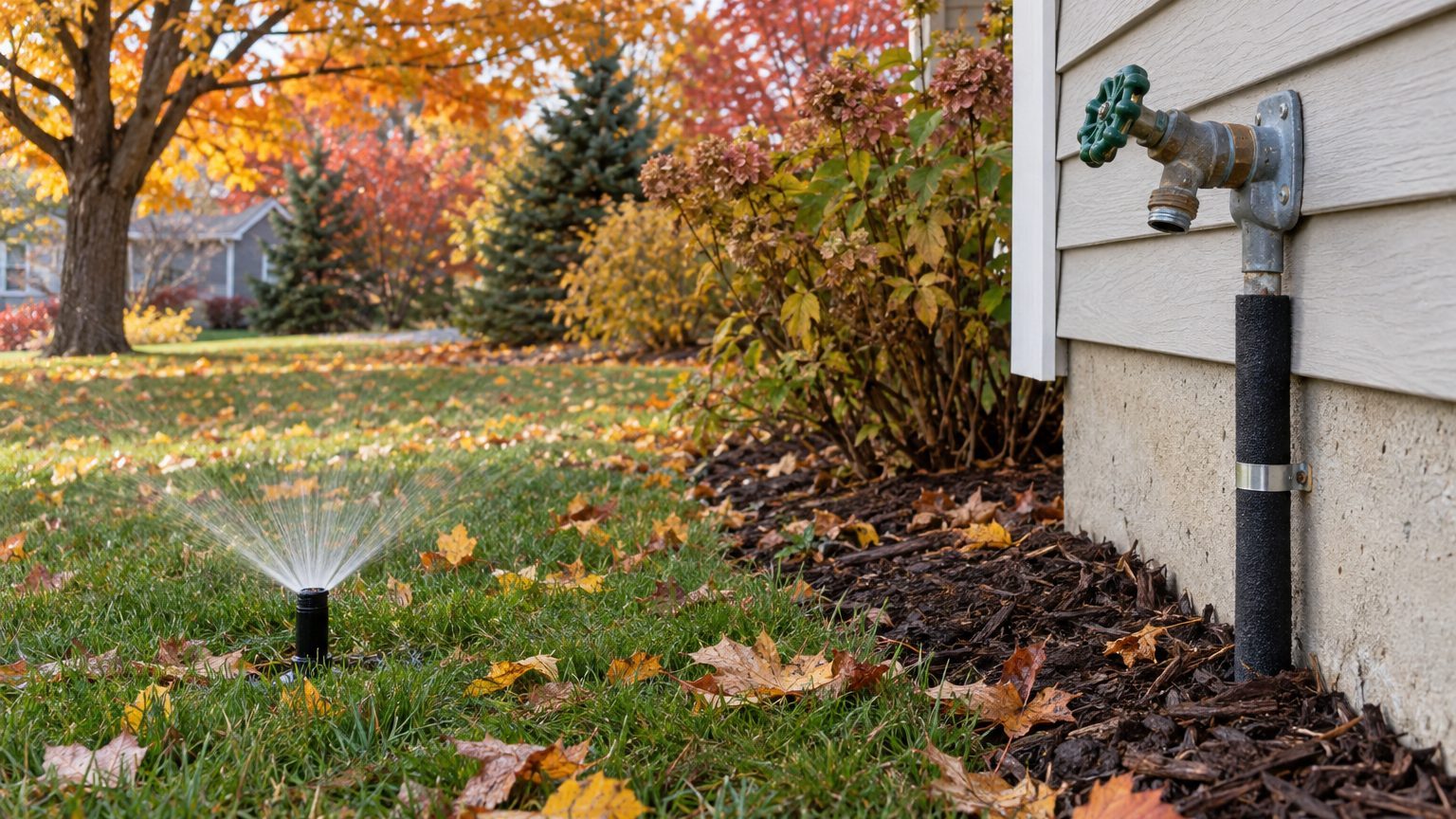

Mississippi winters are mild enough that plenty of sprinkler systems get through without ever being blown out. They are cold enough that one unprotected night can still split a pipe or crack a backflow valve. The job here is smaller than in the northern states, but skipping it altogether is a gamble. Below are the timing, the method that suits this climate, and the spots where yards most often get hurt, from forgotten hoses to flooded valve boxes.
When to do it in Mississippi
Winterize in the weeks before the first fall frost, which at the Jackson airport weather station typically arrives between November 7 and November 22, according to the NOAA NCEI 1991-2020 Climate Normals (the 30 to 70 percent band of 32°F freeze probabilities). The rule is to act before the first hard freeze, not after the first light one.
A light frost whitens the lawn and blackens basil, and exposed pipe usually shrugs it off. A hard freeze is a night cold enough, and long enough, to freeze water sitting in aboveground pipe, fittings and a backflow assembly. The first can be followed by the second within days, and the forecast is the only warning you get.
Here is the line to write on the calendar: finish before the November 7 to November 22 first-frost window opens. In practice that means doing the work during the fall weeks that lead up to it. Those dates describe one airport station. Suburban and rural yards usually see the first fall frost earlier, often by one to two weeks. The northern part of the state and higher ground run colder still, so fall tasks move earlier there. Your county extension office can tell you what frost dates look like near you.
The winter itself is gentler than those dates suggest. The mean daily minimum of the coldest month at Jackson is 36.6°F (NOAA NCEI Climate Normals 1991-2020), which is above freezing on an average night. That is why a full compressed-air blowout is often unnecessary here, especially for a system built with drain valves. Averages hide cold snaps, though. The USDA Plant Hardiness Zone Map 2023 lists zones 7b to 9a for the state, and that rating is built on the average annual extreme minimum. The extreme night is the one that cracks pipes, and different parts of the state sit at different points in that range.
What should you do instead of a full blowout?
A short list covers most yards in a mild-winter climate. It takes an afternoon, and it handles the parts of the system that actually sit in cold air.
- Close the main shutoff that feeds the irrigation system.
- Open the manual drain valves, or confirm the automatic ones have emptied the lines, and drain the pipe between the shutoff and the backflow preventer using the system’s own drain or bleed valves.
- Wrap the aboveground backflow preventer in an insulated cover that sheds rain.
- Switch the controller to off or rain mode so no zone tries to run on a freezing night.
- Take hoses off every outdoor tap.
When a forecast first shows a night at 32°F, do the whole list that afternoon. A system that is shut off and drained gets through most winters here without further work. More seasonal jobs for the state are collected in the Mississippi guides.
Sprinkler lines: drain or blow out
Water that sits in an irrigation line has nowhere to go when it freezes. Ice takes up more room than the liquid it came from, so it pushes outward on whatever holds it: PVC pipe, glued fittings, valve bodies, the risers under each head, and the brass and plastic parts of the backflow preventer. The weakest piece gives way, usually a fitting or a valve. Nothing shows when it happens. The crack stays closed under ice or underground until spring, when pressure comes back and it turns into a geyser or a wet, hissing patch.
How do manual drain, automatic drain and compressed-air blowout compare?
All three aim at the same result, which is empty lines and empty valves before the cold arrives. They differ in how they get there and in what the system needs to have been built with.
| Method | How it works | Best fit |
|---|---|---|
| Manual drain | You open drain valves at the low points of the system and let gravity empty the lines. | Systems installed with a drain valve at each low spot |
| Automatic drain | Valves open on their own when line pressure drops and let water out of the pipe. | Systems built with them, where cold snaps are short. Check that every zone really empties. |
| Compressed-air blowout | A compressor pushes air through each zone and forces water out of pipes and heads. | Systems with no drain valves, sagging runs, or long pipe runs that gravity leaves wet |
With a coldest-month minimum of 36.6°F at Jackson (NOAA NCEI Climate Normals 1991-2020), a gravity drain is normally enough for a system designed to drain. Manual or automatic, either one handles the typical Mississippi winter. A blowout is the safer pick when the system has no drain valves, when the yard has low spots where water pools in the pipe, or when you live in the colder northern part of the state or on higher ground. Whichever method you choose, finish before the first-frost window opens.
Check the automatic valves by walking the yard. A zone that drained well last year can clog with grit or sit slightly out of level after the soil settles, and a pipe that still holds water will not announce it.
When is a professional the sensible choice?
Blowing out lines yourself is easy to do badly. Air that is pushed through too fast or at too high a pressure can damage heads, valves and the pipe itself. Running every zone at once can overload the system. The usual practice is to work one zone at a time, keep your eyes protected and never stand over a pressurized line. A compressor that is too small can also leave water behind, and that leftover water is the part that freezes.
A professional makes sense when the system has no drain valves, when you do not know how it was laid out, when a zone has frozen before, or when the backflow preventer sits in a buried box you have never opened. It also makes sense if you cannot find the main shutoff. Book a professional blowout in the weeks ahead of the November 7 to November 22 window, so the visit happens on a calm day and not after a freeze forecast has everyone calling at once. If the backflow device needs periodic testing, ask your water utility who is allowed to do it.
Lawns still drink during a dry fall, so run zones as needed through those weeks and shut the system down in the days before the window. Winterizing a Lawn covers the other fall jobs in the yard.
Outdoor faucets and hoses
Outdoor faucets (hose bibs, spigots) are the exposed end of the house’s plumbing, and each takes a few minutes. Do them in the same weeks as the sprinklers. Every step below is a matter of turning valves and unscrewing hoses, and nothing more.
How do you shut down an outdoor faucet for winter?
Start at the faucet and work back toward the house. The order matters, because the water has to have an exit before you close it behind you.
- Unscrew every hose, splitter, sprayer and timer. Drain the hoses and coil them indoors.
- Find the interior shutoff valve for that outdoor line, often in a crawl space, garage or utility room, and close it.
- Open the outdoor faucet fully so the water left in the line can run out, and leave it open for the season.
- Fit an insulated faucet cover if you have one, which helps on a one-night cold snap.
If there is no interior valve, or the one you find will not close or leaks past the handle, call a plumber. Cutting in a new valve, replacing a faucet, or repairing a line inside a wall is plumbing work and should be treated that way. The longer walkthrough is in Winterizing Outdoor Faucets Before the First Freeze.
Why does a frost-free faucet still fail with a hose attached?
A frost-free faucet has a long stem that puts the valve seat inside the warm wall, well away from outdoor air. When you shut it off, the water left in the barrel drains out the spout, as long as the faucet tilts slightly downward. A hose left on the spout traps that water. Cold air reaches the barrel behind the hose, the trapped water freezes, and the pipe splits. The split sits inside the wall and shows up only when the water goes back on in spring. A hose with a nozzle left closed makes it worse, and so does a faucet that tilts up toward the house, which holds water no matter what you do. A plumber can reset a tilted faucet, and you cannot fix it with a valve.
That is why every hose comes off before the November 7 to November 22 window, whatever type of faucet you own. The design only protects the pipe when the barrel can empty. Frost-Free Outdoor Taps explains how to tell which kind you have.
The mild winter does not change this much. A frost-free faucet with a hose on it is exposed on exactly the nights that matter, and a single night near freezing is enough.
What goes wrong here
Most damage in this climate comes from procrastination rather than extreme cold. November often arrives warm, the shutdown stays on the to-do list, and then one night proves the list was too long.
What happens when a cold snap arrives before you have drained?
The early end of the frost band is the risk. A freeze can arrive before the date most people have marked on the calendar. Spring shows the result: a zone that will not build pressure, a geyser at a riser, a hissing valve, or a backflow preventer that sprays from a crack. Prevention is mostly attention. Once the first cold fronts arrive, glance at the extended forecast. When any forecast first shows a night at 32°F, finish the shutoff and drain that same afternoon. If the list is already written, it goes fast.
What do a forgotten hose and a flooded valve box look like in spring?
A forgotten hose usually announces itself when you turn the outdoor faucet on in spring. Water sprays from behind the handle or the wall, a stain appears on an interior wall or ceiling below the faucet, or there is a drip in the crawl space or garage. The water meter may spin with every tap closed. The cure is to get in the habit of taking hoses off before the window, every year, so there is no question left in the fall. A pipe that froze but has not yet cracked is covered in Frozen Pipes.
The valve box is the quieter failure. Boxes sit low and collect rain, leaves and silt, so the valves and backflow parts end up sitting in standing water. A freeze turns that water into ice around parts that cannot take it. In spring look for a zone that will not shut off, a valve that weeps, a wet patch around the box, or a backflow preventer that leaks when the system comes on. Before the cold, clear out debris, bail any standing water, put the lid back on firmly, and use only insulation that stays dry, since wet leaves hold water. Then bring the system up slowly in spring, open the main valve gradually, and walk each zone looking for hissing or soggy ground.
Common questions
Do I need a compressed-air blowout every year?
Often not. A coldest-month minimum of 36.6°F at Jackson (NOAA NCEI Climate Normals 1991-2020) means a system built with working drain valves can usually be drained by gravity or by automatic valves. A blowout is the right call for systems without drain valves, for sagging pipe runs, and for yards in the colder northern part of the state or on higher ground.
Can I winterize after the first frost has already happened?
Yes, if that frost was light and no hard freeze is in the forecast. Do the shutoff and drain right away. If a hard freeze is already forecast, treat it as the deadline and finish the same day. If a freeze has already hit, shut the water off and check for splits before turning anything back on.
Do hoses need to come off if I have a frost-free faucet?
Yes. A hose holds water in the faucet barrel and keeps it from draining, and the frost-free design only works when the barrel can empty. Unscrew every hose, splitter and timer, drain them, and store them indoors before the first-frost window opens.
Should I go earlier if I live outside Jackson?
Most likely. Suburban and rural yards often see the first fall frost one to two weeks earlier than the airport station does, and the northern part of the state and higher ground run colder still. Aim to finish before the November 7 to November 22 window at Jackson opens, and check your county extension office for local frost timing.