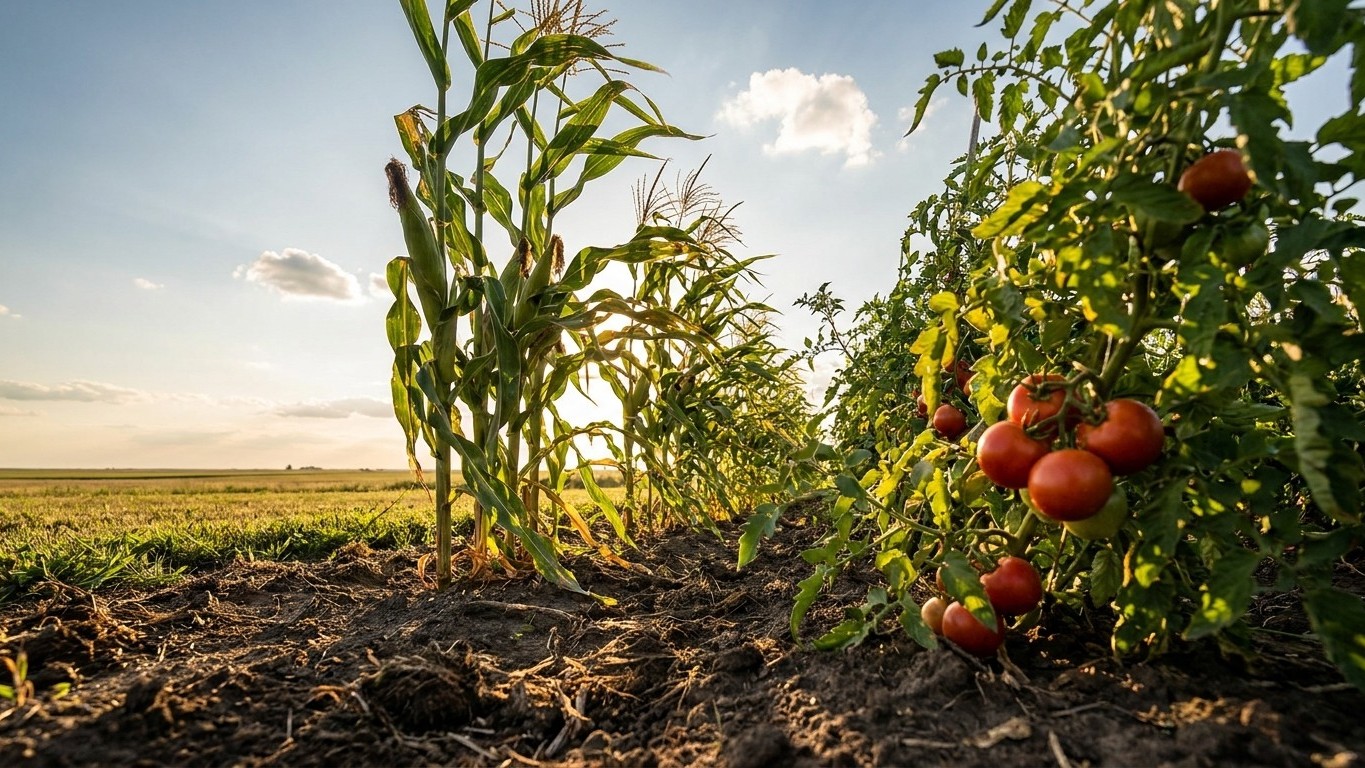

Sweet corn is ready when three signs line up: the silks have dried brown, the husk is still moist and green, and a punctured kernel gives milky juice. Around New York City, that happens from roughly July into September, depending on when the soil warmed enough to plant. After picking, the clock runs fast. Sugar starts leaving the kernel right away, and heat speeds the loss, so the hours between stalk and refrigerator matter more than most gardeners expect.
When sweet corn are ready in New York
Check all three signs together, because any one of them alone can mislead: dry brown silks, husks that are still moist and green, and milky juice from a punctured kernel. Around New York City, plantings made once the soil has warmed come ripe from roughly July into September, and upstate gardens run later.
How do frost dates shape the sweet corn season?
The NOAA NCEI climate normals for Central Park put the last spring freeze (the 30 to 70 percent probability band at 32 F) between March 23 and April 3. The first fall freeze falls between November 14 and November 27. Those are New York City numbers, from a dense urban site. Upstate New York and the Adirondacks frost far earlier in fall and later in spring, so a gardener in Watertown or Saranac Lake should not borrow them.
The last spring frost is not the planting day. Soil warms well after it. Clemson Cooperative Extension says not to plant before the soil at the 4-inch depth is at least 50 F, and to wait until 65 F for extra-sweet varieties. Utah State University Extension puts the general need at soil above 60 F. A thermometer pushed 4 inches into the bed gives a more reliable answer than a calendar, and the planting-date details are in When to Sow Sweet Corn in New York.
Once seed is in, Utah State gives the crop 60 to 90 days from planting. Around the city, with the first fall freeze still in mid-November, even a 90-day planting made in late spring has room to spare. Upstate, where the fall freeze comes sooner, add up the packet days before choosing a late variety.
How many days from silks to harvest?
A second clock answers a different question. The 60 to 90 days from planting tell you whether the crop fits the season. What tells you which week to pick is the count from silk emergence, and ears are generally ready once the silks have browned and the kernels are plump. Mark the day silks show on the calendar and start checking the three signs near the early end of that range.
Sweetness depends on the neighbors as well as the weather. Utah State warns that sweetness is lost if su, se and sh2 types tassel at the same time. The source gives no separating distance, so the working rule is about timing: keep those types from shedding pollen in the same days, and plant in blocks of three or more rows rather than one long single row.
Keeping them, and for how long
Clemson Cooperative Extension explains the loss in plain terms: “Sweet corn loses sugar from the kernel rapidly at high temperatures… Sweet corn can be stored under optimal conditions for about five days, but will lose sweetness with each day of storage.” That is the real basis for the old advice about running from the garden to the pot. Sugar leaves the kernel, and heat speeds it up.
Read the number as a ceiling. About five days is what an ear can manage under optimal conditions, and the same sentence says sweetness drops with each day. An ear that rides home in a warm car or sits on a sunny counter will not reach it. The extension’s emphasis is on heat, so the colder the ear is kept after picking, the slower the sugar goes.
Which sweet corn type holds its sugar longest?
The genetic type of the corn changes how fast the loss happens. Standard su types lose sugar fastest. The se types hold it longer, and sh2 types hold it longest. That is the practical reason to choose one over another. If you pick on Saturday and cook on Tuesday, an su ear will taste noticeably flatter than an sh2 ear picked the same hour.
Choosing the longer-keeping type has a price at planting. Clemson says to wait until soil at the 4-inch depth reaches 65 F for extra-sweet varieties, while ordinary sweet corn can go in at 50 F. The two thresholds are not interchangeable. A supersweet seed sown into 50 F soil rots rather than germinates. That explains how the same gardener can succeed one year and fail the next after switching varieties. Keep sh2 plantings apart in time from su and se plantings too, so they do not tassel together.
Summer heat adds to the rush. The New York City reference station averages 12.2 days a year at 90 F or more, and those hot afternoons land in the same weeks the corn ripens. An ear picked in a heat wave starts at a disadvantage. Cool it quickly. Ears left standing past ripeness also attract animals and insects, which What Eats Corn in New York, and When covers by season.
Where in the house that actually is
Of the places in a house, the refrigerator comes closest to what the research asks for. For some crops a domestic fridge is too cold, tomatoes being the usual example. For sweet corn the fridge errs in the right direction, since heat is the enemy. The kitchen counter, any heated room and a sunny porch are all too warm, and each shortens the five-day ceiling.
A garage looks cool but swings with the weather. On a July afternoon with the city near 90 F, a closed garage can be hotter than the kitchen. On a cool September night it may be fine. That unpredictability makes it a poor place to leave ears, and a basement does better only if it stays cool through the whole summer.
Fridges also vary inside. The door runs warmer than the back of a lower shelf, and a crowded fridge holds temperature differently from an empty one. A cheap appliance thermometer settles it. Set one where the corn will sit, leave it several hours, and compare it with a reading from the door and the top shelf. Choose the spot that stays coldest without freezing the contents.
Put a thermometer in the fridge before the first ears come in, because the cost of skipping it is invisible. The corn looks fine on day three while the sugar has already gone, and you only find out at the table. Harvest as close to mealtime as you can manage, and let the fridge handle only the gap you could not avoid.
Common questions
Is sweet corn ready when the tassels turn brown?
Tassel color is not the test. Look at the silks at the ear tip, which should be dry and brown, then check that the husk is still moist and green. Puncture a kernel to see whether the juice is milky. All three signs together mean ripe, and watching the silks brown and the kernels fill tells you when to start checking.
Can I plant sweet corn right after the last frost?
Soil warms well after the last frost. Clemson says not to plant until the soil at the 4-inch depth is at least 50 F, and to wait for 65 F with extra-sweet varieties. Around New York City the mean last spring freeze falls between March 23 and April 3, and the soil usually takes much longer than that to reach those temperatures.
Can different sweet corn types grow in the same garden?
They can, but not if they tassel at the same time. Utah State says su, se and sh2 types lose sweetness when they shed pollen together. Stagger the plantings so each type tassels in its own days, and plant in blocks of three or more rows. For the full season from seed to silk, see Growing Sweet Corn in New York.
Do the New York City frost dates work upstate?
No. They come from Central Park, a dense urban site. Upstate New York and the Adirondacks frost far earlier in fall and later in spring, so the 60 to 90 days from planting may not fit a late variety there. Your county extension office can tell you the frost dates for your own ground before you buy seed.