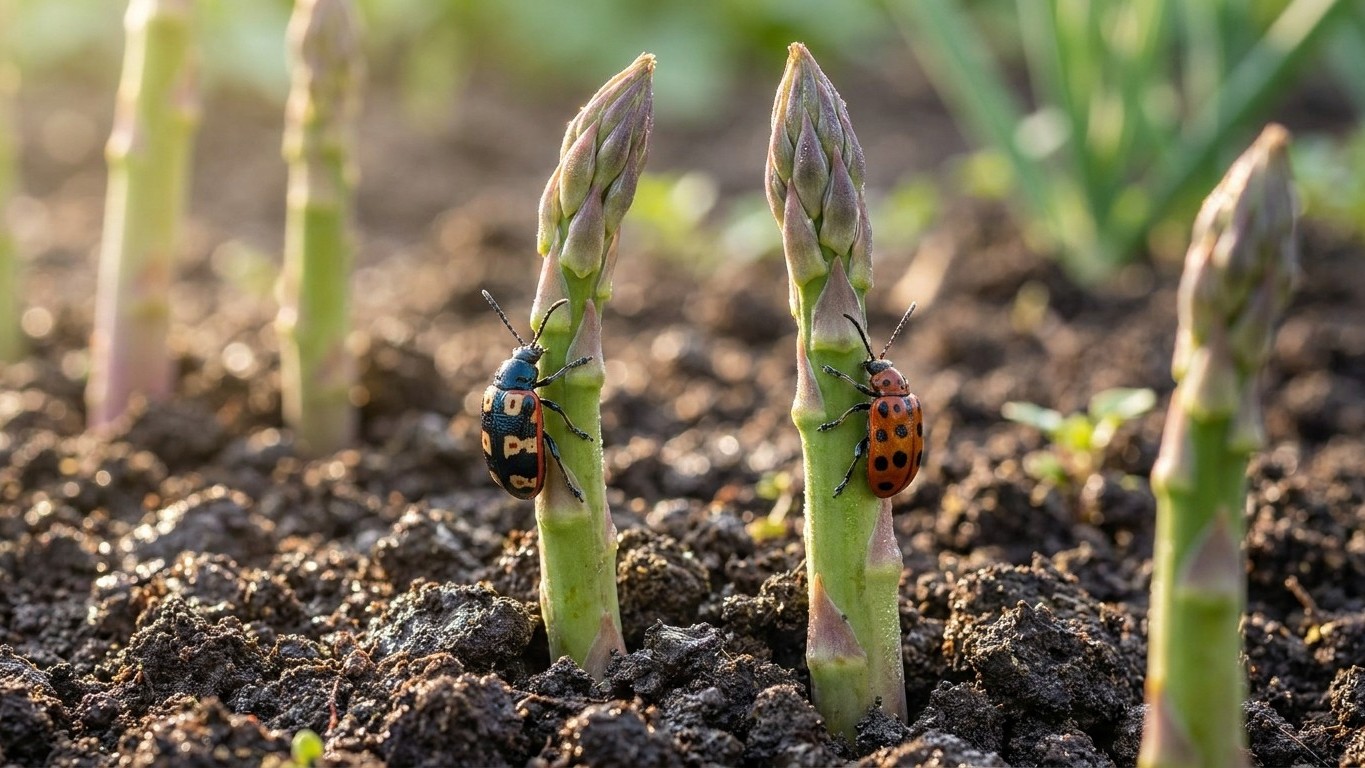

Chewing insects can reach asparagus from the moment spears break the soil until the ferns yellow in fall, and a Saskatchewan season squeezes all of that into a short frost-free window. Which insect is at work depends on the district, so the useful skill is reading damage by stage: ragged spear tips in spring, stripped ferns in summer, thin or missing spears from a weak crown. The regional agriculture office names what is active near you.
Which pests attack asparagus in Saskatchewan
No single list covers every garden in the province, and the insects that matter shift between river valleys, open prairie and the northern edge of farmland. The regional agriculture office is the body that tells you which insects are active in your district in a given season. What a gardener can do alone is sort the possibilities by what the insect feeds on. A feeder belongs on an asparagus list only if it eats spears, ferns or the crown below ground.
That sorting rule removes a lot of noise. Insects that turn up in lists for grain fields or shelterbelt trees are not asparagus problems just because they live in the same province. If a name from one of those lists is offered as the cause of your damage, ask the office to confirm it before you act.
Three groups are worth keeping in mind:
- Insects that chew or scar the spears while they are young and tender.
- Insects that strip the feathery ferns once the harvest is over.
- Feeders at or below the soil line that weaken crowns, which shows up as thin, sparse or missing spears.
Asparagus is planted as crowns in 8-inch furrows in early spring and is not harvested until year 3, then produces for 10 to 15 years. That timeline raises the stakes on the ferns. In the first two years every spear is left to grow into fern, so a bed that loses its foliage early is losing the growth the crown needs for the years ahead.
The soil matters here too. The dominant profile in the province’s agricultural regions is a well-drained Chernozem, a loam to silt with about 4.0 percent organic matter. Well-drained ground suits a bed that has to last this long and is less friendly to some soil-dwelling problems than a soggy spot. A river bottom or a scraped building lot can be very different, and the piece on Will Saskatchewan Soil Hold an Asparagus Bed for Fifteen Years? covers how to judge your own plot.
When each one shows up, and what it does first
The calendar starts with the frost-free window. The mean last spring frost at the Saskatoon SRC station is May 18. That is a midpoint, so in one year out of two the last frost falls later. Northern and upland districts run weeks behind that station. Spears that rise before the frost is truly over can be damaged by cold, and that damage is easy to mistake for insect work (the next section sorts the two).
Spring: spears in the first weeks
The first thing you see is on the spear itself. Tips look chewed or ragged. The surface of the spear may be scarred, or the spear may be bent and misshapen where something fed on it as it grew. This is the stage when spears are soft and rising fast, and the damage appears within the first days or weeks after they emerge. In years 1 and 2 nothing is cut, so this damage costs you foliage, not a meal.
Stop cutting when most spears are thinner than a pencil. That is the signal to let the ferns grow. Cutting past it takes from the crown at the moment it needs to refill.
Summer: ferns once harvest is over
When the ferns open, the first symptom is usually thinning or stripping of the fine foliage, sometimes with bare patches on the stems. Summer in this part of the province brings about 168 mm (6.6 inches) of rain across June, July and August, with August the driest month at 43 mm (1.68 inches). A dry August stresses ferns on its own, so a bed that looks ragged in late summer may have a water problem, an insect problem or both.
Year after year: the crown
Crown trouble announces itself slowly. Spears come up fewer, thinner or in gaps along the row, season after season. Nothing chewed is visible above ground because the feeding is below it. Slow decline of this kind is the one symptom you should take to the regional office early, since a crown is a 10 to 15 year investment.
Telling the damage apart from everything else
Plenty of things that look like insect work are not. Misdiagnosis is the usual reason people spray at the wrong time, so the pattern of the damage counts for more than any single symptom. Use the table as a set of signs to check, then send photos and the details to the regional office for a firm answer.
| What you see | Possible cause | What settles it |
|---|---|---|
| Ragged tips or stripped ferns on some plants | Insect feeding | You find the feeder, its droppings or its eggs on the plant, and the damage is uneven across the row |
| Limp, water-soaked, darkened spear tips after a cold night | Frost | The whole bed is affected at the same height, and new spears coming later look normal |
| Ferns yellowing and browning in a dry stretch | Water stress | The soil is dry a few inches down, and the plants improve after a deep watering |
| Snapped or bent spears with clean breaks | Mechanical damage | No chewing marks, and the damage lines up with foot traffic, hoeing, mowing or wind |
| Pale, weak growth across many plants | Nutrient shortfall or poor drainage | A soil test, and standing water or soggy soil around the crowns after rain |
| Spots, lesions or discolored stems | Plant disease | A diagnosis from the regional office, since several problems look alike |
The rule that decides most cases is to look at the pattern before you look for the culprit. Insects tend to work unevenly, one plant hit hard beside one untouched. Frost, drought and drainage problems tend to hit a whole area or a low spot in the same way.
Your own soil also changes the picture. The province’s dominant profile is a loam to silt (43 percent sand, 22 percent clay, 35 percent silt), but a median across thousands of mapped soils says little about one garden. A soil test on your own plot tells you more than any provincial average, and the regional office can tell you which lab to use.
What actually works here, and what is a waste of time
On a short season, timing and physical barriers do more than any treatment. A lightweight row cover or fine netting placed over the bed before spears rise keeps many flying insects off tender growth. It goes on early, because once feeding has started the barrier only traps the insects inside. Removing last season’s dead fern debris in spring, before the new spears rise, takes away places for some pests to wait out the winter.
Hand-picking on an evening walk works well on a bed this size, because you can check every spear and branch. It works best when you start at the first sign of damage and repeat often. Healthy crowns also shrug off a lot of feeding. That is why the schedule matters: no harvest until year 3, and the furrow backfilled gradually, not all at once. A crown that has been allowed to build strength tolerates damage better than a rushed one. The article on When to Plant Asparagus Crowns in Saskatchewan covers the early-spring planting window.
What does not work is spraying on a calendar without knowing what is feeding on the bed. A treatment aimed at the wrong insect does nothing to the right one. Treating drought or frost damage as if it were an infestation does the same, and it costs money. Cutting spears in years 1 and 2 to get ahead of the pests also backfires, because it removes the foliage the crown depends on.
Which products are registered for home use in the province changes over time and carries its own rules. The regional agriculture office is the place to ask, and only after the cause has been confirmed.
Where to check this for your own county
Your regional agriculture office is the right place to ask which insects are active in your district this season, what is registered for home use, and how to confirm a diagnosis. Ask for the office that covers your rural municipality or town, and bring photographs, a note of when the damage started, and whether it is spread across the bed or confined to patches. For the asparagus growing schedule itself, Utah State University Extension’s guide to asparagus in the garden is the reference behind the planting, harvest and backfilling timeline used here.
Start by taking dated photos of any damage you see next time you walk the bed, then call or email the office with those photos and your soil test result in hand. The broader Growing Asparagus in Saskatchewan guide covers the rest of the bed’s life.
Common questions
When do pests start on new asparagus crowns?
Crowns are planted in early spring, and insects can feed as soon as spears rise. In years 1 and 2 you cut nothing, so the spears become ferns and the ferns are what you protect. Watch the foliage from the first week or two after emergence.
Can I harvest during the first two years if pests are bad?
Pests do not change that rule, and cutting early weakens the crown.
Which spray should I use?
That depends on what is feeding on the bed and what is registered for home use in the province at the time. Ask the regional agriculture office after the cause has been confirmed.