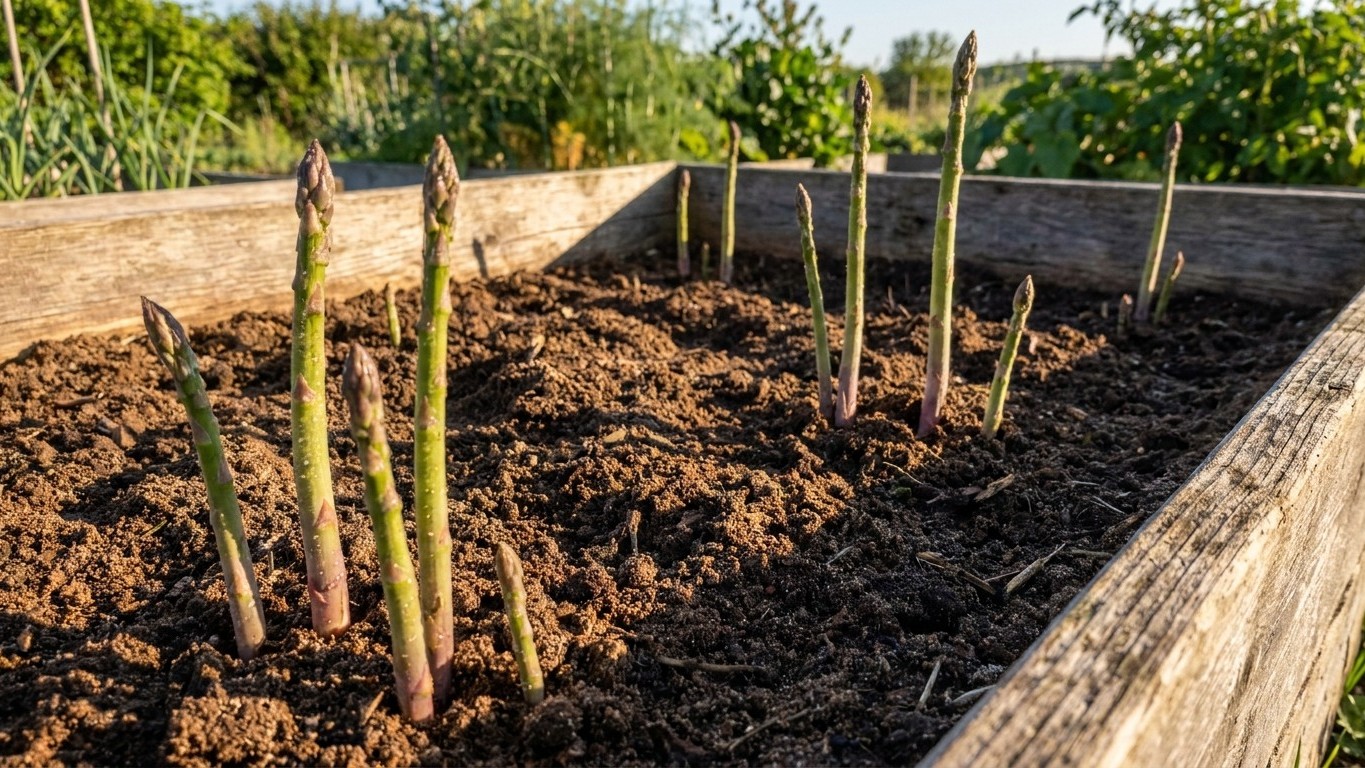

Asparagus gets eaten in two places and in two seasons. Insects chew the spears in spring, and other feeders work the ferns through the hot, humid summer, when the plant is storing energy for next year. Young crowns add a third risk, because a freshly planted bed shows almost nothing above ground for weeks. Start with the bed itself in Growing Asparagus in South Carolina, then match a symptom to a season.
Which pests attack asparagus in South Carolina
Clemson Cooperative Extension county offices hold the asparagus pest list for each area, and that list is the authority. Before calling, sort the possibilities by one question: does this insect have anything to eat on an asparagus plant?
Which parts of asparagus do insects feed on?
Asparagus gives insects only two things to eat: the spear and the fern. The spear is the shoot you would harvest, and it is exposed for a few weeks each spring. The fern is the tall, feathery growth that follows, and it stays up from late spring until frost browns it. Roots and crown sit under the soil in a furrow planted 8 inches deep, so underground feeders reach them only in the early years, before the furrow is filled in.
The plant is on a long clock. Crowns go in during early spring and the bed is not harvested until year 3, then produces for 10 to 15 years. For the first two seasons the ferns are the only thing above ground, so any insect damage you see in those years is on the plant’s food factory, not on a crop.
Which garden pests can you rule out for asparagus?
Plenty of insects on a state pest list have no business in an asparagus bed. Bark and wood borers need a tree trunk or a woody stem to tunnel into, and asparagus has neither. Pests that live in stored grain or flour want dry seed, and a fern offers none. Insects that bore into tomatoes or squash have no fruit to find here (the berries on female plants are the one exception, and they matter little to the crown).
What remains is a short group defined by habit: chewers that scar spear tips, feeders that strip ferns, and small sap-sucking insects that cluster on soft new growth. Ask the county office which of those are active near you, since the answer shifts from the coast to the Upstate.
When each one shows up, and what it does first
Timing follows the frost-free window. At the coastal reference station, the last 32°F freeze falls between February 28 and March 17 (the 30 to 70 percent probability band). Spears push up as the soil warms after that, so the first insect activity tends to arrive within the first weeks of spear growth.
Charleston’s peninsula runs milder than the airport station, and the Upstate runs several weeks tighter at both ends. Shift everything below by those weeks, and watch the plant rather than the calendar.
The symptom comes before the name, so here is what each stage tends to look like:
- Spear stage, early spring: tips that look scarred, bronzed or chewed, or spears that bend into a hook where something has fed on one side.
- Newly emerged shoots: a seedling-sized shoot cut off at the soil line, or gone entirely overnight.
- Fern stage, after harvest or in a young bed: ferns that look ragged, lace-like or stripped to bare stems, with small holes in the feathery growth.
- Midsummer ferns: sticky residue, curled tips or a cluster of tiny insects on the softest growth.
Harvest weeks add a second timeline. A bed gives a stretch of cutting in the first harvest year and longer ones after that, and the stop signal is an object: end the season when most spears come up thinner than a pencil. Stopping there lets the fern grow, and a fern that gets to grow is what carries a bed through summer feeding. Planting crowns at the right time sets that whole clock; When to Plant Asparagus Crowns in South Carolina covers it.
Telling the damage apart from everything else
Insects get blamed for plenty of problems they did not cause. Heat and water stress, nutrient shortage, rot and plain mechanical injury all leave marks that look like feeding. The summer rainfall figures show why the confusion is common: about 19.8 inches fall across June, July and August (6.21 in June, 6.6 in July, 6.97 in August), out of 52.5 inches a year. On a hot day at or above 90°F, though, a summer thunderstorm mostly runs off, and a heavy clay surface stays soggy for days while the roots below still sit in standing water.
Find the insect, its droppings or fresh chewing before naming a cause. A wilted or yellow fern with no visible feeder may be a drainage story rather than an insect story. The soil the USDA lists as representative of South Carolina, the Bohicket series, is a very young heavy clay with 35 percent clay, 48 percent silt and 17 percent sand, and it is very poorly drained. It shows what low, wet ground tends to do, but not what your own bed holds, and a soil test settles that. The longer discussion is in Will South Carolina Soil Hold an Asparagus Bed for Fifteen Years?
| What you see | Other causes to rule out | What helps decide |
|---|---|---|
| Scarred or hooked spear tips | Wind, a hoe or a trowel blade, a cold snap near the last freeze | Insect feeding leaves a rough, chewed edge. A tool leaves a clean cut line. |
| Yellow or thinning ferns | Waterlogged crown, thirst on hot days, a nutrient shortage, or the plant simply aging toward frost | Check how the soil drains after rain and whether it has been dry for days. A soil test answers the nutrient question. |
| Weak, thin, wilted spears | A crown that is too young, over-harvest, or rot from poor drainage | Count the years since planting and the weeks you have already cut. Dig gently at one edge of the row to look at the crown. |
| Stripped or ragged ferns | Hail, strong storms, foot traffic through the bed | Look for the insect itself, or for damage clustered after a particular storm. |
None of these rows can diagnose a specific bed from a description. Photograph the damage, bring a sample if you can, and have the county Extension office confirm the cause before you treat anything.
What actually works here, and what is a waste of time
On a long-lived crop with a short harvest, the calendar does more than any product. The most reliable steps are physical and timed. Keep the harvest to its weeks so ferns can grow and recover. In a young bed, a lightweight cover over fresh shoots keeps flying and crawling feeders off while the plant has little to spare. Pick off larger insects by hand in the morning, when they are slow, and keep the row tidy so nothing shelters in old fern debris through winter.
Drainage is the other half of the answer. A crown that sits wet is stressed, and a stressed plant takes more damage. Backfill the furrow gradually across the first year instead of filling it at once, so the shoots keep finding their way up. Water on days when the soil is dry, and let a rain gauge in the bed tell you how much the sky has already given.
Some habits are a waste of time. Spraying the whole row on a fixed schedule kills the insects that eat the pests and tells you nothing about what is actually there. Waiting until the ferns are stripped bare means the damage has already reached the crown that feeds next year’s spears. Treating a drainage problem as an insect problem repeats the same failure every season. Any product used near harvest has a labeled waiting period for a reason: you will eat what grows after it. The county Extension office knows what is registered for asparagus in the state, and in what form.
Where to check this for your own county
Clemson Cooperative Extension keeps an office in every South Carolina county, and that office knows what is active in local gardens. A pest that shows up on the coast may be rare in the Upstate, and a statewide list cannot tell you whether it is in your bed. The frost window shifts by weeks, the soil changes from river bottom to hill country, and a lot that a builder has scraped or filled behaves differently from an old garden plot.
Call or visit with something concrete: a clear photo of the damage, or a sealed bag holding a few affected spears or ferns plus a note of the date and what the plant looked like the week before. Add your planting year and the weeks you have harvested, if any. Those details let the agent rule out the look-alikes in the table above in minutes. For choosing a spot and caring for the bed, go back to Growing Asparagus in South Carolina.
The next move is simple: take your photos and one sample to the county office before you buy anything, and ask which insects are active in your area this season.
Common questions
Do I need to worry about pests in the first two years?
Yes, though the concern is the ferns. No spears are cut until year 3, so insects in years 1 and 2 matter because the ferns are the only way the crown stores energy. Check the bed regularly and ask the county office about anything you see on the ferns.
Can heavy rain or poor drainage cause damage that looks like pests?
It can. A crown sitting in wet clay yellows, thins and wilts, and those signs can pass for insect damage. Look at how the soil drains after a heavy rain and dig gently at one end of the row before assuming an insect is at work.
Should I cut the ferns down at the end of the season?
Many gardeners cut them once frost has browned them, which removes the shelter they offer to insects over winter. Ask the county office about local timing, since coastal and Upstate ferns do not brown at the same time.
Who decides what I can safely spray on asparagus?
The county Extension office, since it knows what is registered for the crop in the state and what the label says about timing near harvest. Read any label closely and follow it.