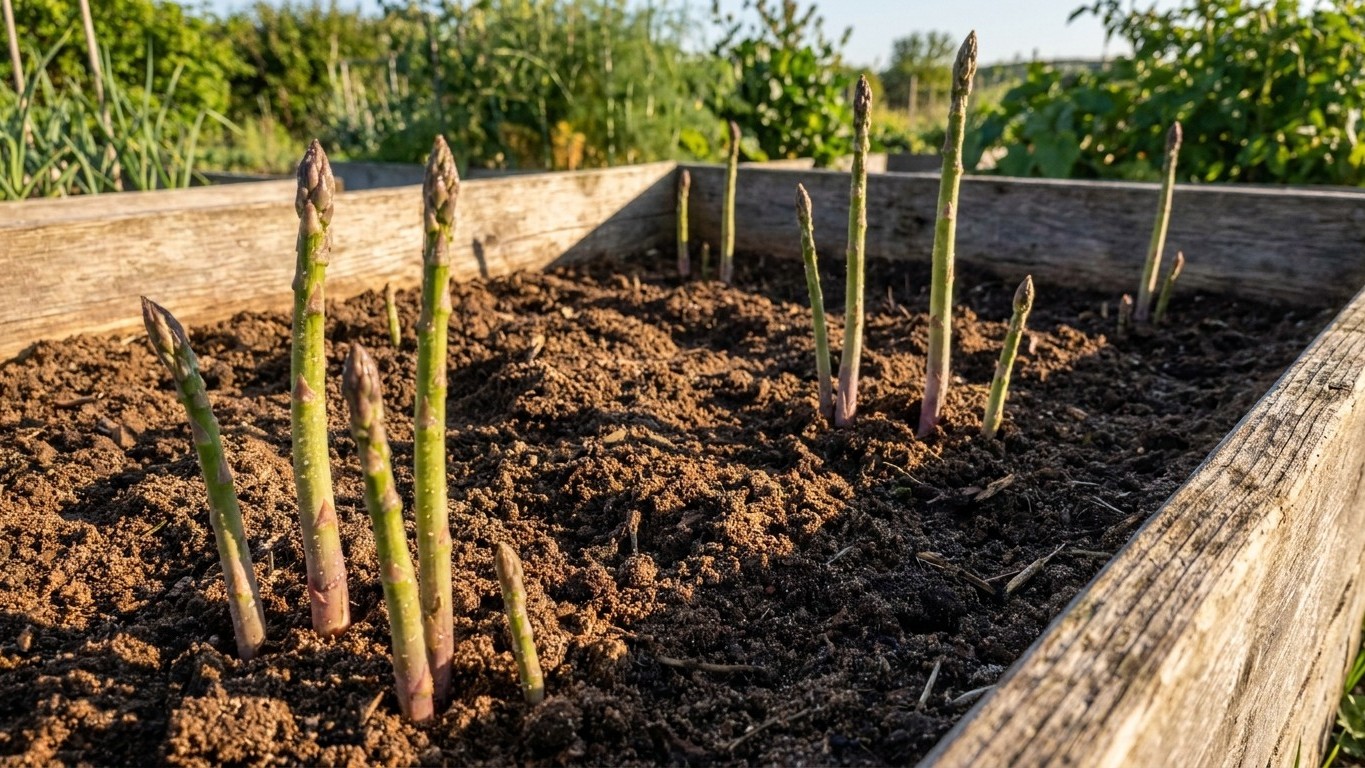

Ten to fifteen years. That’s how long a single asparagus bed stays productive once it’s established, and the only soil condition the University Extension source attaches to that promise is drainage. South Carolina’s representative soil, the Bohicket series, is heavy clay and officially rated very poorly drained, so the short answer is: it depends entirely on which patch of ground you’re standing on, not on the state as a whole.
The short answer
The Bohicket series is what the USDA lists as representative of South Carolina soil, and on paper it’s a tough match for a fifteen-year asparagus commitment. Surface samples run 17 percent sand, 35 percent clay, and 48 percent silt, with organic matter around 15.0 percent and a surface pH near 7.3, close to neutral. The drainage class is the number that matters most here: very poorly drained. Asparagus crowns rot in standing water, and a bed that can’t shed excess moisture through a normal wet spell isn’t going to make it to year three, let alone year fifteen.
But the Bohicket series is a snapshot of one mapped soil, not a verdict on every yard in the state. It’s an Entisol, meaning it’s geologically young with almost no developed profile, the kind of soil you find in low-lying, marsh-adjacent, or frequently saturated ground. Plenty of South Carolina gardens sit on sandier, better-drained ground entirely unrelated to this series, particularly anywhere land has been graded, filled, or built up above the natural water table. The state soil tells you what the region tends toward; it doesn’t tell you what’s under your own raised bed or backyard plot.
The practical move is simple: dig a hole about a foot deep, fill it with water, and time how long it takes to drain. If it’s gone within a few hours, you’re fine. If water is still sitting there the next morning, that ground behaves like the Bohicket series, and asparagus is the wrong long-term tenant for it as-is. The fix isn’t abandoning the idea, it’s raising the bed. A mounded or framed raised bed, built up 10 to 12 inches with amended soil, sidesteps a heavy, slow-draining subsoil without needing to change the native ground at all. That’s a one-time construction cost against a fifteen-year payoff.
Variety selection is a separate question from drainage, and it’s worth being honest about how thin the published guidance is. The Utah State University Extension source names four varieties and gives only their sex: Jersey Giant and Jersey Knight are all-male, while UC 157 F1 and Purple Passion are male and female. No flavor comparison, no yield figures, no stated reason to prefer one over another appears in that source.
| Variety | Sex type |
|---|---|
| Jersey Giant | All-male |
| Jersey Knight | All-male |
| UC 157 F1 | Male/female |
| Purple Passion | Male/female |
All-male varieties are generally chosen because they don’t spend energy producing seed, but that reasoning isn’t part of the sourced facts here, so treat it as background context rather than an endorsement.
Will the summer here water it for you?
An established asparagus bed wants 1 to 2 inches of water every other week for its first two years, then eases to about the same amount every three weeks once it’s mature. South Carolina’s summer rainfall, measured at reference station USW00013880 over the 1991-2020 normals period, averages 19.8 inches across June, July, and August combined. Broken down, June brings 6.21 inches, July 6.6 inches, and August 6.97 inches. On the surface that looks like more than enough. Whether it actually is depends on how that rain arrives and what soil it’s landing on.
- Convert the target to a biweekly number. A young bed needing 1-2 inches every other week works out to roughly 2-4 inches a month. South Carolina’s summer months each clear that on paper, June’s 6.21 inches alone is above the top of that range.
- Check how the rain falls, not just how much. Summer rainfall in this region tends to arrive as thunderstorms, meaning a large share of a month’s total can land in one or two heavy bursts rather than spread evenly. A bed can go ten dry days between storms even in a “wet” month on paper.
- Weigh in the soil. On heavy, slow-draining clay like the Bohicket series, a single storm can carry a bed for two weeks by holding moisture in the root zone. On sandier, well-drained soil, that same storm passes through within a day or two, and the bed is back to needing supplemental water well before the next one arrives.
- Watch the driest stretch. June, the lowest of the three summer months at 6.21 inches, is also when new crowns are settling in for their first full growing season. That’s the month to keep the closest eye on soil moisture rather than assume the season average will cover it.
- Put a rain gauge on the actual bed. Regional normals describe what a wide area can expect over three decades, not what falls on one plot in one season. A five-dollar gauge next to the bed answers the question more reliably than any state figure can.
The honest takeaway is that South Carolina summers generally deliver enough total rainfall to meet asparagus’s needs, but the gaps between storms, plus how fast the local soil lets water through, mean most gardeners should still expect to run a hose during dry stretches rather than rely on the sky alone.
When to put the crowns in
Crowns go into the ground in early spring, planted about 8 inches deep in furrows. in South Carolina, that window sits around the last spring frost date, which for reference station USW00013880 falls somewhere between February 28 and March 17 based on 1991-2020 freeze-probability normals. That’s a range, not a single day, and it’s worth remembering it’s a mean drawn from three decades of data, so treat it as a planting guide rather than a guarantee that frost won’t show up later in a given year. Coastal areas of the state, including peninsular Charleston, tend to run milder than this airport-based reading, while the Upstate runs several weeks tighter on both ends of the frost calendar.
The furrow itself doesn’t get filled in all at once. As the crowns send up shoots, soil is backfilled gradually over the course of the year, about 2 inches added every other month, rather than burying the crown fully at planting time. That gradual approach lets the developing root system establish before it’s under a full 8 inches of soil, and it’s part of why the planting process stretches across a full growing season rather than wrapping up in an afternoon.
Seed is the alternative route to crowns, and it exists in the source material as a legitimate option, though it adds time before the plant reaches the same maturity a purchased crown starts with. Whichever route is chosen, the harvest clock doesn’t start moving for a long while: no spears are cut at all in year one or two. Year three brings the first harvest, and even then it’s limited, about 4 weeks of cutting. That extends to roughly 6 weeks the following year, and about 8 weeks once the bed is fully mature. The rule for when to stop cutting each season isn’t a date on a calendar, it’s a visual signal: once most of the spears coming up are thinner than a pencil, harvest ends for the year, no matter what week it happens to be.
Common questions
Does South Carolina’s soil pH work for asparagus?
The Bohicket series reads at a surface pH near 7.3, close to neutral, but the Utah State University Extension source is silent on any preferred pH for asparagus. That figure describes the state’s representative soil, not a target range for the crop, so a soil test on your own bed is the only way to answer that question for your ground.
How many years until an Asparagus Bed pays off the wait?
No spears are harvested in years one and two at all. Year three brings the first cutting, limited to about 4 weeks, followed by roughly 6 weeks in year four and about 8 weeks once the bed matures, a stretch that then continues for 10 to 15 years total.
Do I need to worry about winter chilling hours in South Carolina?
That figure isn’t published in the source material used here. The only stated soil requirement for asparagus is drainage, and no chilling-hour threshold is given, so it shouldn’t be assumed or estimated from the state’s hardiness zone.
What if my soil test comes back close to the Bohicket series numbers?
A very poorly drained, heavy clay result is a signal to build up rather than plant directly into the native ground. A raised or mounded bed, built 10 to 12 inches above grade with amended soil, keeps the crowns out of standing water without requiring you to rework the subsoil underneath.