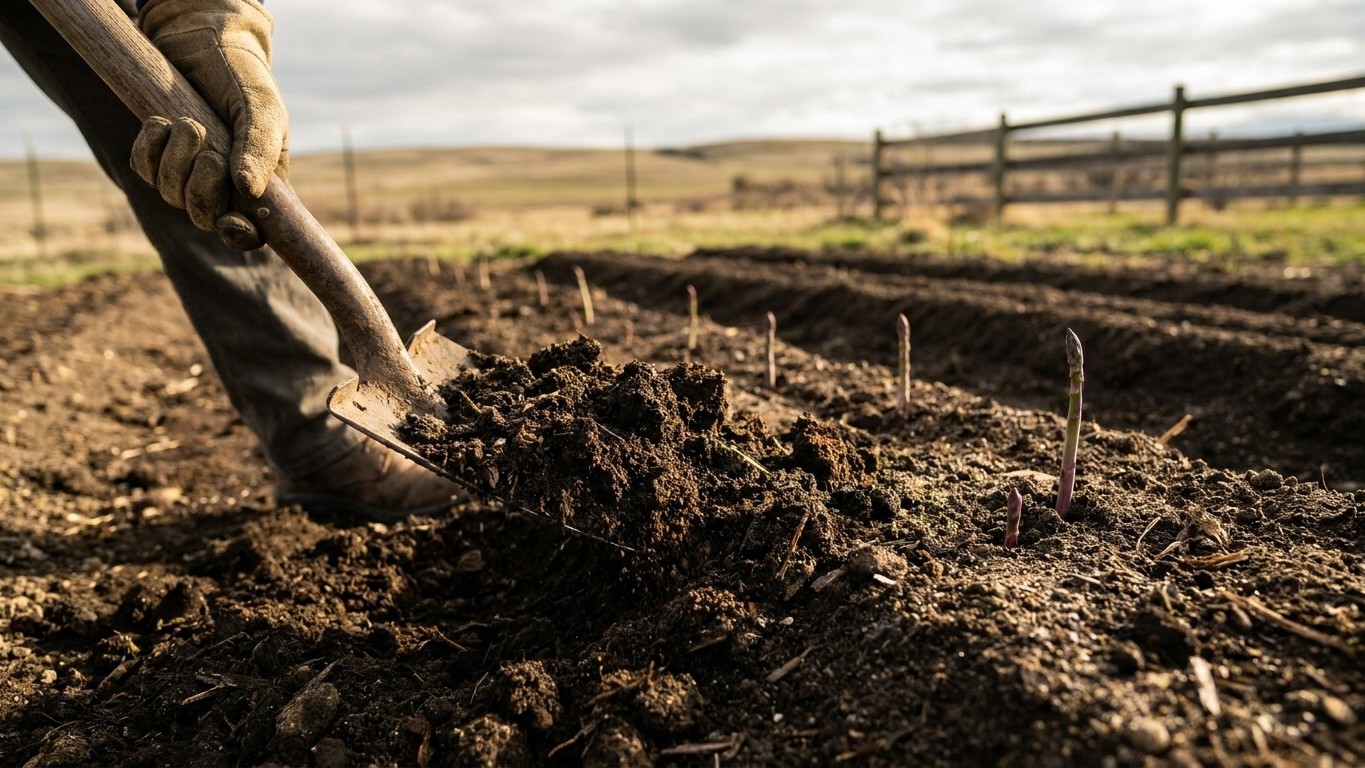

South Carolina’s asparagus answer is a qualified yes. A bed here runs 10 to 15 years once it starts bearing, and the ground you choose has to drain, full stop. The soil used to represent this state on paper is heavy, wet clay with almost no natural drainage, which is exactly the wrong starting point for a crop you will not move for a decade and a half. The fix isn’t complicated: raise the bed, or amend it heavily, before the first crown goes in.
The short answer
The soil USDA lists as representative of South Carolina is the Bohicket series, an Entisol, meaning a very young soil with almost no profile development. Its surface runs about pH 7.3, close to neutral, and it carries 17 percent sand, 35 percent clay and 48 percent silt, with organic matter around 15.0 percent. USDA NRCS Soil Data Access classes it as very poorly drained. That figure comes from the surface horizon of the series’ major components, queried August 29, 2026, and it describes a mapped soil type, not a soil test result from a worked garden bed.
Set that beside what Utah State University Extension says about the crop itself: When to Plant Asparagus Crowns in South Carolina, they go in as crowns, set into 8-inch furrows, in early spring. Nothing gets harvested the first two years. Year three is the first cut, and from there the bed keeps producing for 10 to 15 years. The source’s only real demand on the ground is that it drains. Most soils will do, the extension notes, provided that one condition holds.
A very poorly drained soil does not hold. That’s the whole tension in growing this crop in a state whose representative soil series carries that exact label, and it’s the question at the heart of Will South Carolina Soil Hold an Asparagus Bed for Fifteen Years? A crown sitting in standing water rots before it ever produces a spear, and unlike a tomato bed you can till and rework next season, an asparagus row is a decision you live with for well over a decade. If a heavy soil is merely a nuisance for an annual crop, amended every year and forgiven every fall, it’s a disqualifying condition here unless it’s corrected before planting, not after.
None of this means every yard in South Carolina drains poorly. The Bohicket series is what USDA names as representative of the state as a whole, not a diagnosis of any one garden. Coastal plain sands, Piedmont clay loams and fill dirt around a newer house all behave differently, sometimes completely differently, from the mapped series. The practical move is a soil test and a simple drainage check: dig a hole about a foot deep, fill it with water, and see how long it sits. If it’s still standing after several hours, plan on a raised bed 10 to 12 inches high, or mounded rows, rather than planting straight into native ground.
On variety, the published record is thin. Utah State University Extension names four varieties by sex alone, nothing more:
| Variety | Sex |
|---|---|
| Jersey Giant | All-male |
| Jersey Knight | All-male |
| UC 157 F1 | Male/female |
| Purple Passion | Male/female |
No flavor comparison, no yield figures and no stated reason to prefer one over another appear in that source, so none get invented here.
Will the summer here water it for you?
The extension’s watering guidance is specific: 1 to 2 inches every other week for the first two years after planting, then every three weeks once the bed is established. South Carolina’s summer rainfall, drawn from NOAA NCEI’s 1991-2020 climate normals at station USW00013880, runs about 19.8 inches across June, July and August combined, with June the driest month at 6.21 inches, July at 6.6 inches and August at 6.97 inches.
- Young bed, first two years: the target is roughly 1 to 2 inches every other week. Spread evenly, June’s 6.21 inches over four weeks works out to a bit over 1.5 inches a week, which sounds close on paper.
- The catch is distribution, not total: summer rain in this region tends to arrive as thunderstorms rather than steady soaking rain. A two-inch downpour that runs off a compacted or clay surface in an hour does far less for root moisture than the same two inches spread over two days.
- Established bed, year three on: the requirement drops to 1 to 2 inches every three weeks, a lighter demand that summer rainfall here generally covers on its own in a wetter month like August.
- What actually decides it: heat drives evaporation faster on days at or above 90F, which are common across a South Carolina summer, and a clay-heavy bed holds surface water differently than a sandy one even when the same rain falls on both. A rain gauge on the actual bed, checked every week or two, tells a gardener more than any regional average.
None of these normals are a forecast, and none of them are a substitute for watching the bed itself. A rain shadow behind a tree line, a slope that sheds water fast, or a low spot that holds it too long can all push an individual garden well off these figures.
When to put the crowns in
Utah State University Extension is direct on timing: crowns go into their 8-inch furrows in early spring. In South Carolina, that window sits against a last spring frost that falls, on average, somewhere around February 28 to March 17, based on the 32F freeze-probability normals at station USW00013880 for 1991-2020. That’s a mean, not a guarantee, so treat it as the center of a range rather than a fixed date to circle on a calendar.
The station itself matters here. Peninsular Charleston tends to run milder than the airport reference station the normals are drawn from, while the Upstate runs several weeks tighter at both ends of the season. A gardener in the Upstate working off the coastal date, or the reverse, risks planting crowns into ground that’s still hard with frost, or waiting so long the plants lose the head start early spring gives them.
Once the crowns are in the furrow, the extension’s method is gradual, not a single afternoon’s work. Backfill about two inches of soil every other month across the year, rather than filling the trench in one pass. That staged backfilling protects the young crown while it establishes and lets the emerging shoots push through loose soil rather than fighting a deep, compacted furrow all at once.
Starting from seed is the alternative route the source lays out, though it’s the slower one. Seed-started plants need an extra year of growing before they’re ready to go into the ground the way a purchased crown already is, and the source doesn’t publish specific germination or transplant dates for that path. Most home gardeners choosing the seed route are trading a year of patience for a lower upfront cost, and either way, the same two-year wait before harvest and the same three-year mark for the first cut still apply once the plants are established.
One thing worth flagging clearly: nothing in the source material addresses a winter chilling requirement, and nothing addresses soil pH tolerance for the crop. A hardiness zone number is not a stand-in for a chilling figure, and none gets manufactured here. If that detail matters for a specific planting plan, it’s a question for a local expert, not a number this article can supply.
Checking this against your own county
Everything above describes a state-level pattern: one representative soil series, one set of regional rainfall normals, one frost-date range built from a single reference station. None of it substitutes for what’s actually happening in a specific yard. South Carolina’s soils range from sandy coastal plain ground to heavy Piedmont clay, and a builder’s fill dirt can behave like neither.
Clemson University’s Cooperative Extension Service is the land-grant resource built for exactly this gap, county by county, with agents who can walk through a soil test result, confirm local frost timing, and flag whether a particular spot drains well enough for a bed meant to sit undisturbed for over a decade. Their programs are listed at clemson.edu/extension. A quick soil test through that office, run before any crown goes in the ground, settles the drainage question with actual numbers from an actual property rather than a statewide average.
Common questions
How long until asparagus can be harvested in South Carolina?
No harvest happens in the first two years after planting, regardless of location. Year three brings the first cut, typically limited to about four weeks, extending to six weeks and then eight weeks in following seasons as the crowns mature, per Utah State University Extension.
How do I know when to stop cutting each spring?
The rule is a condition, not a date on the calendar: stop harvesting once most of the spears coming up are thinner than a pencil. That signals the crown’s energy reserves are running low and the plant needs to grow foliage rather than be cut.
What if my yard has heavy, slow-draining soil?
Test the drainage before planting rather than after. If water sits in a test hole for hours, a raised bed 10 to 12 inches high or mounded rows solve the problem at the start, which matters far more here than with an annual crop, since this bed isn’t getting reworked next season.
Does variety choice matter much in South Carolina?
The published record from Utah State University Extension names four varieties by sex only, all-male Jersey Giant and Jersey Knight, and male/female UC 157 F1 and Purple Passion, without flavor or yield comparisons. A Clemson Extension agent is the right source for any variety recommendation specific to a county.