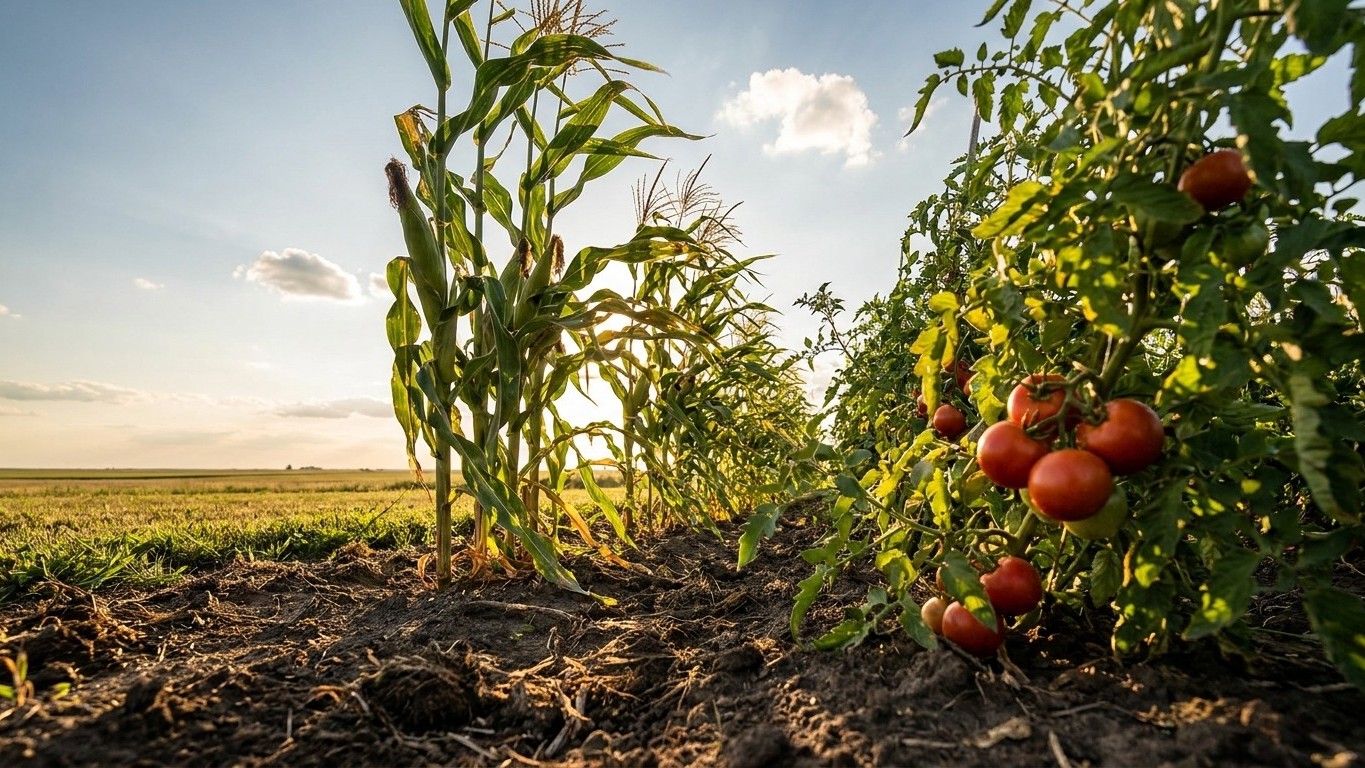

Sweet corn in North Dakota is ready when the silks have dried brown and a punctured kernel runs milky. Picking day is as sweet as the ear will ever be: sugar starts leaving the kernel at once, and warmth speeds the loss. Below are the timing, the shelf life, and the spot in your house that slows the fade.
When sweet corn are ready in North Dakota
Check the ear before the calendar: dry brown silks, a husk that is still moist and green, and milky juice when you puncture a kernel, all three together. The window for that runs roughly mid-August to mid-September for corn sown once the soil has warmed, and the count that gets you there is 17 to 24 days after the silks first appear.
That silk count answers a different question than the 60 to 90 days from planting that Utah State University Extension gives for sweet corn. The planting clock tells you whether a variety fits the season at all. The silk clock tells you which week to pick. Adding them together gives you nothing useful.
What do the silks, husk and kernel tell you together?
Each sign misleads when read alone. Silks can brown early in a dry spell, and a husk can look fine while the kernels underneath are still watery. Clear juice usually means the ear needs a few more days, while a thick, pasty kernel means you waited too long. When all three agree, pick.
Does sweet corn fit the North Dakota growing season?
At the Fargo reference station, NOAA’s NCEI U.S. Climate Normals put the last spring frost at May 4 to May 15, and the first fall frost at September 25 to October 5. Those dates mark where a 32 F freeze sits between 30 and 70 percent likely (NOAA station data). The station’s frost-free stretch runs from that May window to that late-September window. Suburban and rural gardens typically see the last spring frost one to two weeks later and the first fall frost one to two weeks earlier, and more so at elevation, so check your own county with the extension office.
Corn does not go in on the last frost date. Utah State University Extension says the soil should be above 60 F, and that happens well after the final frost. Clemson Cooperative Extension adds the depth and a second threshold: “Do not plant before the soil temperature at the 4-inch depth is at least 50 ºF. Wait to plant extra-sweet varieties until soil temperatures reach 65 °F.” A reading at the surface runs warmer than the 4-inch depth and would send you out too early. Timing details for sowing are in When to Sow Sweet Corn in North Dakota.
Once the soil is warm, 60 to 90 days still have to fit before the first fall frost. A variety on the long end of that range leaves little cushion if your garden loses a week or two at each end of the season. Summer heat is rarely the problem here, since only 11.7 days a year reach 90 F or more at the reference station.
What decides whether the ears turn out sweet?
Sweetness depends on what tassels nearby. Utah State University Extension warns that sweetness is lost when su, se and sh2 types tassel at the same time. It also says to plant in blocks of three or more rows, so pollen lands where it should. The workable plan is to grow one type, or to stagger plantings so different types are not shedding pollen in the same week. Separate the plantings by timing, and give each its own block.
Keeping them, and for how long
The old advice about running from the garden to the pot has a mechanism behind it. Clemson Cooperative Extension’s sweet corn fact sheet puts it this way: “Sweet corn loses sugar from the kernel rapidly at high temperatures… Sweet corn can be stored under optimal conditions for about five days, but will lose sweetness with each day of storage.”
Read that as a ceiling. About five days applies when everything goes right, and a warm car ride, a sunny porch or a hot kitchen counter uses some of it up. The same sentence says sweetness slips with every day, so an ear eaten on day one beats the same ear on day four, even if both are still perfectly edible.
Heat is the accelerator. North Dakota summers have few scorching days (about 11.7 a year reach 90 F or more at the reference station), but an ear picked on one of them and left in the sun gives up its sugar faster than the same ear picked on a mild afternoon. The cooler the ear gets after picking, the more of the sugar it keeps.
Does the type of sweet corn change how long it keeps?
It does, and it is the practical reason to choose one type over another. Type su loses sugar fastest, se holds it longer, and sh2 holds it longest. If you tend to pick a big batch and cannot eat or freeze it the same day, se or sh2 gives you a wider margin.
Sh2 has a catch at planting. Clemson’s guidance says to wait for 65 °F soil at the 4-inch depth for extra-sweet varieties, while ordinary sweet corn only needs 50 ºF. A supersweet seed sown at 50 F tends to rot instead of sprouting. That is why a gardener can do well one year and fail the next after switching varieties without changing anything else.
Is it better to leave ripe ears on the stalk?
Waiting on the stalk is a gamble of its own, since ripe ears draw animals as well as people. What eats corn and when is covered in What Eats Corn in North Dakota, and When. A reasonable habit is to pick what you will eat within a day or two and check the rest every day or so against the three ripeness signs.
Where in the house that actually is
The refrigerator comes closest. A domestic fridge runs colder than some crops tolerate (tomatoes and basil sulk in it), but sweet corn’s enemy is warmth, so cold is the goal here. A heated room is too warm, and that includes the kitchen counter and a sunroom. A garage is the unpredictable one. On a September afternoon it can run warm, and on a night near the frost dates it can drop low, and corn left there gets whatever the weather hands it that day.
What should you check with a thermometer?
Fridges are not uniform. The door runs warmest, and shelves near the back or the cooling vent run colder, sometimes cold enough to freeze the outer leaves of produce. A closed crisper drawer usually holds moisture better than an open shelf, which matters for husks that should stay moist and green.
Put a thermometer where the corn will sit and leave it a full day and night before harvest. Skipping it means guessing, and a shelf that runs a few degrees warmer than you assumed spends your five days faster. If the fridge is full of other food, clear one shelf or pick only as many ears as fit.
For a garage, basement or cold room, do the same check but read it at two times, late afternoon and early morning, and note the high and the low. A spot that stays steady through the day beats one that averages out well but swings widely. For the growing side of the story, start with Growing Sweet Corn in North Dakota.
Common questions
How do I tell sweet corn is ripe without stripping the ear?
Look at the silks first: they should be dry and brown. Squeeze the husk, which should still feel moist and green. Then pull back a small strip at the tip and puncture a kernel with a fingernail. Milky juice, with all three signs agreeing, means pick it.
How many days after silking is sweet corn ready?
Watch the silks and count the days from planting. That count is separate from the 60 to 90 days from planting, which tells you whether the variety fits before the first fall frost. Mark the silk date on a calendar or a plant tag so you know which week to start checking.
Which sweet corn type keeps its sweetness longest?
Type sh2 holds sugar longest, se holds it longer than su, and su loses it fastest. Even the best of the three loses sweetness with every day of storage, so the five-day ceiling from Clemson still applies. Sh2 also needs warmer soil, 65 °F at the 4-inch depth, before planting.
Can I grow different sweet corn types in the same garden?
Yes, if they do not tassel together. Utah State University Extension says sweetness is lost when su, se and sh2 types tassel at the same time. Plant each type in its own block of three or more rows, and stagger the sowings so their tassels shed pollen in different weeks.