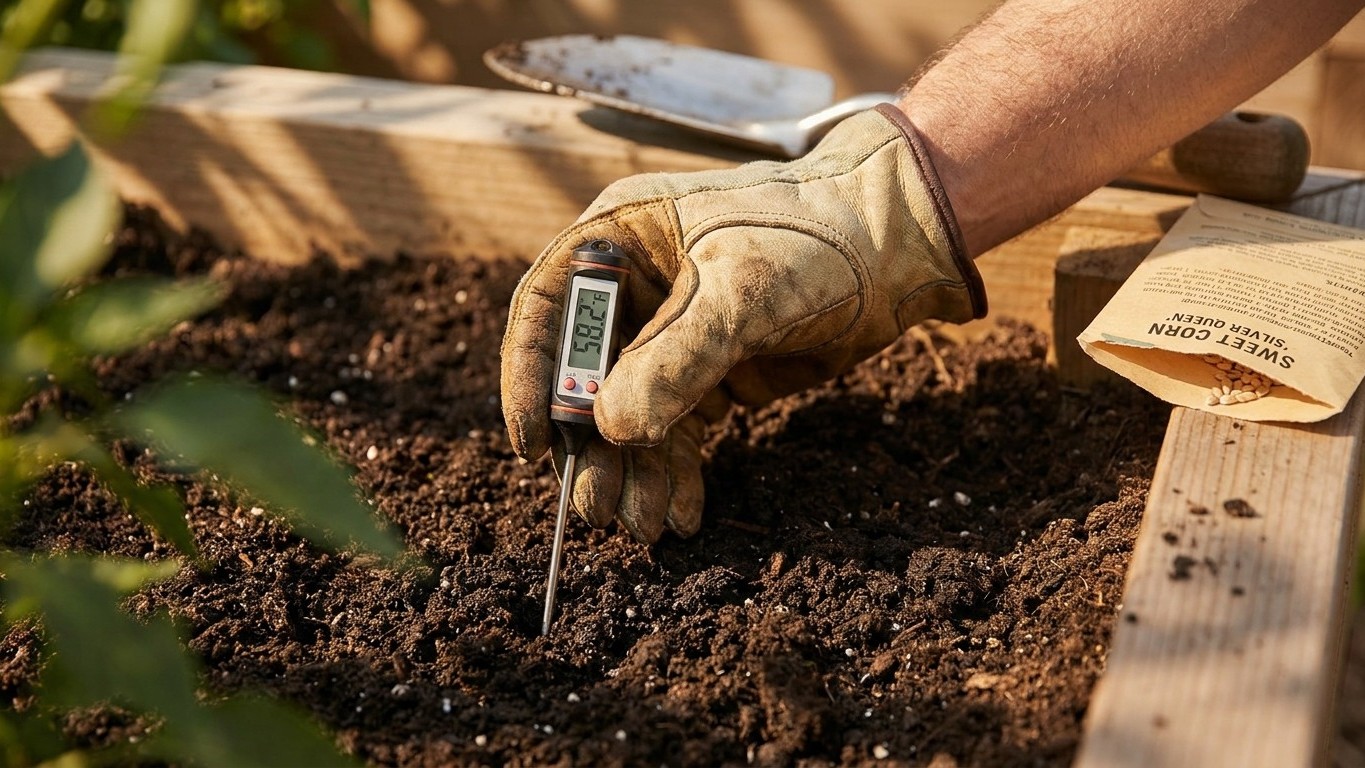

Sweet corn in North Dakota goes into the ground later than most gardeners expect. The soil needs to sit above 60°F before seed will germinate reliably, and that mark is reached well after the last spring frost, typically stretching from late May into the first week of June depending on the season. From there, a 60- to 90-day variety needs to fit before the first fall frost, which arrives between September 25 and October 5 at the reference station.
The short answer
The last spring frost at the reference weather station falls somewhere between May 4 and May 15. That date matters, but it isn’t the number to plant by. Sweet corn seed needs soil warmed to 60°F to germinate without rotting in the ground, and soil doesn’t hit that mark the same week the frost risk clears. In this part of the state, the soil typically needs another two to three weeks of sun after the last frost before it crosses that threshold, which pushes realistic sowing into late May for most years and into the first week of June in a cool, wet spring.
That’s the piece that trips people up. A gardener who plants the weekend after the last frost date, treating May 4 or May 15 as the green light, is very likely planting into soil still in the 40s or low 50s. The seed sits there, doesn’t germinate, and often rots before the ground ever warms enough to sprout it. The frost date tells you when the cold air is gone. It says nothing about the soil.
Once the soil clock actually starts, the math on the growing season gets more forgiving. First fall frost lands between September 25 and October 5. Counting from an early June planting, that leaves roughly 115 to 125 days before the season closes out. A 60-day variety needs less than half that window, so it has enormous room to spare. A 90-day variety uses most of it, but even in a year where the soil takes until early June to warm, a 90-day type maturing by early September still lands three to four weeks ahead of the earliest fall frost date.
Summer heat is part of the picture too. The reference station averages 11.7 days a year at 90°F or higher, which is a moderate but real heat load. That’s not an obstacle to sweet corn, which actually appreciates warm days once it’s established, but it does mean water demand climbs through July and August. Corn that’s short on moisture during tasseling and ear fill won’t fill out kernels evenly, regardless of how well the planting date was timed.
So the short answer: wait for soil, not just air, to clear 60°F, expect that to land in late May to early June most years, and know that both a 60-day and a 90-day variety have a real shot at finishing before the first fall frost, though the margin isn’t the same for both.
Does a late variety fit here?
“Fits” depends entirely on which end of the maturity range a variety sits at, since the difference between a 60-day and a 90-day type changes the amount of buffer left before frost.
A 60-day variety
A 60-day sweet corn planted once soil clears 60°F, call it a realistic early-June start in a slow spring, matures by early August. That leaves a comfortable seven to nine weeks before the earliest fall frost date of September 25. Even accounting for a cool stretch that slows growth, or a planting delayed a week or two waiting for soil to warm properly, a 60-day variety has enough runway that frost risk is rarely the limiting factor here. This is the safer choice for anyone who wants minimal risk or who gardens on a site that tends to run cool, low-lying ground, or a spot that historically lags a week or two behind the surrounding area.
A 90-day variety
A 90-day variety planted at the same early-June point matures around the start of September, which is still ahead of the earliest fall frost date of September 25. On paper, it fits. In practice, the margin is thin. If soil warming runs late, if a stretch of cool weather slows the crop mid-season, or if the garden sits in a low spot where frost tends to settle first, a 90-day variety can end up finishing right at the edge of the frost window rather than comfortably ahead of it. This is the one to plant early and watch closely rather than set and forget, and it makes sense to have a plan for row cover if a cool September night is forecast before the ears are fully filled. In a warm year with an early, prompt soil warm-up, it works fine. In a slow, wet spring, it’s the variety most likely to come up short.
What goes wrong here
- Seed planted while soil is still cold. This is the most common failure tied directly to this region’s climate. Gardeners plant by the calendar or by the last frost date rather than by soil temperature, and the seed sits in ground still in the 40s or low 50s. It either rots before sprouting or comes up thin and uneven. The remedy is simple: check soil temperature directly rather than counting days from the frost date, and hold off until it’s reliably above 60°F, not just touching it on a warm afternoon.
- A variety too late for the available season. A 90-day type planted late, whether because of a slow spring or a delayed decision to plant, can run out of runway before the first fall frost arrives. The fix is to plant late-season varieties as early as soil conditions allow, and to lean toward a 60-day type on any site that tends to warm slowly or sits in a frost-prone low spot.
- Sweetness lost to nearby tasseling, nothing to do with weather. Standard (su), sugary-enhanced (se), and supersweet (sh2) types cross-pollinate if they tassel at the same time, and the result is starchy, tough kernels instead of sweet ones, even though the plants themselves grew perfectly well. This has nothing to do with frost or soil temperature; it’s purely a matter of timing between varieties. The fix is to stagger planting dates so different types don’t tassel in the same window, or to grow only one type in a given season, and to keep corn planted in blocks of three or more rows rather than single rows, since that shape is what allows reliable pollination within a variety in the first place.
Common questions
Can I plant sweet corn right after the last frost date?
Not reliably. The last frost date, May 4 to May 15 at the reference station, marks when cold air risk drops, not when soil is warm enough. Soil generally needs another few weeks of sun before it clears the 60°F mark sweet corn seed needs to germinate.
How do I know when soil has actually reached 60°F?
A soil thermometer pushed a few inches into the planting bed, checked in the morning over a few consecutive days, is the direct way to know. Waiting for a calendar date instead of checking the ground is exactly what leads to rotted seed in a cold spring.
Will a 90-day variety always mature before frost here?
Usually, but the margin is tight. Planted as soon as soil allows, a 90-day type typically matures in early September, ahead of the earliest fall frost date of September 25. A slow spring, a cool summer stretch, or a low-lying garden spot can erode that buffer, so it’s worth planting early and keeping an eye on the forecast as the season closes.
Why did my sweet corn turn out starchy instead of sweet?
The most likely cause is cross-pollination between different sweet corn types, standard, sugary-enhanced, or supersweet, tasseling at the same time nearby. That mixing ruins sweetness even when growing conditions were otherwise good. Staggering planting dates between types, or growing just one type per season, avoids the problem.