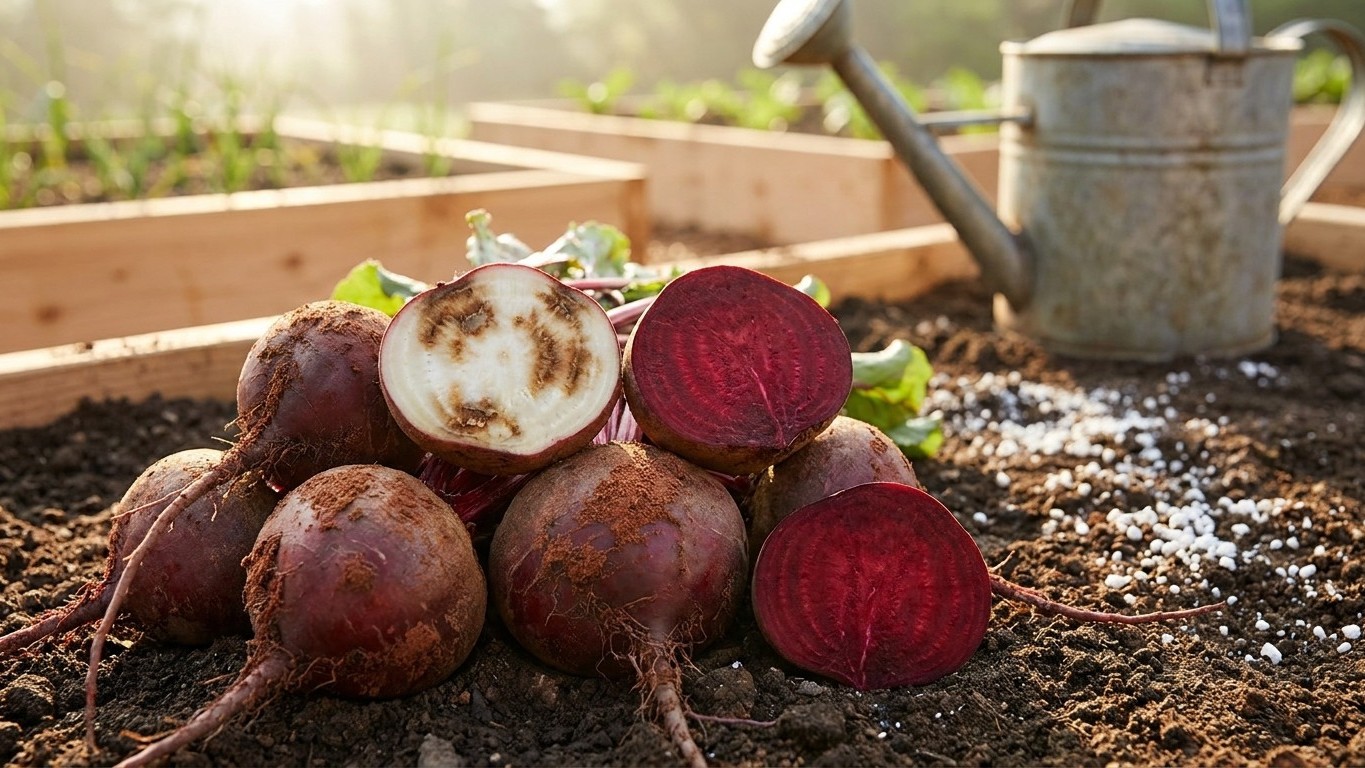

Pull beets 60 to 80 days after seeding, counted from the day the seed went into the ground. Beets are sown in place, so there is no transplant date to count from. Roots meant for winter need more care than the calendar does. Top them, pick the big ones, and hold them at 33 to 36 F with very high humidity. Colder is not better. USDA’s storage handbook says 32 to 34 F brings more black spot and rot than a few degrees warmer.
The short answer
What the Williams series offers a beet
USDA lists the Williams series as North Dakota’s representative soil. It is a Mollisol, the deep, dark prairie ground of the family that built the Corn Belt. The records for its surface horizon (USDA NRCS Soil Data Access, major components of the series as mapped) show a loam to silt texture: 38 percent sand, 22 percent clay and 40 percent silt. Organic matter runs about 4.0 percent, surface pH is about 7.2 (near neutral), and the drainage class is well drained.
Set that beside what Utah State University Extension says beets want. Their guide calls for deep, sandy, well-drained soil rich in organic matter, amended with no more than 1 inch of composted organic matter per 100 sq ft. Drainage is a match. Depth and organic matter are what a Mollisol is known for. Texture is where the two part ways. With 38 percent sand and 40 percent silt, this ground is not sandy, and it tends to hold more water than a sandy bed does. That cushions a dry week, though a silty surface can seal after a hard rain.
A state spans hundreds of soil series, and this is a starting point, not a diagnosis. River bottoms, hill country and any lot a builder has scraped or filled can look nothing like it. These figures are representative values for the mapped surface layer, not a measurement of a worked garden bed, and the 7.2 is not your pH. A soil test gives you your own number, and Beet Soil in North Dakota: What the Root Will Meet walks through what to do with it.
Heat and the woody root
Woodiness is a later failure, and it has its own trigger. Utah State University Extension says heat above 85 F combined with water stress makes the root woody. How many days a year the reference city passes 90 F is not published here, so I won’t offer a count. The 85 F line sits lower than 90 anyway, and an 85 F afternoon is nothing exotic in a North Dakota summer. A beet sitting in warm, dry ground in July is the one at risk.
Early thirst and later heat do different damage, and watering “more” does not cover both. One failure hits the young plant, which sends up a flower stalk. The other hits the maturing root, which turns tough. The next section deals with the first. For the full growing picture, see Growing Beets in North Dakota.
The six weeks that decide it here
Counting from the last frost
The NOAA NCEI U.S. Climate Normals put the last spring freeze (the 32 F probabilities in the 30 to 70 percent band) at May 4 to May 15. That is the reference city’s airport station, not a state-wide guarantee. Suburban and rural gardens typically see the last spring frost later, often by one to two weeks, and more at elevation. Check your own county before you trust the dates.
Sowing two to three weeks ahead of that window means seed goes in from about April 13 to May 1. That is my arithmetic on the station’s dates, and your county’s dates will shift it. Six weeks after those sowings takes you to late May and mid-June. Counting 60 to 80 days from seeding, the first roots from those sowings come due from mid-June to the third week of July.
Where the bolting risk sits
Spring on the Northern Plains swings. Cold snaps give way to warm, windy days, and snowmelt can leave the topsoil wet one week and dry the next. Beet seedlings have shallow roots, so a dry, windy stretch in May or early June hits them first. Utah State University Extension names water stress in the first six weeks as the cause of premature flowering, and that window is where bolting risk sits in this state.
An early sowing is not wrong, but it ties the beets to the weather. A bed sown in mid-April that then meets a dry May is the classic setup. The Williams-type loam helps some, since it holds more reserve than sand. The top inch still dries out, and that inch is where the seedlings live. Water by what the soil is doing, not by the calendar.
What goes wrong here
The soil and the climate cause most of the trouble, and storage causes the rest. For the leaf-chewers that arrive on top of these problems, see What Eats Beet in North Dakota, and When.
In the bed
- Bolting after a dry early spell. Water stress in the first six weeks sends the plant to flower. Keep the seedbed evenly moist from sowing through week six, and mulch lightly once seedlings are up.
- Woody roots after hot, dry weather. Heat above 85 F with water stress toughens the root. Water through hot spells instead of letting the bed dry out, and pull on the earlier side of the 60 to 80 days from seeding.
- A crusted surface after hard rain. Silt-rich loam can seal over and slow emergence. A thin cover of fine compost helps, and so does keeping the bed damp until seedlings break through.
- Piling on compost because the bed looks poor. Beets like organic matter, but the guidance caps amendment at 1 inch of composted material per 100 sq ft. Test first, then stay under that ceiling.
In the cellar
- Chilling topped roots to 32 to 34 F. USDA’s Agricultural Handbook 66 reports more black spot and rot there than at slightly higher temperatures. Aim for 33 to 36 F at 98 percent humidity, and pass on the coldest spot you can find (source).
- Storing with the leaves on. Bunched beets keep only about 10 to 14 days at 32 F and above 98 percent humidity. Top them first if you want them to last longer.
- Saving the small roots. Large roots keep much better because they lose water and shrivel more slowly. Eat the small ones first and store the big ones.
- Letting a pit or cellar drift. The handbook says temperatures in pits and cellars should not drop below 31 F or exceed 41 F. Those are outer limits, and 33 to 36 F is the target inside them, so keep a thermometer in there.
Common questions
How many days from seeding until beets are ready?
Plan on 60 to 80 days from seeding. Beets are sown where they will grow, so the clock starts when the seed goes into the soil, not at any transplant date. Heat and thirst can change how the root turns out, so check size and watch the weather.
Can I store beets with the greens on?
Only briefly. Bunched beets with leaves keep for about 10 to 14 days at 32 F and above 98 percent humidity, and no longer. For longer storage, top them first. Topped roots belong at 33 to 36 F and 98 percent humidity.
Why not the coldest setting I have?
Because it works against you. USDA’s handbook says storage at 32 to 34 F produces more black spot and rot than slightly warmer conditions. Most root crops tolerate cold well, but beets do better at 33 to 36 F. Keep the large roots for storage, since small ones shrivel faster.
Is my garden soil the Williams series?
Probably not exactly. Williams is the series USDA lists as representative of North Dakota, but the state spans hundreds of series. The 7.2 pH and 4.0 percent organic matter describe the mapped surface of that series, not your bed. A soil test gives your own pH and organic matter, and your county’s frost dates will tell you more than the airport’s May 4 to May 15.