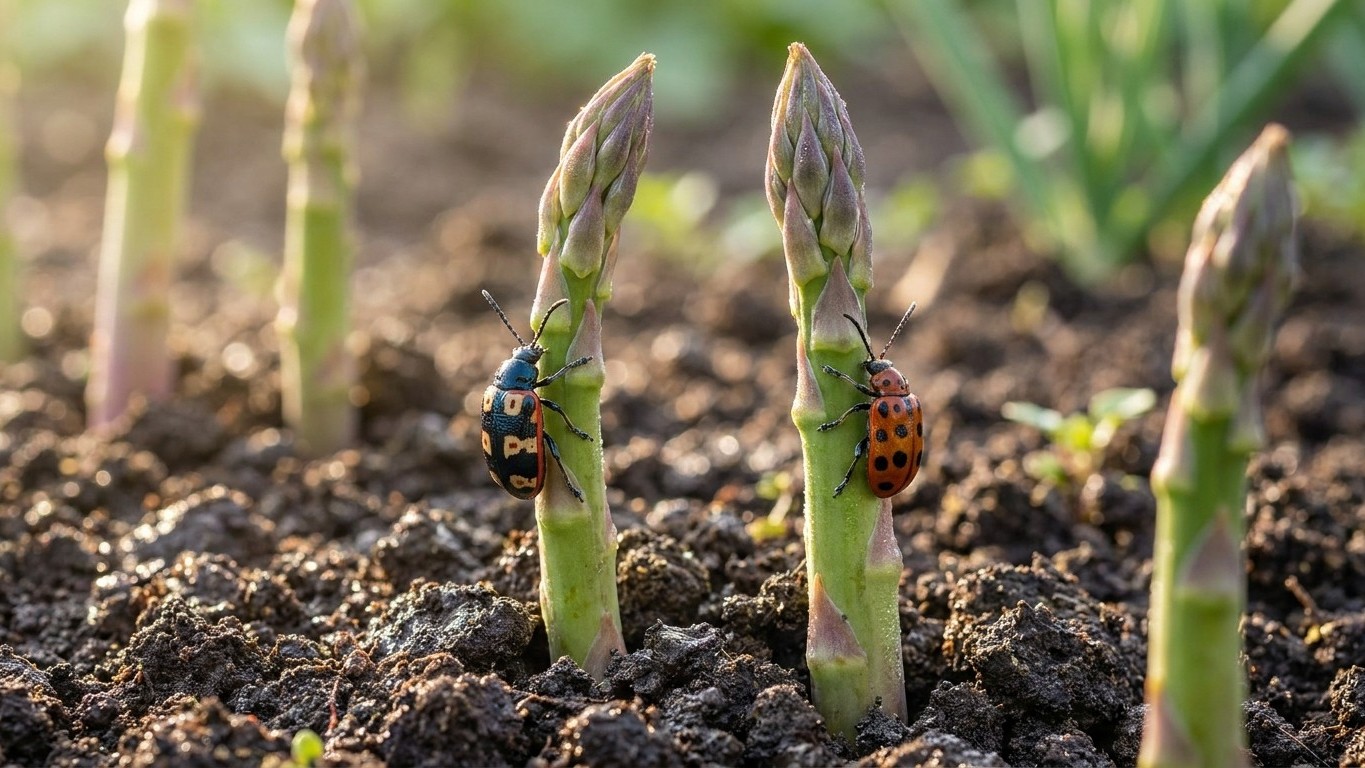

Chewing insects, sap feeders and soil-level cutters all work on asparagus, and each arrives when the plant offers something to eat: tender spears in spring, then feathery fern through summer and early fall. Rhode Island’s extension service keeps the local list. The most useful way to read it is by what the plant shows you. Scarred spears in the cool part of spring point to a different group than ragged, thinning fern in late summer.
Which pests attack asparagus in Rhode Island
The University of Rhode Island Cooperative Extension is the service that documents which insects feed on garden asparagus in the state. Its list is the one to trust over a national roundup, because a national list covers every region’s problems and a Rhode Island bed meets only some of them. Read it with two questions in mind: does this insect eat what asparagus actually grows, and does it show up in the season when that growth is exposed?
Which listed pests have no business in an asparagus bed?
Anything that needs wood or fruit to complete its life can be set aside. Borers that tunnel into tree trunks, scale insects that coat shrub stems and pests of orchard fruit show up on garden-pest lists, but asparagus is a herbaceous perennial that dies back to the ground every fall. It has no trunk to bore and no fruit worth eating. A bed that carries red berries on female plants does not change that, since the berries are not what gets damaged. If a pest on a long list lives on bark or apples, skip it.
How do you sort the ones that do feed on asparagus?
Sort them by what they eat, because that is what you will see first in the bed. Four groups cover most of what a home gardener meets:
- Insects that chew or scar the skin of spears as they emerge.
- Insects that strip the fern, leaving thin, ragged branches.
- Sap feeders that cluster on new growth and leave it sticky or distorted.
- Soil-level feeders, including slugs and cutting insects, that clip or rasp spears at the base.
One feature of this crop makes all four matter more. A bed stays in one place for 10 to 15 years, so any pest that settles in has the same address every spring. That is the reason to learn the insect early. Get the insect identified by extension from a photo or a specimen before anything is sprayed or dusted. The same wilted look can come from several different causes, and the wrong response costs a season.
When each one shows up, and what it does first
The calendar starts with the plant, not the month. Spears push up after the soil warms following the last spring frost. At the reference airport station that frost falls April 7 to April 17. Suburban and rural gardens usually see it one to two weeks later, and more than that at elevation. Count your own weeks from your own last frost.
What shows up on spears in spring?
The first signs are on the spears themselves. Look for rough, scraped patches on the skin, tips that are bent or chewed, and spears cut off cleanly at ground level. On damp mornings, silvery slime trails across the soil point to slugs. A newly planted bed gets the most careful watching. Crowns go into 8-inch furrows in early spring and nothing is harvested until year 3, so a damaged spear in year 1 or 2 is a loss of growth the crown needs. Cutting on that schedule removes spears before many feeders settle in.
What shows up on the fern after harvest?
Harvest ends when most spears come up thinner than a pencil. Then the fern grows out and the target changes. The first things you notice are needle-like branches that look stripped or chewed, small insects crowded on new tips, and a sticky film on the foliage below them. Damage often starts on a few stems and spreads outward along the row, which is why checking a bed weekly beats a monthly walk-by.
Summer weather changes how this looks. The reference station normally gets about 10.3 inches of rain across June, July and August, with July the driest month at 2.91 inches. A fern under dry stress yellows and thins on its own schedule, and that yellowing is easy to blame on insects.
Telling the damage apart from everything else
Insects get blamed for a lot they did not do. Frost, drought, tool nicks, hungry soil and wet crowns all produce marks that pass for pest damage at a glance. Damage with no insect, egg or dropping anywhere on the plant is a reason to check weather, water and soil before reaching for any treatment. The table pairs each common symptom with what separates it from a pest problem.
| What you see | What it can be mistaken for | What settles it |
|---|---|---|
| Dark, limp, water-soaked spear tips in spring | Insect chewing | A cold night just before. Frost affects tips at the same height across the bed. Chewing leaves missing tissue and torn edges. |
| Yellowing fern in the driest part of summer | Sap feeders or disease | Soil moisture a hand’s depth down, and a rain gauge reading. Well-drained loam sheds water quickly, and a heavy storm mostly runs off instead of soaking in. |
| Pale fern and thin spears across the whole bed | A pest on the roots | A soil test, and how long the harvest ran last season. Cutting past the pencil-thin point weakens a crown. |
| Straight cuts or bruises at one height | Chewing insects | The height of the mower, string trimmer or hoe. A tool leaves the same mark on every plant it touches. |
| Fern browning from the base up in soggy ground | Insect feeding | Standing water around the crowns. Extension can tell you whether a disease is involved. |
The soil that represents Rhode Island, the Narragansett series, is a well-drained loam to silt, so dry-spell stress is a realistic suspect in a hot July. That is what the series tends to do across the state, not a reading of your bed. River bottoms, hillsides and ground a builder has scraped or filled can behave very differently. A bed that stays wet in spring and a bed that dries out by midsummer need different fixes, which is why Will Rhode Island Soil Hold an Asparagus Bed for Fifteen Years? is worth reading before you blame anything on insects. When a symptom still does not fit, a sample taken to extension tells you more than any chart.
What actually works here, and what is a waste of time
On a short season, timing does more than any product. A physical barrier set before the pest arrives, such as a light cover over emerging spears or a collar at ground level, beats a treatment applied after the damage shows. In a bed where harvest begins in year 3, the covers and checks belong in the early years, when the crowns are building the reserves they will live on for a decade or more. Keep a watch on the young fern in year 1, and leave it standing. That fern is the plant’s only way to feed the crown for the following spring.
Weekly walks through the row do more than monthly ones. Early in the season, check the soil surface and the base of each spear. After harvest, check the tips of the fern, where sap feeders gather first. A rain gauge on the plot tells you whether a dry spell is stressing the plants, and in a dry July deep watering at the base helps the fern hold up under whatever is feeding on it. Rhode Island summers can also bring a few days at or above 90°F that dry the bed quickly.
Several common responses do not pay off. Spraying on a calendar, without knowing what is on the plant, kills useful insects along with the pest and teaches you nothing. A product off a store shelf has to list both asparagus and the specific insect on its label, and the Cooperative Extension knows what is registered for use in the state, so the product question belongs with them. Cutting chewed fern in midsummer starves the crown, so let it stand. Harvesting before year 3 to get ahead of pests backfires too, because even a few spears weaken the plant for every season after.
Backfilling the furrow follows the same logic of patience. Fill it gradually, not all at once. For timing a new bed around your local frost, When to Plant Asparagus Crowns in Rhode Island covers the window.
Where to check this for your own county
Start with the University of Rhode Island Cooperative Extension. Its garden staff and Master Gardener volunteers can identify an insect from a photo or a specimen and tell you what is approved for use in the state. Rhode Island’s counties have no county government role, so help comes through the statewide extension program rather than a county office. Ask for the person who handles home garden pests.
Pest presence varies inside a small state more than most gardeners expect. Coastal and inland yards differ, and so do hillsides and river bottoms. The reference station’s frost dates are an airport reading, and a rural bed may run one to two weeks behind them. A pest documented somewhere in the state may be absent from your row, and one that rarely shows up on the statewide list may be active in yours.
For the bigger picture of the crop itself, Growing Asparagus in Rhode Island covers the full 10-to-15-year plan.
Next time something looks wrong, photograph it, note the date and which stage the plant is in (spears, fern, or young crown), and bring a sample if you can. Set a rain gauge in the bed too. That record is what turns a guess into a diagnosis.
Common questions
Should I cut down fern that insects have chewed?
Leave it standing through the growing season. The fern feeds the crown, and cutting it in summer removes the plant’s only way of storing energy for next spring. If damage looks serious, ask extension to identify the cause before taking any action.
How do I tell insect damage from frost or drought?
Look for the insect itself, or its eggs and droppings. Frost damage hits tips at a similar height across the bed after a cold night. Drought yellowing tracks dry soil and the rain gauge. A soil test and a look at the crowns cover most of the rest.