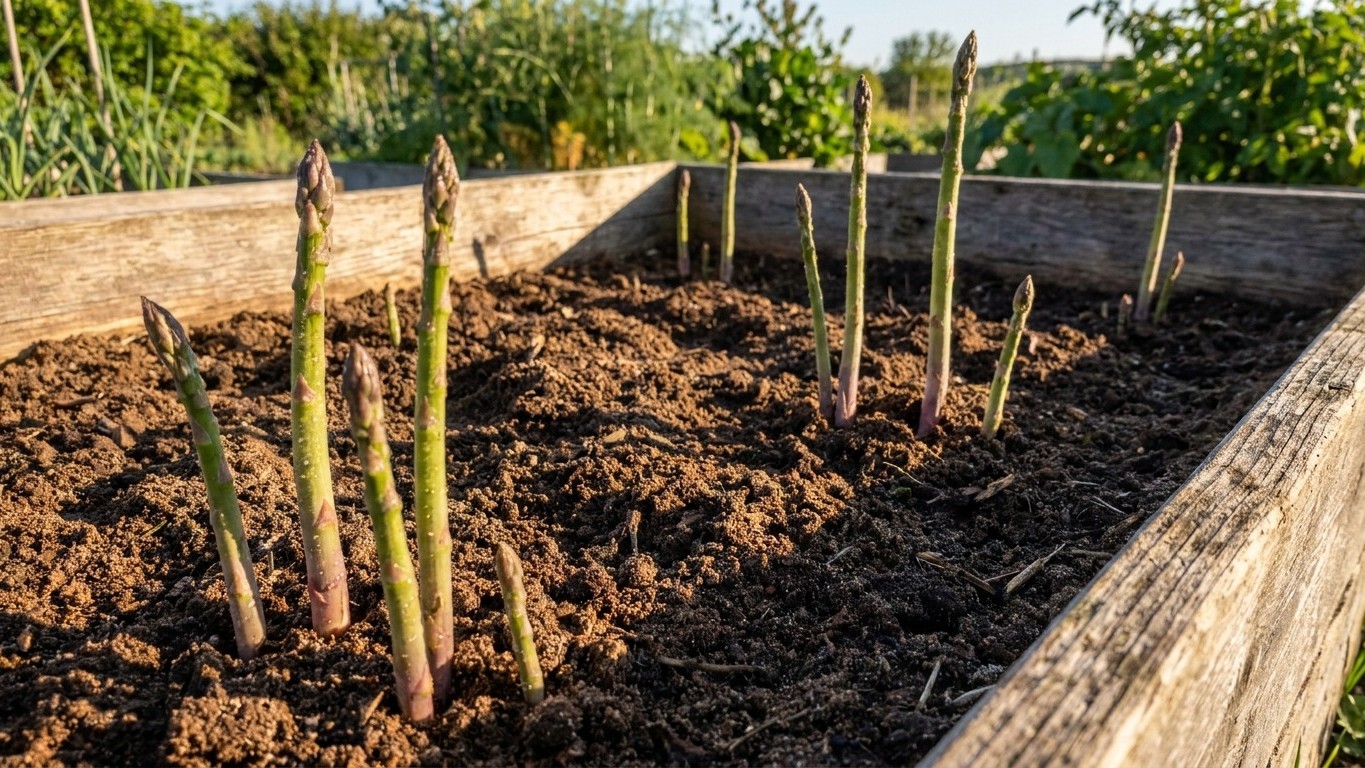

Asparagus gets eaten at three points: on the spears in spring, on the ferns through summer, and at the soil line on young shoots. Wisconsin growers see all three. The timing follows the last spring freeze, which falls between April 16 and April 29 according to NOAA NCEI climate normals. Naming the exact species in your bed takes a sample and a county office, so this guide starts with what you can see.
Which pests attack asparagus in Wisconsin
The University of Wisconsin–Madison Division of Extension is the service that identifies garden insects for the state, and its county offices are where an unknown bug gets a name. Sorting the feeders by the part of the plant they work on narrows a diagnosis fast.
The first group chews on spears as they emerge. These insects leave ragged edges, scarred tips or small holes in a spear you were about to cut. The second group feeds on the fern, the tall feathery growth that develops once harvest stops. Stripped or bleached-looking fern is their signature. The third group works at or just below the soil line, where a young shoot is cut off or gnawed through at the base. A spear that lies on the ground, severed cleanly, points here.
Some animals browse spears too. Rabbits and deer nip tips and fern, and the bite is angled and clean rather than ragged. That is a different problem from an insect problem, and it gets a different fix.
The rule that matters most for a bed meant to last: asparagus is not harvested until year 3, then produces for 10 to 15 years, according to Utah State University Extension. A pest problem that goes unnoticed in year one can follow the planting for a decade, so learn the pattern of damage early, while the plants are small and every spear is easy to inspect.
When each one shows up, and what it does first
The calendar hangs on the last spring freeze. NOAA NCEI puts it between April 16 and April 29 at the reference station for Wisconsin, based on the 30 to 70 percent probability band for a 32°F freeze. Spears come up as the soil warms after that freeze, and anything that feeds on them follows.
Spear feeders appear first, in the weeks after the first shoots break the surface. What you see first is cosmetic: a spear is scarred, bent, or marked by small brown patches, and the damage is on the outer skin. Cutting every other day during harvest lets you catch it while it is still on one or two spears.
Soil-line cutters work earliest of all, often before the spears are tall enough to notice. The first sign is a missing shoot in a row that looked full the day before, or a spear lying flat with a clean break at the base. Look at the soil around the gap, because the culprit is usually still close by.
Fern feeders come later, after harvest ends, once the spears have opened into fern and the plant is building up the crown for next year. The first sign is thinning or stripped fern tips, or foliage that looks scraped rather than torn. You are no longer cutting spears by then, so the damage can go unseen for weeks.
Harvest timing matters here. The first harvest is in year 3. Stop when most spears are thinner than a pencil, then let the rest grow into fern. That fern is the plant’s only way to feed the crown, so a bed whose fern is stripped in its first summers goes into winter weaker than it should.
Summer weather shapes this stretch. The reference station averages about 11.4 inches of rain over June, July and August (4.38 inches in June, 3.4 in July, 3.65 in August). A dry July stresses fern, and stressed fern is easily mistaken for insect damage.
Telling the damage apart from everything else
A lot of what looks like an insect attack is something else. Frost, drought, disease and a mower blade can all leave marks that pass for chewing. Look for the animal, its droppings, or its trail before you decide anything was eating the plant. Bruised plants with no feeder in sight usually mean weather or a mechanical cause.
| What you see | Common causes | What settles it |
|---|---|---|
| Limp, dark or water-soaked spears | A freeze after emergence | Damage hits many spears at once after a cold night, with no insects present |
| Ragged edges or holes in spears and fern | Chewing insects | Insects, droppings or chewed tissue found on or near the plant |
| A clean slice on a spear lying on the ground | Soil-line cutter, or a tool or mower | Gnawed edges point to an animal; a straight cut points to a blade |
| Thin spears all through a young bed | Crowns still establishing | The bed is in its first seasons and has not been harvested |
| Pale, stunted or yellowing fern in midsummer | Dry spell, poor drainage or disease | Check soil moisture a few inches down and look for leaf spots or lesions |
| Yellowing fern late in the season | Normal dieback | The whole bed yellows evenly as cold approaches |
Water is the biggest confounder. Wisconsin’s state soil, the Antigo series, is a well-drained silt loam according to USDA NRCS, with about 70 percent silt, 20 percent sand and 10 percent clay at the surface. That tells you what the region’s ground tends to do, not what your bed does. A low spot, a filled lot or compacted ground can behave completely differently, and standing water around crowns causes its own damage.
If you cannot tell which of these you are dealing with, take a clear photo of the damage and a fresh sample to your county Extension office, and only then decide whether anything needs treating.
What actually works here, and what is a waste of time
Only the University of Wisconsin–Madison Division of Extension can tell you what is approved for a food crop in the state, at what stage, and with what wait before you eat it. What follows is what a grower can do without a product.
A physical barrier at the right moment beats any treatment. A light cover over young shoots keeps flying feeders off the spears while they are most exposed. Wire or fencing around the bed takes care of rabbits and deer. Both only work if they go on before the damage starts, as the soil warms after the last freeze, not after you have seen chewed spears.
Calendar matters more than product on a short season. Cutting spears often during the harvest window removes the stage insects like best. Ending harvest when most spears are thinner than a pencil lets the fern recharge the crown. Backfill the furrow gradually, not all at once, because burying the crown too fast smothers the shoots you are trying to protect.
Cleaning up old fern at the end of the season also helps, since insects and diseases overwinter in plant debris. You can read more in Growing Asparagus in Wisconsin.
What does not work is spraying on a schedule just in case. Treating without having identified the insect kills helpful species along with harmful ones and risks leaving residue on spears you are about to eat. Planting more crowns to outpace the damage fails too, because a stressed bed stays stressed and new plants take three years before you can harvest them. Watering heavily to push fern growth rarely helps in a well-drained soil, where it mostly runs through. A rain gauge in the bed tells you whether the plot is actually dry.
Where to check this for your own county
The University of Wisconsin–Madison Division of Extension runs a county office across the state. Staff there can look at a sample, name the insect and tell you what is active locally. That beats any general list, because pests vary inside the state. What turns up in a southern county may be rare in the north, and what hits a river-bottom garden may skip a hillside one.
Climate varies the same way. Lake Michigan delays the first fall freeze at the lakeshore, inland southern Wisconsin typically freezes in early October, and the north freezes far earlier. Those differences shift the timing of everything described here, as does soil, since the Antigo series USDA NRCS describes represents the state, not any one yard.
Statewide documentation says which feeders are present somewhere in Wisconsin. It cannot say what is in your bed this month. Soil drainage deserves its own check, and Will Wisconsin Soil Hold an Asparagus Bed for Fifteen Years? walks through it. If you are still deciding when to set crowns, When to Plant Asparagus Crowns in Wisconsin covers the spring window.
The next step is simple. Put a rain gauge in the bed, photograph any damage the day you find it, and call the county office before you buy anything.
Common questions
Can I harvest spears while I am dealing with pest damage in a young bed?
Not before year 3. Asparagus is planted as crowns in 8-inch furrows in early spring and is not harvested until its third year, according to Utah State University Extension. Damage to young ferns in the first two years matters more than damage to spears, because the ferns are what builds the crown.
How long should I harvest once the bed is established?
Stop when most spears are thinner than a pencil. After that, let the fern grow.
Is it safe to spray the bed during harvest?
That depends on what is registered for asparagus in Wisconsin and on the wait time before harvest. The county Extension office holds that information. Do not spray until the insect has been identified.
Could weak fern be a water problem instead of insects?
Yes. The reference station averages about 11.4 inches of rain across June, July and August, with July the driest month at 3.4 inches. Those are regional normals from NOAA NCEI, not your plot. Dig a few inches down and put a rain gauge in the bed before blaming insects.