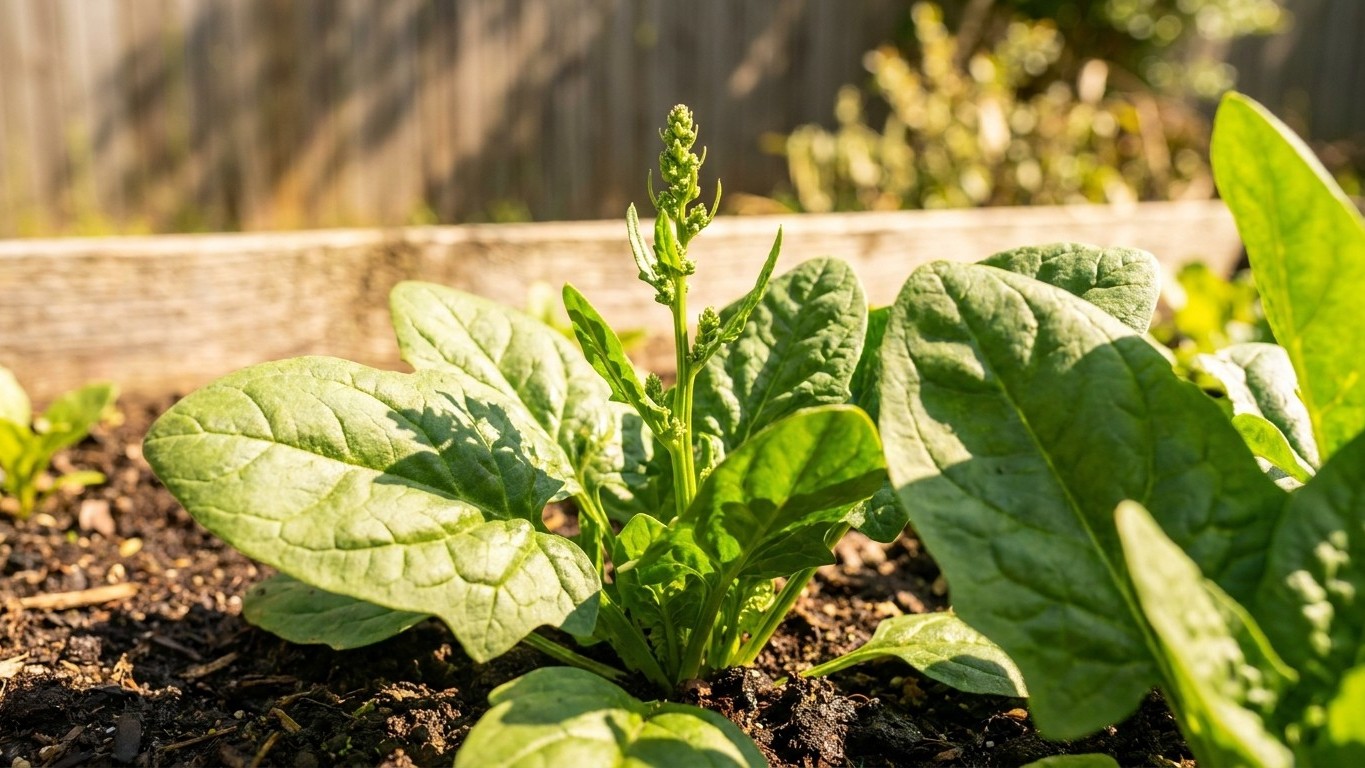

Cut spinach when the outer leaves are big enough to eat and the center is still a tight, low rosette. In Maine that means late spring and again in fall, with a midsummer gap when long days and heat push the plant to flower. Once cut, spinach is short-lived. The best case is 32°F with very high humidity and a ceiling of two weeks, and most home refrigerators fall short of that.
When spinach is ready in Maine
The plant tells you before the calendar does. Spinach is ready when the outer leaves are the size you would want on a plate and the center stays low, with no stalk rising from it. In Maine that usually falls in the weeks after the last spring frost, which at Portland runs April 22 to May 1 (NOAA NCEI 1991-2020 Climate Normals), and again in fall until the ground freezes hard.
Portland is the mild end of the state. Inland and northern Maine run later in spring and earlier in fall, so slide every date here toward the cooler side if you garden away from the coast. The leaf-size signal holds everywhere. If your seed went in as soon as the soil could be worked, you are cutting before the days get long. If it went in late, you are racing them. The full planting picture is in Growing Spinach in Maine.
Why does long daylight end the spring crop in Maine?
Heat is only half the story. Utah State University Extension says spinach bolts during long days and warm temperatures, and that it grows best where temperatures do not exceed 75 F. Above that, growth slows and the leaves turn bitter.
A cool coast does not fix the day-length part. On the longest day of the year, Portland gets 15 h 15 of daylight, and that is enough to push spinach toward flowering whatever the thermometer says. Heat is not the main threat here: the reference station averages only 3.8 days a year at 90°F or higher. Day length does the damage, which is why a cool June still ends the spring crop. A stalk starting up from the center and leaves turning narrow and pointed mean the plant has switched to making seed. Will Spinach Bolt Early in Maine? covers what to do when you see it.
When should you sow spinach for a fall cut in Maine?
Utah State University Extension gives a simple rule for fall: plant 50 to 75 days before the date you want to harvest. If you want a cut around the first fall frost, which at Portland falls October 9 to October 21, time your sowing so the plants reach cutting size before that date.
Early sowings run into a different problem. Spinach seed germination drops once the soil is above 80 F, and a sunny bed in late July or early August can easily be that warm. It is the soil heat that holds you back, not the cold. Shade the seedbed with a board or cloth until the seedlings are up, and keep it watered. Your local county extension office can point you to varieties worth a look on the seed rack.
If something is chewing the leaves before you get to them, What Eats Spinach in Maine, and When sorts out the usual suspects by season.
Keeping it, and for how long
Spinach is one of the most perishable greens you can grow. The UC Davis Postharvest Technology Center puts the optimum at 0°C, which is 32°F, with a relative humidity of 95 to 98 percent. Under those conditions it says spinach “will not maintain good quality for more than 2 weeks.” That is a ceiling you reach only with a cold chain a home kitchen rarely matches.
How long does cut spinach last in the fridge?
UC Davis says wilting, yellowing of leaves and decay are likely to increase after 10 to 14 days of storage. It also says deterioration comes faster at common distribution conditions of 5 to 10°C, or 41 to 50°F. The practical number to write down is 32°F, because every degree above it shortens the clock. At 41°F and up, you are on the fast side of that range.
Plan on eating homegrown spinach within a few days of cutting. If a bunch is still crisp at the one-week mark, call that a bonus. Treat two weeks as the outer edge of what is possible, and do not build a meal plan around it.
What should you do between the bed and the fridge?
Time in the field after cutting counts against the clock. Cut in the cool of the morning, bring the leaves inside right away, and get them cold the same hour. A basket left on the porch rail on a sunny May afternoon can lose days of shelf life before it ever reaches the kitchen.
Spinach is also a leaf with a lot of surface area, so it loses water fast. That is why the humidity figure sits at 95 to 98 percent. At those levels, the air around the leaves is close to saturated, and the leaves stay firm. Dry refrigerator air pulls moisture out of them and they go limp. Wetness is the opposite problem. Leaves sitting in standing water start to break down quickly, which is why the next section matters.
Sort out damaged leaves before storage. A bruised or yellowing leaf releases moisture and speeds decay in its neighbors. Pull those out, eat them first, and give the rest some room.
Where in the house that actually is
A kitchen refrigerator does not run at 32°F. It is set warmer, and the door is warmer still, because every opening lets room air in. The door shelves are the worst place for spinach, and that is where many people put leafy greens in a hurry. In practice you are somewhere in the 41 to 50°F range that UC Davis says shortens storage life, and a bag left in the door will start to yellow within days.
The coldest spot in most refrigerators is the back of the bottom shelf, away from the door and away from the light. That is the closest a home appliance gets to the optimum. Keep the leaves from touching the back wall itself, since a spot that cold can freeze delicate leaves in some models. Where the crisper drawer closes tight and has a humidity slider, set it to high. If the drawer sits on the bottom shelf and runs cold, it is a good option.
How do you get high humidity in a home fridge?
You build it yourself. Put the spinach in a loosely closed plastic bag or a container lined with a damp towel, which holds moisture around the leaves without drowning them. A paper towel wrung out until it is barely damp does the job. Dripping wet does not.
If you cut whole plants or long-stemmed leaves, you can stand them with the cut ends in about an inch of water in a jar, then loosely cover the tops with a bag. The cut ends drink, and the leaves stay upright. Change the water every day or two. Skipping the moisture step costs you the crispness first, and then the whole bunch.
Common questions
Can you cut spinach more than once?
Yes, until the plant bolts. Take the outer leaves and leave the center growing, and the plant keeps putting out new ones. Once a stalk rises from the middle, the leaves get bitter and the plant is finished.
How long does spinach keep after cutting?
At 32°F and 95 to 98 percent humidity, UC Davis says spinach will not hold good quality beyond two weeks. In a home fridge, expect less, since quality drops after 10 to 14 days even in good storage, and faster at 41 to 50°F.
Is yellowing spinach safe to eat?
Slightly limp leaves are fine, especially cooked. Yellow, slimy or sour-smelling leaves are past it and belong in the compost. Yellowing is one of the first signs UC Davis lists for storage gone too long.
When should you stop cutting spring spinach in Maine?
Stop when a stalk starts rising from the center or the leaves turn bitter. With 15 h 15 of daylight at the longest day, that tends to happen in early summer, so plan to finish the spring crop before then and sow again for fall.