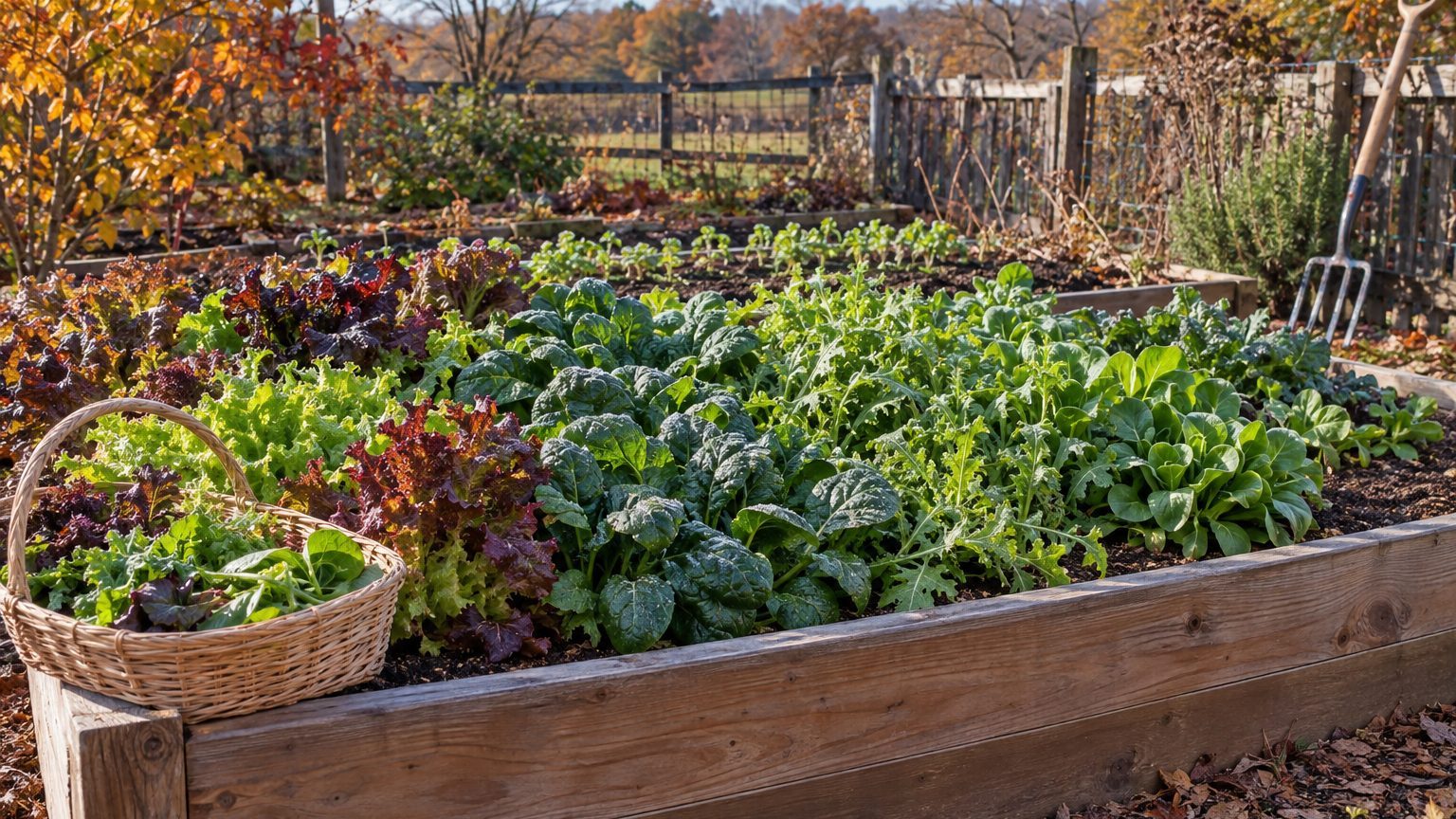

Succession sowing for winter salads means front-loading. Instead of a small sowing every couple of weeks through the harvest, you make several larger sowings in late summer and early fall, while days are still long enough to grow leaves. Then you pick slowly from those beds once growth stops. Lettuce, spinach, arugula and mâche all follow this pattern, and the beds keep supplying leaves long after the last seed goes in.
What is actually going on
Winter harvest comes from plants that are already grown, not plants that are still growing. In summer, a lettuce you cut regrows in days, so a small sowing every fortnight keeps the supply even. In midwinter that regrowth slows to nothing. A bed you strip in December may not refill until the light comes back, so the thing to understand is front-loading: sow more before the light fails, then harvest slowly afterward.
Why does winter growth stall?
Growth follows day length as much as temperature. When daylight falls below roughly ten hours, most salad crops add almost no new leaf, even if they survive the cold. The hardy types (spinach, mâche, many Asian greens, chicories) stay alive through freezing nights and stay edible. They just stop getting bigger. A leaf at full size in November keeps for weeks in a cold bed, much like food in a refrigerator. A seedling that is still small in November sits there until spring.
How does front-loading change a sowing plan?
Make the bulk of your sowings in the weeks when plants can still reach full size. Sow several times, close together, and sow more seed each time than you would in summer. Then stop. Harvest by taking a few outer leaves from each plant rather than cutting whole heads, so each plant gives a little at a time over months. Later sowings under cover fill gaps and set up early spring picking, but the fall beds are the main supply. To match the first sowing to your own first frost, see Sowing Winter Salads at the Right Moment.
Cold tolerance varies a great deal within each crop type. Your state extension service can tell you which varieties have been trialled in your region, and that list is worth more than any generic recommendation.
In the garden
Work backward from the date daylight drops to about ten hours where you live. Any sunrise and sunset calculator gives you that date for your town. Packet days to harvest count from sowing for these direct-sown crops. Fall growth runs slower than the packet suggests, so leave a generous margin. Everything below is sown from seed packets into beds, containers or cold frames.
| Crop type | Sowing rhythm | Last useful sowing | If it goes wrong |
|---|---|---|---|
| Spinach | Two or three sowings, a week or two apart, starting once summer heat breaks | Early enough to reach full leaf before the ten-hour line | Seed sown into hot soil germinates poorly. Late plants stay small and give a thin pick. |
| Mâche (corn salad) | One generous sowing, repeated once | A little later than most, since it takes cold well | A thin sowing leaves little to pick because the rosettes are small. Hot soil gives patchy germination. |
| Arugula | Small sowings every week or two early on | Later than most, because it grows quickly | Sown in long, hot days it bolts and turns harsh. Flea beetles pepper the leaves, and a row cover keeps them off. |
| Mustard and other Asian greens | Two or three sowings | Mid-window | Sown too early they bolt. Less hardy types turn limp in a hard freeze with no cover. |
| Loose-leaf lettuce | Two or three sowings, or transplants started indoors | Early, with cold-hardy types and a cover for the late beds | Uncovered leaves go to mush in hard freezes. Late sowings never reach pickable size. |
| Chicories (endive, radicchio) | One or two sowings | Early, because they size up slowly | Late sowings give small hearts. Heat during growth makes the leaves sharply bitter. |
| Baby kale | One sowing, thick | Same window as spinach | Late plants stay too small to pick. Aphids settle in crowded, sheltered beds. |
How do you set the last useful sowing date?
Take the ten-hour date, subtract the packet days for the crop, and then subtract more for slow fall growth. A last useful sowing date is the one that still gives you a full-size plant before the light gives out. Past it, the plants stay seedlings. A cold frame, low tunnel or row cover pushes the cutoff later by keeping the air around the leaves a little warmer, but the light does not change. Cover gives you a few extra weeks of margin at the edge. It does not rescue a bed sown in November.
What it depends on where you are
The mechanism is the same everywhere. Light drives growth, hardy leaves hold in the cold, and front-loading beats steady sowing. What changes is where your window opens and closes, and that depends on three local things: how long the growing season runs, how hot summer gets, and how much rain falls in late summer.
Where summers are hot and humid, the start of the window is the hard part. Spinach and lettuce seed will not germinate well in hot soil, and early sowings may need shade cloth, afternoon shade from taller crops, or a wait for the weather to break. Where summers are dry, the same early sowings need regular watering until the seedlings are established. Where frost arrives early and light fades fast, the window is short and the sowings have to be tight. In the mildest winter regions, growth may slow without stopping, regrowth partly returns, and a steadier succession works better than a hard front-load.
Your own extension service is the best source for local sowing dates and varieties, since it knows your frost dates, summer weather and soil. Start at your county or state extension office and search for fall vegetable planting dates. For the regional picture across the country, the state pages in the series Winter Salads: What Grows When Lettuce Will Not put the timing in the context of local climates.
A good habit is to keep a note each year of the dates you sowed and when each bed stopped growing. After two seasons you have a local calendar that no general plan can match.
The mistake that costs the most
Gardeners treat winter salads like summer ones and sow a little every couple of weeks all the way through fall. It feels like good management, since it is exactly how succession works for lettuce in June. In October it produces a row of seedlings that never reach picking size, because the light that fed the early sowings is gone by the time the later ones are up.
What should you do instead?
Put your effort into the early weeks. Make the biggest sowings while days are still long enough to bring plants to full size, and plan to stop sowing at the last useful date for each crop. Sow more seed per foot than you would in summer, because once picking starts you will not be able to replace what you take. Pick from the outer leaves of each plant and move along the row, so that no plant is stripped bare.
Later sowings are not wasted if you want them for early spring. Small plants that survive the cold under cover will start growing again as days lengthen, and they give you a first pick before anything sown in spring is ready. Plan them as a second crop, though, not as a continuation of the fall one.
Some salad crops reseed themselves and can fill gaps in the bed, as described in The Ones That Come Back on Their Own.
Common questions
How often should I sow winter salads?
In the early window, every one to two weeks for fast crops such as arugula and Asian greens, and a little less often for slower ones like chicories. Once the window closes, stop. Extra sowings after that point rarely reach harvest size.
Can I keep sowing all winter under a cold frame?
You can, but most of those seeds will germinate and then wait. Growth is limited by light, and a frame adds warmth, not daylight. Late sowings under cover are best treated as a head start on spring.
Do self-seeding salads change the plan?
They can take care of some of the later sowings for you, and they come up when conditions suit them. Even so, the main fall beds still need to be sown on schedule if you want leaves in the dark months. Which crops self-seed reliably depends on your climate, so check with your extension service.
Can I grow watercress in succession too?
Only from seed or plants bought for the purpose, grown in containers kept constantly moist. Never take cuttings from a stream or ditch. Water that livestock graze can carry liver fluke, and plants growing in the wild are not a safe source for a salad bed.