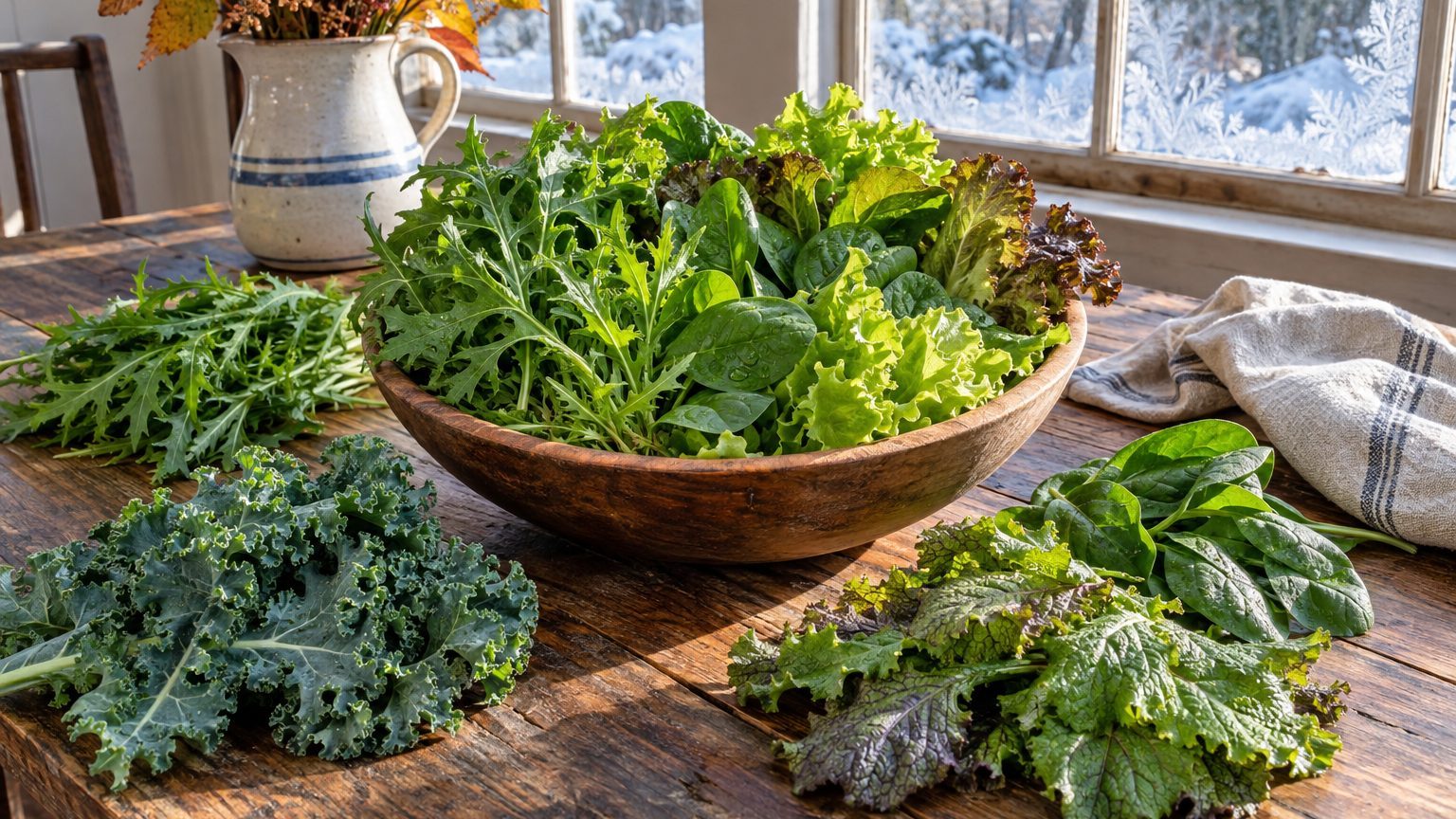

The best winter salads for North Carolina are the cold-hardy greens: spinach, mâche, claytonia, arugula, mizuna and kale, with leaf and romaine lettuces at the tender end of the list. Sown in fall, they keep growing or at least hold through a winter whose nights average right around freezing in the Piedmont. Heading lettuces and slow crops fare worse. Here is how to sort the list for your ground.
The short answer for North Carolina
Pick by type, and pick hardy. At the Charlotte reference station, the mean daily minimum of the coldest month is 31.8°F. Nights hover at the freezing mark, which is cold enough to rule out tender lettuce in an open bed but mild enough that spinach, mâche, claytonia and kale stay green and harvestable through most of the winter. Many gardeners cut from the same bed in January that they sowed in October.
The frost dates frame the season. At that station, the 32°F freeze probabilities put the last spring frost between March 23 and April 5, and the first fall frost between October 30 and November 8. Those are the dates when the chance of a freeze at 32°F sits between 30 and 70 percent. They describe a band of odds across thirty years of weather, so any given year can land outside it. Charlotte is Piedmont country, so the Blue Ridge to the west runs several weeks later in spring and the coastal plain runs earlier.
Which salad greens handle a North Carolina winter?
The table sorts the common choices by how they take the cold and what job each does best. For the wider picture of winter salad growing in the state, see Winter Salads for North Carolina Gardens.
| Green | Cold tolerance | Best use here |
|---|---|---|
| Mâche (corn salad) | Very hardy | Mild, nutty base for a December and January salad bowl |
| Claytonia | Very hardy | Succulent leaves that keep coming back after cutting |
| Spinach | Hardy | Fall sowing, steady winter picking, early spring flush |
| Kale (baby leaf) | Very hardy | Sweeter after frost; tender when cut young |
| Arugula and mizuna | Moderately hardy | Quick spicy leaves; take light frost, burn in a hard freeze |
| Leaf and romaine lettuce | Moderate | Best sown early in fall; cover in the coldest weeks |
| Butterhead and crisphead | Tender | Reliable only under cover or in mild coastal beds |
If you grow only three, make them spinach, mâche and kale. They cover most of the winter without protection in the Piedmont, and they give you something to pick even in the coldest stretch.
What will not work here

Lettuce sown in a warm September is the most common failure. The first fall frost does not arrive until the end of October or the first week of November, so early fall soil is still warm. Lettuce and spinach seed germinate poorly in warm soil, and what does come up is spotty. Sow in the shade of taller plants, water the row to cool it, or wait for a cooler week. Mâche and claytonia are less fussy about this.
Sowing too late fails just as surely. Once the first frost band has passed, days are short and growth slows to a crawl. With nights averaging near 32°F in the coldest month, a seedling with two leaves in mid-November will mostly sit and wait for spring. Winter salads need to be close to harvest size before the cold settles in, because winter holds them rather than grows them. When a bed of late sowings gives you nothing until March, that is the reason.
Humidity punishes close spacing. The state’s damp, mild winters keep leaves wet for long stretches, which invites downy mildew, rot and slugs. A bed sown thick for baby greens can look great in November and turn slimy by January. Thin so the leaves do not overlap, water in the morning so they dry by evening, and keep the rows open to airflow.
Warm spells then hard freezes are another trap. A week of 60-degree days softens growth, and the next freeze scorches it. That is why arugula and tender lettuce are the first to look ragged in a North Carolina winter. A light row cover pulled over the bed before a forecast freeze solves most of it.
Spring ends the season quickly. With the last frost between March 23 and April 5 in the Piedmont, warm weather follows fast, and lettuce, arugula and spinach bolt and turn bitter. Count on winter salads finishing by about the time spring tomatoes go in. Plan a spring sowing only for early harvests, and do not expect it to last into summer.
What changes across North Carolina
North Carolina spans USDA hardiness zones 5b to 8b, a spread of several zones from the highest peaks to the outer coast. There is no single answer for the state. The USDA zone is built on one variable, the average annual extreme minimum temperature, so it says how cold the coldest night gets and nothing about how long the season runs. A dated recommendation therefore needs a reference place, and the dates above belong to Charlotte and the Piedmont around it.
If you garden in the mountains or at altitude, shift everything. Spring comes several weeks later than in Charlotte, and fall frost arrives sooner, so the window for fall sowing closes earlier. Sow weeks ahead of Piedmont timing, favor the hardiest types (mâche, claytonia, spinach, kale), and use row cover or a low tunnel as routine. Cold air also drains into valleys and hollows, so a bed on a slope often outlasts one at the bottom of the same property.
On the coastal plain, spring frost comes earlier and winters are milder, so lettuces and arugula last longer into the cold months and sowing can start earlier in late winter. The tradeoff is that spring heat arrives sooner too, and bolting comes earlier. The When to Sow Winter Salads in North Carolina guide lays out the sowing window in more detail.
To see where your own garden falls, look up your ZIP code on the USDA Plant Hardiness Zone Map. Treat the zone as a guide to which plants survive your coldest nights, then adjust the timing using your own local frost dates.
Where to check this for your own county
Your state extension service is the next stop. NC State Extension runs a center in every county, staffed by agents who know your soil, your elevation and the pests that show up in your area. Look for two things: the local planting calendar for cool-season vegetables, and any variety trials run in or near your county. A trial tells you which spinach, lettuce or kale actually held up in local conditions, which a seed catalog cannot.
Many county centers also have Extension Master Gardener volunteers who answer questions by phone or email, and some post fall and winter garden guidance for the area. If a county agent gives you a sowing date that differs from what you read here, go with the agent. A county recommendation beats a state one, because any statewide recommendation averages a mountain valley and a coastal field, and a county office does not.
Bring specifics when you call: your approximate elevation, whether the bed is low or on a slope, and what you have grown in it before. A bed that stays wet, or one that gets six hours of winter sun, changes the answer as much as the county line does.
Checking this against your own garden
Your own observations outrank every date here. Three are worth watching.
- Soil warmth by feel. Push your bare hand a few inches into the bed in late summer. If the soil still feels warm, lettuce and spinach seed will struggle to germinate, so wait or sow in shade. When it feels merely cool, go ahead. A bed that stays warm longer than a neighbor’s tells you it is sunny and sheltered.
- The first true leaves. After the seed leaves come the first true leaves, which look like the adult plant. Seedlings with several true leaves before the first hard freeze handle winter far better than those that have only just emerged. If yours are behind by late October, cover them and expect slower growth.
- Where frost lingers in the morning. Walk the yard on the first frosty mornings and note which spots stay white longest and which clear first. Low corners and open lawn hold frost, while the south side of a wall or fence stays milder. That map tells you where tender lettuce can go and where only the hardiest greens belong.
Write what you see in a notebook for a couple of seasons. After two winters you will know your own last frost and first frost better than any average can tell you.
Common questions
Can winter salads grow outdoors in North Carolina without cover?
Hardy types such as spinach, mâche, claytonia and kale usually can, especially in the Piedmont and on the coastal plain. Arugula, mizuna and leaf lettuce are better with a light row cover on freezing nights. In the mountains, plan on cover for almost everything except the hardiest greens.
What is the easiest winter salad green for beginners?
Spinach and kale are forgiving. Both tolerate frost, sprout reliably in cool fall soil, and keep producing after repeated cutting. Mâche is nearly as easy but germinates slowly, so be patient.
When should I stop sowing in the fall?
Stop when seedlings will not have time to put on several true leaves before the first hard freeze. In the Piedmont that first frost band runs from October 30 to November 8, so sowings made well before it have time to establish. Mountain gardeners need to stop earlier, and the sowing window guide has the details.
Why did my winter lettuce turn bitter in spring?
It bolted. As days lengthen and temperatures climb after the last spring frost, lettuce sends up a flower stalk and the leaves turn bitter. Harvest heavily in late winter and pull the plants once the center starts to elongate.