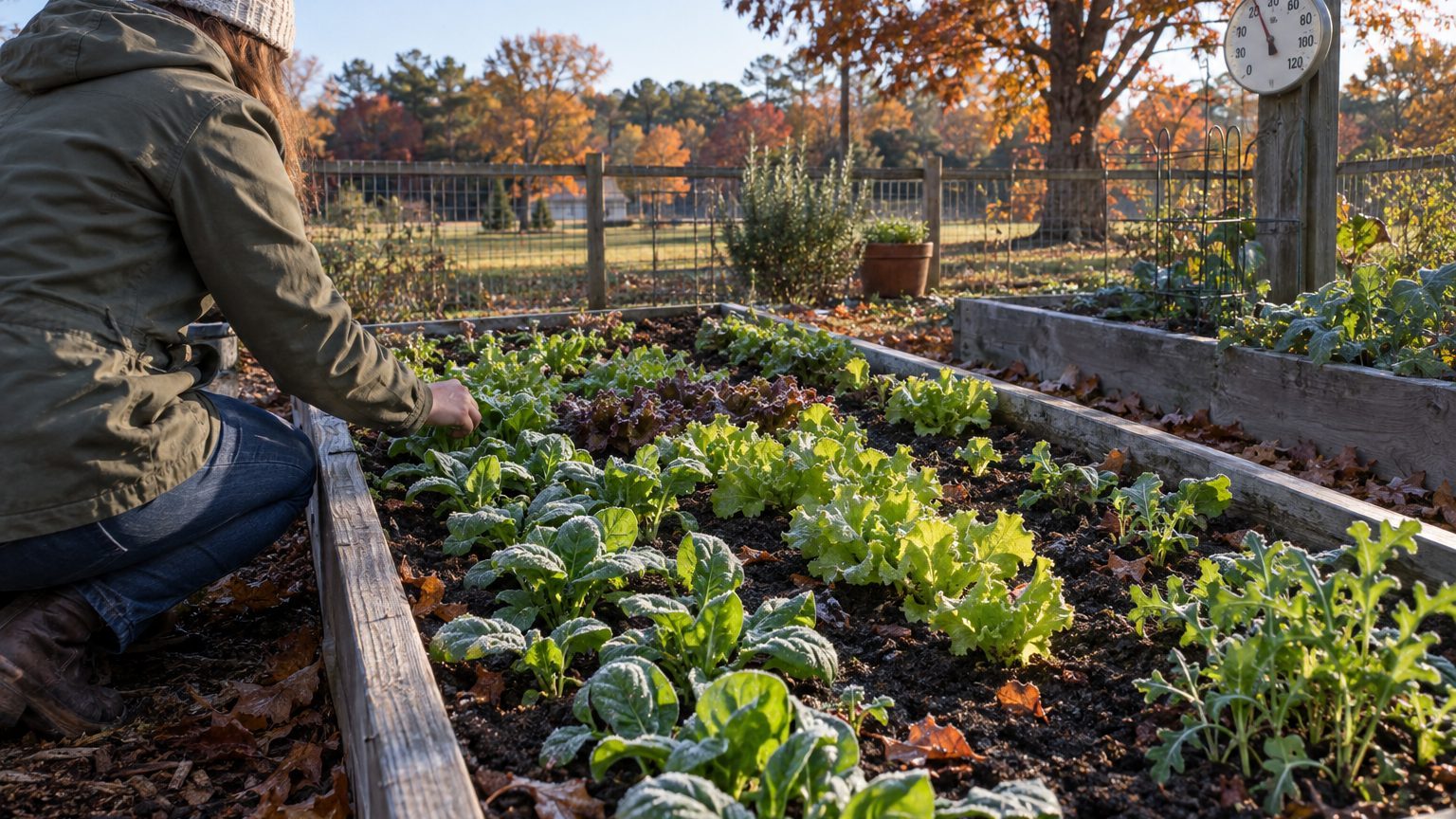

Sow fast winter salad greens from late July to mid-August, and hardier ones such as spinach, mâche and claytonia from mid-August to early September. Count back from the first fall frost, which falls between September 25 and October 5 at the Fargo reference station. Anything meant to last past November needs a cold frame, low tunnel or heavy mulch.
The short answer for North Dakota
What do the frost dates actually measure?
Two pairs of dates frame the calendar, and both come from the NOAA 1991-2020 U.S. Climate Normals for the Fargo airport station. They describe the odds of a 32°F freeze. In spring, between May 4 and May 15, the chance that another freeze is still coming runs from 30 to 70 percent. In fall, between September 25 and October 5, the chance that the first freeze has already happened falls in that same band.
These are airport numbers. Suburban and rural gardens usually get the last spring frost later and the first fall frost earlier, often by one to two weeks, and more at elevation. For a farm or an acreage outside town, plan on the early end of the fall window or a little before it.
What sowing dates work for each type of winter salad?
Winter salads are a fall-sown crop, so the fall frost date does the work. Plants need to reach near harvest size before the days shorten, because growth slows sharply as daylight drops. By the solstice, daylight is short, and a seedling that is still tiny in November will mostly sit there until February. For the full list of types and what suits each, see The Best Winter Salads for North Dakota.
| Type | Sow window | What it is aiming for |
|---|---|---|
| Fast baby greens (arugula, mizuna, leaf lettuce) | Late July to about August 10 | A first cutting within roughly a month to six weeks, with regrowth into October |
| Cold-tolerant greens (spinach, mâche, claytonia) | Mid-August to early September | Sturdy plants before the hard freezes, then slow harvest under cover |
| Spinach for overwintering | Early to mid-September | Small rosettes that sit dormant under mulch or a frame and restart in early spring |
Treat the windows as a starting point and adjust by one to two weeks earlier for rural or higher ground.
What will not work here

Why do late sowings fail in North Dakota?
Sowing in late September, the way a gardener in a milder state might, gives you seedlings and little else. The first freeze arrives within days or weeks of that date, and a plant with two small leaves has nothing to harvest. Slow crops fail for the same reason. Head lettuce, radicchio and endive need a long stretch of steady growth, and the season here runs out before they finish.
The opposite mistake happens in July. Lettuce seed often refuses to sprout in hot soil, and a bed in full afternoon sun can stay too warm for days. Shade the row with a board or a piece of cloth and water daily until the seedlings show.
Can winter salads survive a North Dakota January?
Unprotected, no. The mean daily minimum of the coldest month at Fargo is 0.2°F, so leaves in an open bed spend weeks frozen solid, and wind dries out what the cold does not kill. Mâche and spinach are among the toughest salads grown, but even they need a roof over them for a winter harvest.
A single layer of floating row cover helps in October and does little in January. A cold frame or a low tunnel with a second layer inside it does much better. Snow itself is good insulation, so a bed that stays under a steady blanket is better off than one scoured bare by wind. Both setups bring their own problems. A frame lid left shut on a sunny day in February can cook the plants inside, and a flat tunnel cover can collapse under wet snow. Prop the lid open when the sun is out, and use hoops steep enough to shed a heavy load.
What changes across North Dakota
The state spans USDA zones 3a to 4b, according to the 2023 USDA Plant Hardiness Zone Map. That zone system rests on a single number, the average annual extreme minimum temperature, so it says how cold winters get but nothing about how long the growing season lasts. Even so, the spread tells you there is no single sowing date for North Dakota. A garden at the colder end of the range has a shorter season at both ends than one at the milder end.
If you garden in the north, or on higher ground anywhere in the state, move everything earlier. Sow the fast greens in the last days of July, put the first row cover on in early September instead of October, and expect the frame to carry the crop alone for longer. Gardens in the milder parts of the state can use the later end of each window in the table. Low spots and the edges of open fields gather cold air on still nights, and those can behave like a zone colder than the rest of a yard.
Your own zone is a matter for the map. The USDA Plant Hardiness Zone Map lets you search by ZIP code, and the result is more reliable than guessing from a nearby town. For the wider picture of what grows through a northern winter, start at Winter Salads for North Dakota Gardens.
Where to check this for your own county
NDSU Extension is the state’s land-grant extension service, with offices in the counties. Start there for two things. The first is a local planting calendar, with the average last spring and first fall frost for your part of the state rather than for the airport. The second is any list of varieties that have been grown in trials near you, which tells you what has done well locally.
When you call or write, ask three plain questions: when the first hard freeze usually hits your area, which greens agents suggest for fall sowing, and whether season-extension frames are common in local gardens. County agents often know the quirks that no table can show, such as a river valley that stays frost-free longer or a ridge that freezes early.
A county recommendation beats a state one every time. A statewide calendar has to cover a huge area with very different microclimates, so it can only give a middle path. Use the dates above to plan the shape of your season, then let the county office tighten them.
Checking this against your own garden
What you see in your own beds outranks any date in a table. Three things are worth watching, and none needs equipment.
- Soil warmth by feel. Push your hand into the bed at seeding depth in late July. If it feels hot and dry, lettuce and spinach seed will stall, so water first or shade the row. Soil that still feels cool in the shade of a fence or wall tells you which spot holds heat best.
- First true leaves. The tiny first pair is the seed leaf. The next pair, which look like the real plant, mark the point where a seedling is established. If most of your August sowings have true leaves by early September, they are on track. If they are still bare by mid-September, they will need frame protection from the start.
- Where the first frost lands. Check tender plants such as basil or squash vines on the first cold morning. The ones that blacken first show you the cold pockets in your yard, and those are the places to put a frame or avoid altogether.
Keep a note of the dates for each of these in a notebook or on a calendar. After one season you will have a local calendar that fits your garden better than any published one.
Common questions
When should I start winter salad seeds in North Dakota?
Late July to mid-August for fast greens, and mid-August to early September for the hardy types. Sow earlier if you are in the north, at elevation or on open rural ground.
Can I grow winter salads outside without protection?
Only through the fall. The coldest month has a mean daily minimum of 0.2°F at Fargo, which is too cold for unprotected leaves to stay usable. For harvest from December through February, use a cold frame or a low tunnel.
Do the frost dates here apply to my garden?
They are the Fargo airport figures, with a 30 to 70 percent chance of a 32°F freeze in each window. Gardens outside town typically see the last spring frost later and the first fall frost earlier, often by one to two weeks.
What zone is North Dakota?
The USDA map shows zones 3a to 4b across the state, so there is no single answer. Look up your own ZIP code on the USDA Plant Hardiness Zone Map, and ask your county extension office how local conditions compare.