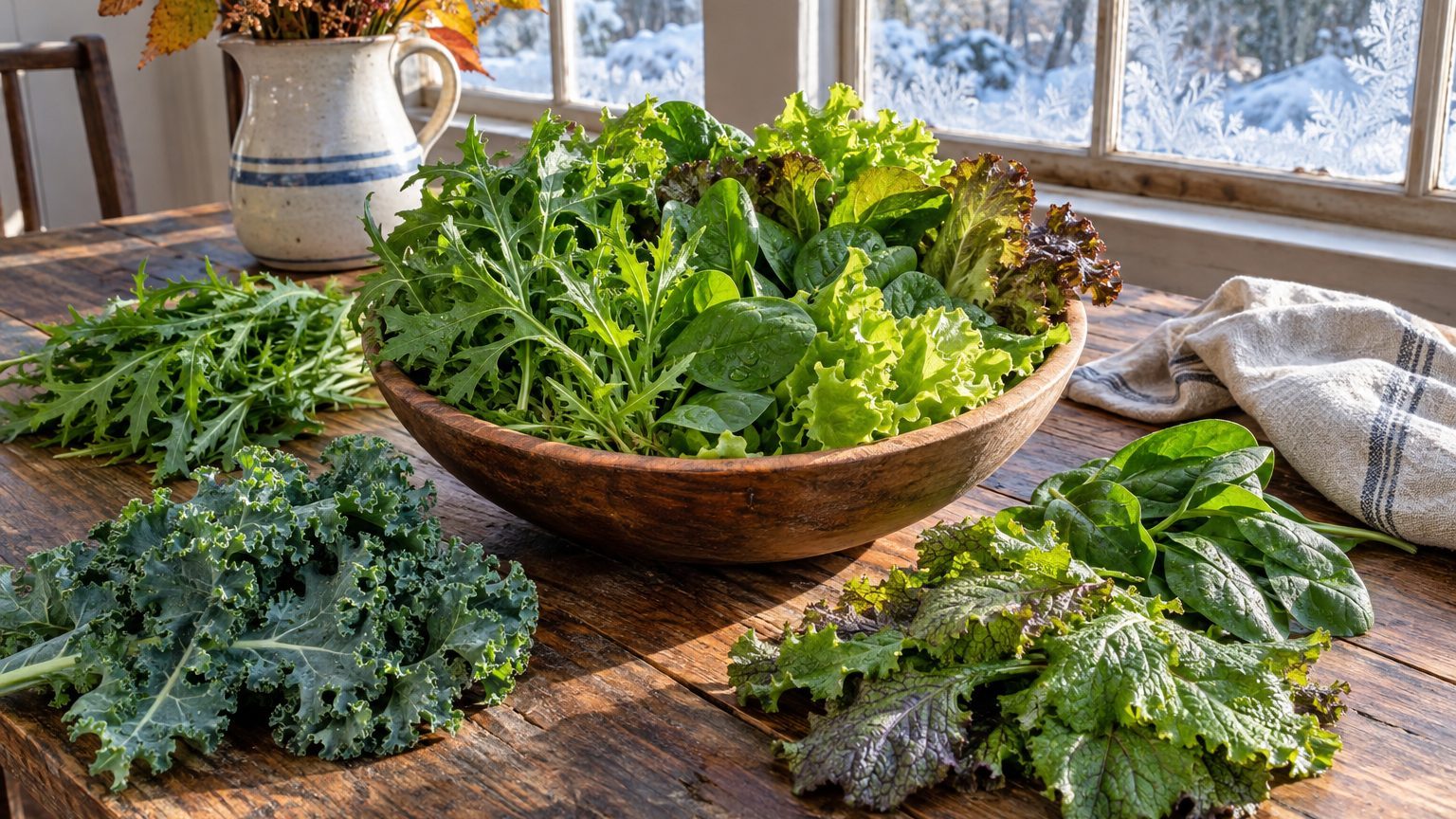

The best winter salads for North Dakota are the hardiest leafy greens: spinach, mâche, claytonia, and cold-tolerant lettuce, grown under a hoop house, low tunnel, or cold frame. No tender salad crop comes through a Dakota January in an open bed. Sow in late summer, let the plants reach size before the light fades, then pick leaves slowly from a covered bed through the dark months.
The short answer for North Dakota
Two numbers set the plan. At the Fargo reference station, the mean daily minimum of the coldest month is 0.2°F. The first fall freeze (32°F) falls between September 25 and October 5, the band where the odds of that freeze are 30 to 70 percent. Suburban and rural gardens usually freeze one to two weeks earlier than the airport, and more so at elevation. A short fall means everything must be nearly full size before cold weather. After that the covered bed works as a pantry, because growth nearly stops in deep winter when days are short.
That favors small, fast, cold-loving types over slow heading ones. The overview in Winter Salads for North Dakota Gardens covers the full system. The decision by type looks like this:
| Type | Role in a Dakota winter bed | Cold tolerance |
|---|---|---|
| Mâche (corn salad) | Small rosettes, slow but steady, pick whole or leaf by leaf | Among the toughest salad greens |
| Claytonia (miner’s lettuce) | Succulent leaves, holds well under cover | Very high |
| Spinach | Backbone of the bed, sweetens in the cold | High, if sown to be near full size by hard freezes |
| Cold-tolerant lettuce | Loose-leaf and small romaine types, picked as outer leaves | Moderate, needs a covered bed |
| Mizuna, tatsoi, baby kale | Fast fall fillers, good for early winter picking | Moderate to high |
| Arugula | Quick, spicy, best in fall and again in early spring | Moderate |
Which varieties should you look for?
Read seed descriptions for words like “winter,” “overwintering,” or “cold-hardy.” Spinach sold as a winter type is a safe start. For lettuce, a small-headed or loose-leaf type bred for cold frames beats large summer heading varieties. Mâche varieties are widely available and need little fuss. Pick three or four types rather than one, since each handles a different stretch of the season.
What will not work here

Slow heading crops fail first. Endive, escarole, radicchio, and big romaine heads need many weeks of mild weather to finish. With a first fall freeze as early as September 25 at the reference station, and earlier on many farms and in many suburbs, sowing them in August leaves them half-grown when growth stalls. A head that stopped at the size of a fist in November will not catch up in January.
Open-bed overwintering also fails. A coldest-month mean minimum of 0.2°F, within a USDA hardiness range of 3a to 4b, means leaves left outside under snow turn to mush or blacken by midwinter. Even a single layer of floating row cover over an open bed is not enough for harvest through a Dakota winter. A cold frame or unheated hoop house with a second layer of cover inside gives the plants a chance. Even then, the leaves will freeze solid on cold nights. Pick only after they thaw, because handling frozen leaves tears them and invites rot.
The prairie adds two more problems. Wind rips loose plastic and shifts lightweight hoops, so anchor everything well. Heavy, wet snow can crush a low tunnel, so brush it off after storms. Sunny days in late winter can also overheat a sealed structure, and trapped humidity breeds gray mold and downy mildew on crowded leaves. Vent on any day that climbs well above freezing, and space plants a little wider than you would in spring.
Watering habits matter too. Soil in a covered bed dries slowly in deep cold, so soaking it weekly keeps leaves wet and invites disease. Water lightly and only in the morning on mild days.
What changes across North Dakota
The USDA Plant Hardiness Zone Map (2023, based on 1991-2020 normals) puts North Dakota in zones 3a to 4b. That spread is wide, and there is no single answer for the whole state. USDA zones rest on one variable, the average annual extreme minimum temperature. A garden near the Canadian border can sit a full zone or more colder than one in the southeast, and elevation shifts things again.
If you garden in the colder north or on higher ground, shift three things. Sow earlier, because fall freezes arrive sooner there than the Fargo band of September 25 to October 5. Lean on the toughest types, mainly mâche, claytonia, and spinach, and treat lettuce and arugula as fall and early spring crops. Add a second layer of cover inside your hoop house, such as row cover over the plants, since the extra insulation can matter more than the structure itself.
If you garden toward the warmer southeast, you gain a little extra margin, but the same rules apply. Spring comes late everywhere. The last freeze runs from May 4 to May 15 at the reference station, with suburban and rural gardens typically seeing it one to two weeks later. Overwintered spinach and mâche that survived under cover will restart well before anything sown outdoors in spring.
To find your own zone, use the USDA map and type in your ZIP code. Do not rely on a neighbor’s guess or on the zone printed on a plant tag. Our guide to When to Sow Winter Salads in North Dakota turns these shifts into sowing windows.
Where to check this for your own county
Start with NDSU Extension, the state’s land-grant extension service. Its county offices answer questions from home gardeners, and many have staff who know the local soil, wind, and snow patterns.
Look for two things. First, a local planting calendar for fall and winter vegetables, which should list sowing windows for your area. Second, the varieties trialled near you. A spinach or lettuce that did well in a university trial at a research station is a better bet than one with only a good catalog description. If your county office has information on high tunnels or hoop houses, read it before you build. Snow load, wind, and ventilation advice there is written for your conditions.
Call or stop by if the website does not answer your question. Ask which greens local growers rely on for winter harvest, and what date they stop sowing outdoors in fall. Ask also when they open or vent covers in late winter. Those answers will be more specific than anything written for the whole state.
A county recommendation beats a statewide rule, and statewide guidance like this is only a starting point. The frost dates here come from a single airport station, so a farm 40 miles away can differ by two weeks or more.
Checking this against your own garden
Your own observations outrank every date on any calendar. Three are worth tracking.
- Soil warmth by feel. In early fall and again in late winter, push a hand into the bed. Soil that feels cool but crumbly will still grow seedlings. Soil that feels cold and clumpy will not. A bed that warms up sooner than your neighbor’s has good drainage or a sunny wall, and you can sow a little earlier there.
- Where frost shows first. On the first clear, calm autumn morning, walk the yard and see where white appears on the grass. Low spots collect cold air and freeze first. Beds against a south wall or fence stay green longer.
- The first true leaves. Seedlings show a pair of seed leaves first, then the real ones. If your fall sowings have not made a second set before hard freezes arrive, they are too late to feed you this winter, and you should sow earlier next year.
Write the dates down once a year. After two seasons, your notes will be a better guide than any chart.
Common questions
Can spinach survive a North Dakota winter outside?
Spinach is hardy enough to survive some cold, but with a coldest-month mean minimum of 0.2°F, plants in an open bed are unlikely to make it. Under a cold frame or a covered hoop house with an inner layer, spinach has a good chance and will regrow in early spring.
Do I need a hoop house for winter salads?
For harvest through the coldest months, yes, some protection is needed. A cold frame handles a small bed. A hoop house covers more ground. Without cover, you can still grow fall salads and take a final harvest before the deepest cold.
Which winter salad is easiest for a beginner?
Spinach and mâche are the most forgiving. Both germinate in cool soil, tolerate cold, and keep well in a covered bed. Mâche is slow to germinate, so mark the row and be patient.
When should I sow winter salads?
Sow late enough that heat does not make them bolt, but early enough that plants are close to full size before hard freezes. Because suburban and rural gardens freeze earlier than the reference airport, use your county extension office and the sowing guide linked above to fix your date.