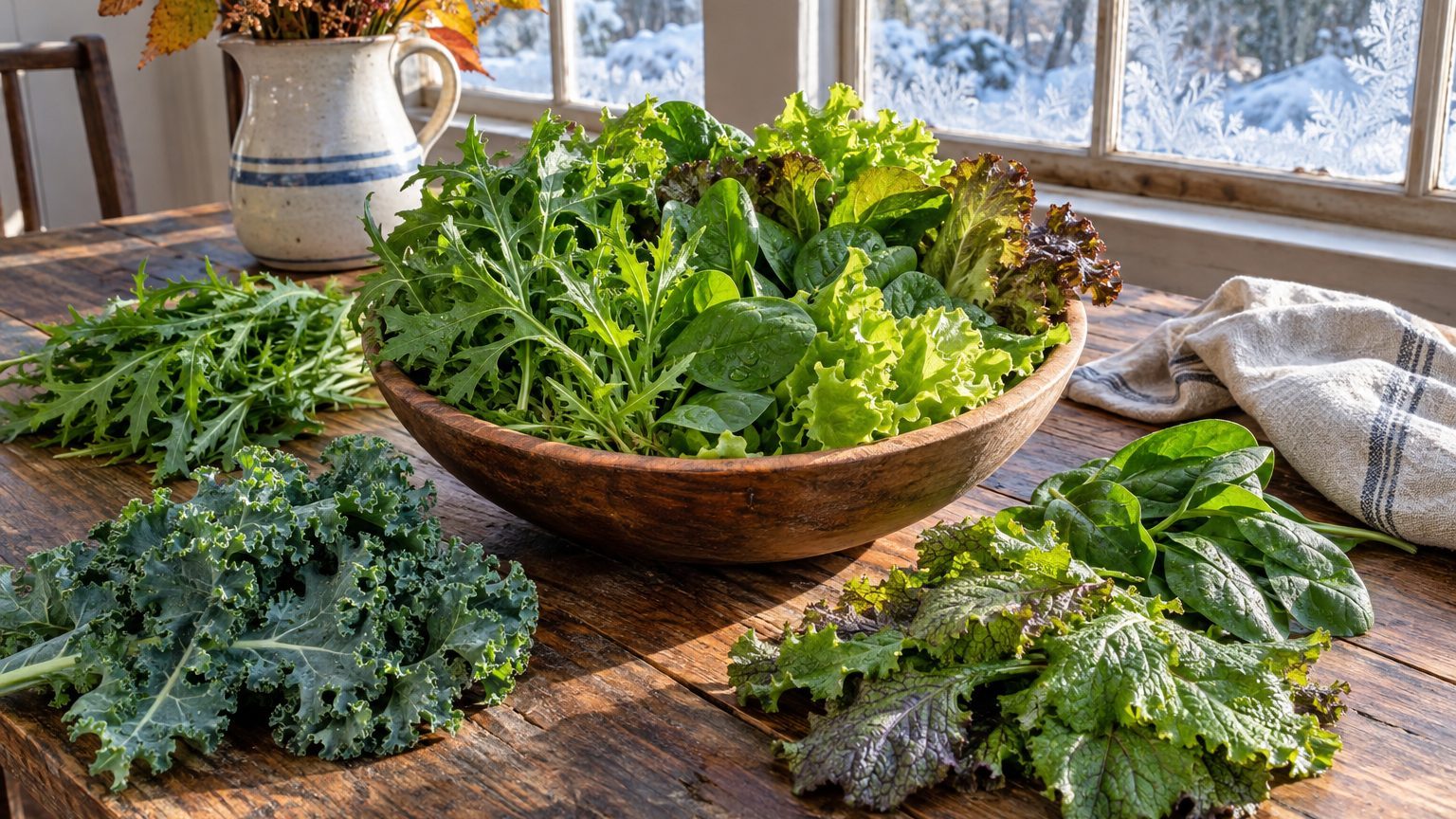

Pick quick, cool-loving leafy greens that can be cut young, and plan to grow most of them indoors. Spinach, arugula, mizuna, loose-leaf lettuce and microgreens suit Nunavut’s short, cold season. Heading cabbages and slow roots do not. Outdoor sowing gets a window of under three months, and the long dark winter belongs to windowsills, grow lights and heated greenhouses.
The short answer for Nunavut
Sort the choices by type and let the calendar decide. The Rankin Inlet A station has a mean last spring frost on June 19 and a mean first fall frost on September 13, but these are midpoints of a window, not safe dates. Those are averages from 1981-2010. In one year out of two the last frost falls later than June 19, and in one year out of two the first fall frost arrives earlier than September 13. Sowing on June 19 itself still leaves a coin-flip chance of another frost.
| Type | Examples | Fit for Nunavut |
|---|---|---|
| Quick baby-leaf greens | Spinach, arugula, mizuna, loose-leaf lettuce | Best outdoor choice, cut young |
| Cold-season specialties | Mâche, claytonia | Good in a sheltered frame or greenhouse |
| Sturdy cut-and-come-again | Baby kale, chard | Workable if harvested small |
| Microgreens and shoots | Pea shoots, radish, sunflower | Best for midwinter, indoors |
| Heading and slow crops | Cabbage, radicchio, endive, storage roots | Poor, they outlast the season |
Which salad greens suit a season this short?
Baby-leaf types. Many are ready to cut in a short time after sowing, which fits the gap between the last spring frost and the first fall frost with room for successive sowings. Cutting leaves while they are young and tender also keeps spinach and lettuce from running to seed. The full list of crops for the territory is covered in Winter Salads for Nunavut Gardens.
What can you eat fresh in the dark months?
Microgreens and shoots. Pea shoots, radish and sunflower greens need only a shelf, a tray of soil and a grow light, and do not care what the thermometer outside says. Nunavut’s coldest month averages a daily minimum of -34.3 °C, and midwinter daylight is thin, so anything that needs a full-size plant outdoors is off the table. Indoor trays turn the dark season into a steady salad supply.
What will not work here

The usual winter-salad playbook comes from places with mild falls, and most of it fails at this latitude. Four things stand out.
Why does fall sowing for winter harvest fail?
Southern advice says to sow hardy greens in late summer and pick them through the cold months. With a mean first fall frost on September 13, a sowing made in August gets only a few weeks of growth before the cold arrives, and the plants never reach harvest size. Sowing earlier, in July, can work for a fall cutting. Overwintering outdoors is another matter. A coldest-month mean minimum of -34.3 °C is beyond what even mâche or claytonia survive in an open bed, and the Canadian hardiness zone for the reference city is 0a, the coldest end of that scale. For timing the sowings that do work, see When to Sow Winter Salads in Nunavut.
Why do heading crops and unheated structures let you down?
Cabbage, radicchio and Belgian endive need a long season in the ground, and the short frost-free window leaves no margin once you subtract the cold, slow weeks after thaw. An unheated cold frame or greenhouse does not help in midwinter either, because inside temperatures follow the outside down. A greenhouse for winter greens needs reliable heat and light, and the fuel bill is the real cost. Plenty of northern gardeners decide a lit tray indoors is the better use of money.
Do spinach and lettuce bolt in Nunavut?
Yes, often. Summer days are extremely long, and spinach in particular reads that as a signal to flower. Sowing in early June, when the soil is still cold, also leaves seeds sitting for weeks. Pick bolt-resistant varieties, sow in short successive batches, shade the bed in the brightest weeks, and harvest young.
What changes across Nunavut
Nunavut is not one garden. It runs from the Hudson Bay coast to high Arctic islands, and the frost dates above come from a single airport station at Rankin Inlet. Northern communities run weeks behind those dates, so the spring window shrinks and the fall window closes sooner.
The hardiness zone of the reference city is 0a in Canada’s plant hardiness system, built by Natural Resources Canada from seven climate variables, using 1991-2020 normals. It is a Canadian zone and does not convert to a USDA zone, since the two systems measure different things. It is also one city’s number. Because the zone describes a reference city, there is no single answer for the territory, and communities farther north will sit in similarly cold or colder conditions. To find your own community, use the Canada’s Plant Hardiness Site map and search by municipality rather than assuming a zone.
What should a reader shift? Farther north, or on exposed ground, lean harder on indoor growing and on the fastest crops. Microgreens and baby leaf crops finish in the time that heading lettuce cannot. Sow in short batches a week or two apart so a late frost or an early one costs you one sowing rather than all of them. Use a south-facing wall or a windbreak made from snow fencing or pallets, because wind chill dries and tears tender leaves. Dark soil in raised beds and a row cover over the seedlings will pick up the extra week or two that sheltered ground can give. Coastal gardens near open water may stay cooler through the summer than inland spots, which helps spinach and hurts anything that likes heat.
Where to check this for your own county
Nunavut has no counties and no US-style network of university extension offices. The nearest federal source is Agriculture and Agri-Food Canada. Start there for northern and cold-climate growing guidance, and look for two things: a planting calendar written for short-season or northern conditions, and any trial results that show which leafy greens and microgreens were grown in Arctic or subarctic communities rather than in southern Canada.
Local knowledge is worth more than a territory-wide summary. A recommendation for your own community, drawn from people who have grown salads in the same wind and the same soil, beats an overview covering a region this large, and a territory-wide overview like the one above is the coarse tool. If your hamlet has a community greenhouse, a school growing program or a gardening group, ask who runs it, what they sowed and in which week. Ask what failed too. A neighbor who lost a tray of spinach to bolting in July can save you the same lesson.
Readers elsewhere in the United States should go to their state’s cooperative extension office and ask for their county’s planting calendar instead, since frost dates change from one county to the next.
Checking this against your own garden
The dates above are averages from a station that may be miles or hundreds of miles from your plot. Your own observations outrank them, and three are enough.
Soil warmth by feel. Push your hand into the bed to the depth of your wrist. If the soil is thawed, crumbles and feels cool rather than icy, spinach, arugula and lettuce seed will start. If it still feels like something from the refrigerator, wait. Compare a bed against a south-facing wall with open ground, and you will learn how much your shelter is worth.
Where the snow leaves first. The patches that clear earliest are your warmest ground. Sow there first, and put container greens in the same spot. A slow-melting drift tells you where not to plant early.
First true leaves. The first pair of leaves a seedling shows are seed leaves. The next set, the true leaves, means roots have taken hold. Note how many days that takes in your garden and compare it with the packet. If yours run slower, add cover or move the tray indoors.
Common questions
Can you grow salad greens outdoors in Nunavut in winter?
No. With a coldest-month mean daily minimum of -34.3 °C and very little daylight, nothing grows outside in midwinter. Winter salads here mean indoor trays, grow lights or a heated greenhouse.
What is the fastest winter salad to grow?
Microgreens. Pea shoots, radish and sunflower greens are usually ready from sowing well ahead of baby spinach or lettuce.
Is Canadian hardiness zone 0a the same as a USDA zone?
No. Natural Resources Canada states that there are no simple conversions between the two systems. The Canadian system uses seven climate variables and the USDA system uses one, so a Canadian zone can overlap several USDA zones.
Is June 19 a safe date to sow outdoors?
It is the average last spring frost at Rankin Inlet A, so in half of all years a frost falls later. Sow hardy greens with row cover on hand. These averages cover 1981-2010, while US frost figures cover 1991-2020, so the two cannot be compared directly.