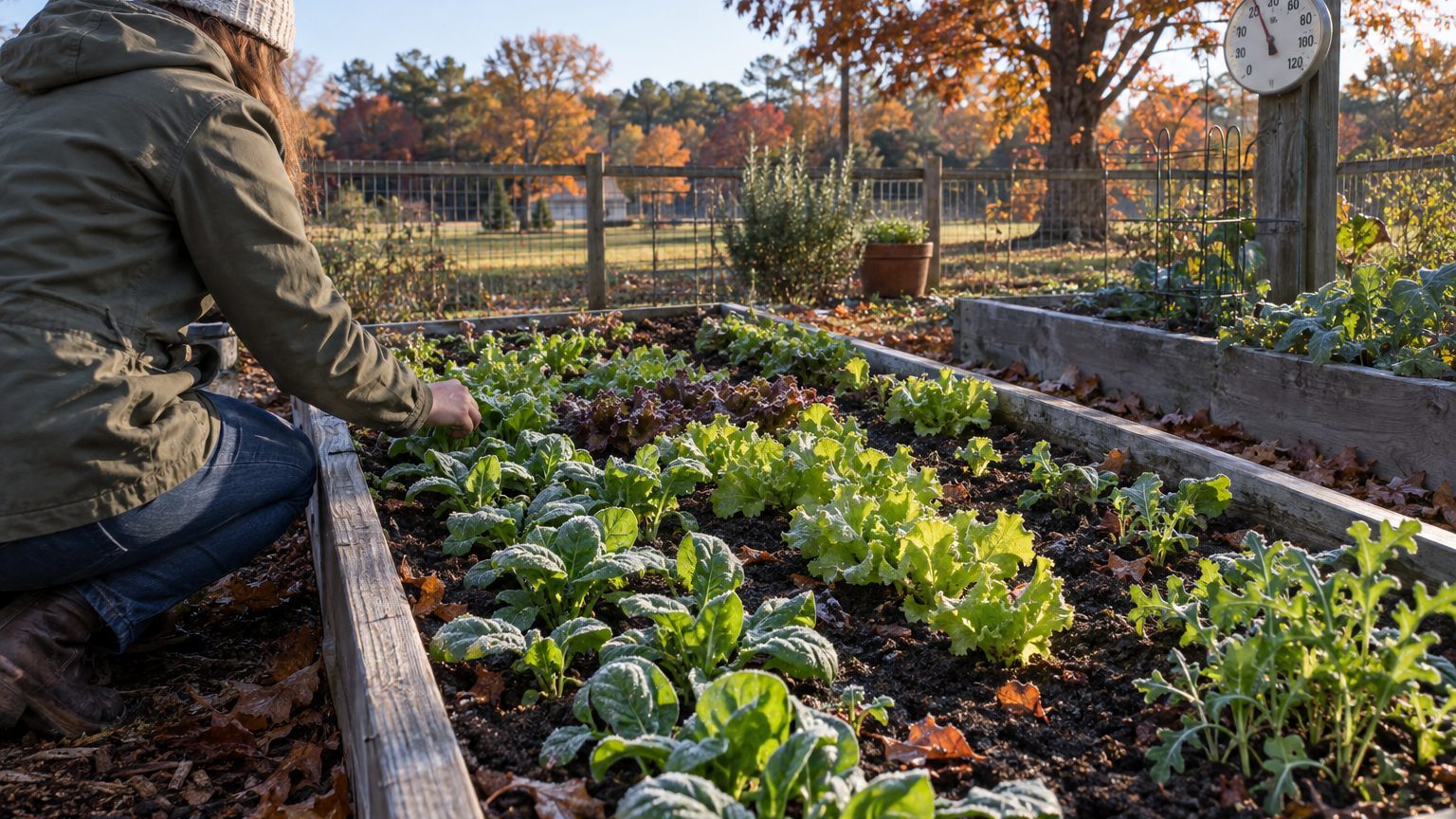

Outdoors, winter salads in Nunavut get one short window, running from the soil thaw in mid to late June until about late July. After that, the greens meet a first frost that arrives before September 13 in half of all years. A true winter crop, sown in the dark months, belongs on a windowsill, under grow lights or in a heated space, and it can be sown any time from now on.
The short answer for Nunavut
Sow hardy salad greens outdoors from about the mean last spring frost, which falls on June 19 at the Rankin Inlet A station, and make the final outdoor sowing in late July. A seed that goes in later than that runs out of season before it makes a harvest. For a broader view of the crop group, see Winter Salads for Nunavut Gardens.
Both dates come from Environment and Climate Change Canada’s 1981-2010 normals for that station, and both are averages. June 19 is the midpoint of the last-frost window: in one year out of two, the last frost falls later. September 13 is the midpoint for the first fall frost: in one year out of two, it arrives earlier. Treat the pair as the middle of a range and never as a safe date. (US figures elsewhere use 1991-2020, so the two sets are not on the same footing.)
When can you sow winter salads outdoors in Nunavut?
Spinach, arugula and many loose-leaf lettuces tolerate a light frost. Seed can go into the ground as soon as the soil has thawed enough to work, even if one more frost is possible. The reference station has about 86 frost-free days between the mean last spring frost and the mean first fall frost. That is the whole season for everything outdoors.
Packet days for leaf crops count from sowing, and baby-leaf greens are often ready quickly. Work back from September 13 and a 45-day crop sown at the end of July has no margin left in an average year. Aim for the first half of July for the last outdoor sowing, and sow in small batches every week or two so the harvest is spread out.
What about sowing indoors?
Indoor sowing follows the light and the room temperature, with no frost date involved. A pot of baby greens under a grow light can be sown in October, January or March. Starting seedlings indoors a few weeks before the thaw also gets leaves growing while the ground is still frozen. For which greens suit these methods, read The Best Winter Salads for Nunavut.
| Method | Sowing window | What ends it |
|---|---|---|
| Outdoors, in beds or containers | Once the soil thaws, around June 19, to the first half of July | First fall frost, mean date September 13 |
| Indoors, to transplant outside | About 3 to 4 weeks before the planting-out date in late June | Seedlings outgrowing their pots |
| Indoors, to harvest in place | Any month | Light and warmth, with no calendar limit |
What will not work here

The classic winter-salad routine is to sow in late summer and harvest under cover through the cold months. It fails in Nunavut. With the first frost arriving on average on September 13, a seed sown in August has only a few weeks to grow, and daylight shrinks quickly at this latitude. The plants stay seedlings, and then the cold arrives.
Overwintering outdoors is equally out of reach. At the reference station the mean daily minimum of the coldest month is -34.3 °C (-29.8 °F). Spinach and mâche that shrug off hard frosts in the mid-latitudes are not built for months at that temperature. A cold frame or a layer of row cover does not hold back that kind of cold, and the soil is frozen solid, so roots cannot draw water even if the leaves survive.
Slow crops are the next casualty. Heading chicories, radicchio and full-size heading lettuces need a long season. Against a season of about 86 frost-free days, they would have to be sown the day the soil thaws and then escape every cold snap. Loose-leaf and baby-leaf types that can be cut young fit the calendar. Anything that has to form a head does not.
Midsummer brings the opposite problem. Near-continuous daylight around the solstice pushes spinach and arugula toward bolting, which turns the leaves bitter and sends up a flower stalk. A bed sown in the long days of late June should be cut as baby leaf within a few weeks. Letting it grow to full size is a mistake.
Two quieter mistakes are worth avoiding. One is setting transplants outside before the mean last frost date has passed, since in half of years a frost still follows that date. The other is seeding into cold, saturated ground in early June, where seed sits and rots instead of sprouting. Raised beds and containers warm sooner than open ground, so they give the first sowing a better start.
What changes across Nunavut
The Rankin Inlet A station is a single point on a very large map. Nunavut stretches from the southern Hudson Bay coast to the High Arctic islands, and no single sowing date fits all of it. The reference city sits in Canadian hardiness zone 0a, the cold end of the Canadian scale. That number comes from Natural Resources Canada and is built on seven climate variables. It is not a USDA zone, and it does not convert to one.
Communities farther north, and those on exposed high ground, run weeks behind the Rankin Inlet dates. The soil thaws later and the first frost arrives earlier, so the outdoor window narrows from both ends. A gardener in one of those places should move the first sowing later, move the last sowing earlier by the same number of weeks, and expect fewer outdoor succession sowings. In the far north, the outdoor window may shrink to a few weeks, and containers and indoor growing carry most of the load.
Coastal sites bring their own twist. Sea ice and cold water keep spring cool near the shore, while a spot a short way inland may thaw and warm up sooner. Shelter matters as much as latitude: a south-facing wall or a windbreak can gain a few days at each end of the season.
Your own zone is on Canada’s Plant Hardiness Site, which lists the zone by municipality. Look up your community there instead of borrowing the reference city’s zone, and treat any outdoor date as a starting point to adjust.
Where to check this for your own county
Nunavut has no counties, and no US-style extension network. The nearest equivalent is the agricultural support that federal and territorial departments provide, and the federal department, Agriculture and Agri-Food Canada, is the place to begin. Look there for northern and short-season growing guidance, and for any planting calendar written for Arctic or sub-Arctic conditions.
Two things are worth asking for. The first is a local planting calendar, with sowing dates tied to your community’s own thaw and frost pattern. The second is a list of the varieties that have been trialled in northern communities, since a variety that does well at a southern research farm can fail on a short Arctic season.
A recommendation from someone who grows in your own community outranks a territory-wide one every time. The dates given here come from one weather station, and Nunavut covers an enormous range of climates. A community greenhouse group, a school garden or an experienced neighbor, if your community has one, can tell you things no regional average can, such as which month the soil really warms up and where the wind flattens a bed.
Checking this against your own garden
Your own observation outranks every date above. Three things are worth watching, and none needs equipment.
- Soil warmth by feel. Push a hand or a trowel into the bed. If the soil is still cold enough to ache and the thaw is only a shallow layer, hold the seed. Soil that feels cool but loose and workable is ready for hardy greens. A bed that reaches that point earlier than the neighbors’ has a warmer microclimate.
- Where the snow melts first. The patch that clears first, usually a sheltered or south-facing spot, is where the earliest sowing belongs. The spot that holds snow longest is a place for late-season crops, or for none.
- The first true leaves. The first pair of leaves on a seedling are seed leaves. The second pair, the true leaves, show how fast the plant is really growing. If true leaves appear soon after sowing, the site is warm enough. If they take much longer, the bed is cold, and a container or an indoor start would do better.
Keep a short note of the dates for sowing, sprouting and the first frost that blackens tender plants. After a season or two, that record is a better calendar than any average.
Common questions
Can winter salads grow outdoors through the winter in Nunavut?
No. The mean daily minimum of the coldest month at the reference station is -34.3 °C (-29.8 °F), and the ground is frozen. Winter salads in Nunavut are grown indoors, under lights or in a heated space.
What is the last date to sow salad greens outdoors?
The mean first fall frost at Rankin Inlet A is September 13, and half of years bring it earlier. For quick baby-leaf greens, the first half of July leaves a safe margin. Communities farther north should sow earlier still.
Is June 19 a safe date to plant out?
No. It is the mean last spring frost, so in one year out of two the last frost falls after it. Hardy greens tolerate a light frost, but tender plants and young transplants need protection.
Is Nunavut’s hardiness zone the same as a USDA zone?
No. Rankin Inlet is in Canadian hardiness zone 0a, a system built on seven climate variables. Natural Resources Canada says the Canadian and USDA systems have no simple conversion, so the two numbers cannot be compared.