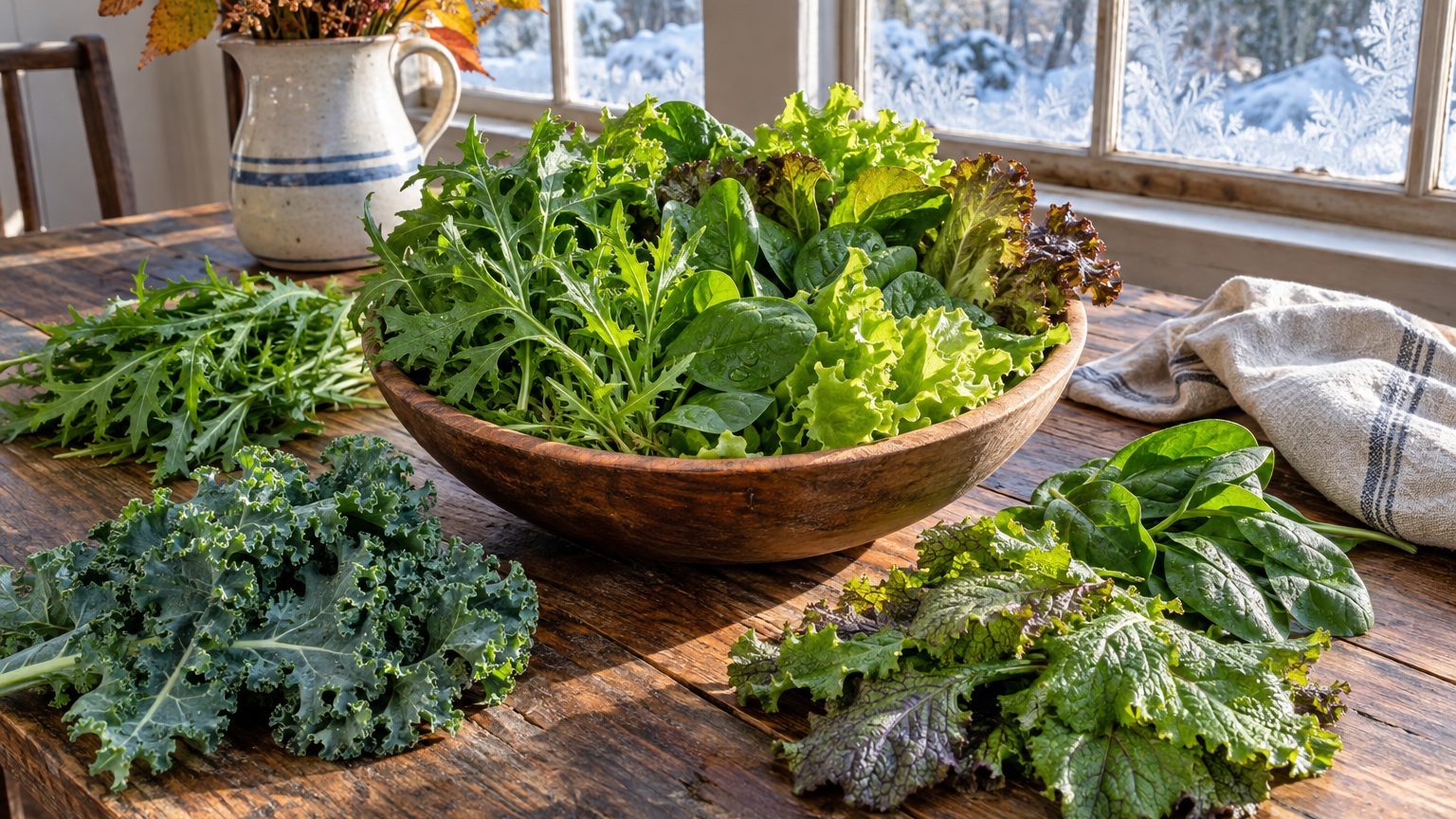

The best winter salads for New York are the cold-tolerant leaf crops: spinach, mâche, claytonia, kale, mizuna and tatsoi, plus hardy chicories and a few cold-tolerant lettuces. Sow them in late summer and early fall, so they size up before the dark months. Skip tender summer lettuce outdoors. For a wider look at the season, see Winter Salads for New York Gardens.
The short answer for New York
Choose by type, and let the cold decide. At the New York City reference station (Central Park), the last spring frost falls between March 23 and April 3, and the first fall frost between November 14 and November 27. Those dates mark the band where the chance of a 32°F freeze runs from 30 to 70 percent. Central Park is a dense urban site, so these are New York City figures, not statewide ones. The coldest month there has a mean daily minimum of 27.9°F. Nights dip below freezing in midwinter, but the cold stays moderate, and hardy greens carry through it with a little cover.
That long, mild fall is the main advantage in the city and on the coast. Cool-season greens can keep growing into November, and the hardiest ones sit through the coldest weeks and resume in late winter. Summer heat is the other half of the picture. Warm soil in August and early September keeps many salad seeds from sprouting, so the sowing date matters as much as the variety. The detailed timing is in When to Sow Winter Salads in New York.
Which winter salad types suit New York best?
| Type | Examples | How it handles New York cold | Best use |
|---|---|---|---|
| Hardy rosettes | Spinach, mâche, claytonia | Among the hardiest salad crops; they stay green through freezing nights | Open beds with light cover, harvest through winter |
| Brassica greens | Kale, mizuna, tatsoi, arugula | Kale and mizuna take hard frost; tatsoi and arugula prefer light cover | Cut-and-come-again salad mix, sweeter after frost |
| Chicories | Radicchio, escarole, endive | Handle fall cold well but grow slowly once days shorten | Early fall sowings only, with cover late in the season |
| Winter lettuce | Cold-hardy leaf and small-head types | The least hardy of the group | Cold frame or low tunnel |
Why do spinach, mâche and claytonia come first?
All three form low rosettes close to the ground, and that shape protects them. Spinach sown in fall sits small through the coldest weeks and grows again as days lengthen. Mâche, also sold as corn salad, has mild, nutty leaves and keeps going in cold soil where most crops quit. Claytonia, sometimes called miner’s lettuce, has round succulent leaves and grows well in cool, low light, which makes it a good fit for a cold frame in January.
What will not work here

Sowing salad greens at the wrong moment fails more often than any variety choice. Lettuce seed sown in the warm soil of late summer often sprouts poorly or not at all, because heat sends the seed into dormancy. Shade the bed, water the seed row lightly, or wait for the soil to cool.
Sowing too late fails just as reliably. With the first fall frost arriving between November 14 and November 27 at the New York City reference station, and days getting shorter long before that, growth slows sharply in October. Slow crops such as radicchio and heading endive that go in after early fall rarely make full heads. They sit as small seedlings, and any harvest waits for spring. Fast leaf crops have more room for error, which is why spinach, mizuna and mâche are the safer bets for a late sowing.
Why does tender lettuce struggle outdoors in winter?
With a coldest-month mean daily minimum of 27.9°F, the average winter night in New York City falls below freezing. Tender lettuce and basil-type crops cannot take repeated freezes, and an unprotected row often turns to mush after the first hard night. Even hardy crops stall in this cold. They hold their leaves, but they stop adding new growth, so a bed that looks full in late November is the harvest you have until late winter. Pick lightly and spread the cutting across plants.
Does a damp fall hurt winter salads?
It can. Fall in New York often brings long stretches of wet, cloudy weather, and crowded plants stay damp for hours. That favors rot at the base of lettuce and mildew on spinach. Give each plant room to dry between rains, and thin seedlings early. A packed bed that looks lush in October is the same bed that collapses in a wet November.
What changes across New York
New York is not one garden. The USDA Plant Hardiness Zone Map (2023 edition, built on 1991-2020 normals) places the state across zones 3b to 7b. That is a range of zones, from the coldest Adirondack valleys to the sheltered coast of Long Island and New York City. The zone is based on one variable, the average annual extreme minimum temperature, so it tells you whether a plant survives the cold at all. It says nothing about when to sow. No single answer fits the whole state.
The practical effect shows up in the calendar. A gardener in the city and on the coast has a long fall and a mild winter, and open-bed spinach and kale can run well into winter. A gardener in the Adirondacks, the North Country or the high ground of the Catskills has a shorter fall, deeper cold and snow that arrives early. Snow is useful here, because a steady cover insulates hardy rosettes. Bare, frozen ground without snow is the harsher test.
What should a gardener in the north or at altitude change?
Sow earlier, because frost comes earlier and the sowing window closes sooner. Favor mâche, claytonia, spinach and kale over lettuce, arugula and chicories. Plan on a cold frame or low tunnel from the start, since open beds will carry far less of the winter. Treat the city dates as the edge of a mild range, and expect to shift sowing earlier the further north or higher you garden.
Your own zone depends on your own address, and the map will show it more reliably than any guess. Look up your location on the USDA Plant Hardiness Zone Map and use the result to judge how hardy a crop you need. The sowing dates in When to Sow Winter Salads in New York are tied to the New York City reference station, so gardeners elsewhere in the state should adjust them.
Where to check this for your own county
Your county office of Cornell Cooperative Extension is the best next stop. Every county in the state has an office staffed by people who work the local soil and weather. The address of your nearest one is available through the Cornell Cooperative Extension directory on that site.
Look for two things. First, a local planting calendar for fall and winter crops. A county calendar reflects local frost dates, which can differ a great deal from Central Park’s. Second, the varieties that have been trialed in your county. Trial results show which cultivars of spinach, kale and lettuce held up locally, and that saves a season of guesswork.
Why does a county recommendation beat a state one?
New York spans several hardiness zones, lake-effect snow belts, river valleys, mountains and a coastline. Statewide guidance, including everything above, averages over very different ground. A county office knows whether your area has early frosts, heavy snow cover, windy exposure or a long wet fall, and it can tell you what actually grew there. When a county recommendation and a state one disagree, follow the county.
Checking this against your own garden
Your own observations outrank every date above. A garden on a south-facing slope, a sheltered corner against a wall or a low spot where cold air pools can differ by weeks from a neighbor’s. Three things are worth watching, and none needs an instrument.
- Soil warmth by feel. Push your hand into the bed in the morning. If the soil still feels warm in late summer, wait before sowing lettuce, mâche or spinach. When it feels cool but not cold, seed will sprout. A bed that stays warm longer than the garden next door has a mild microclimate and can take a later sowing.
- The first true leaves. After the two seed leaves, the first true leaves show a seedling is established. If seedlings reach that stage well before the first frost, they have time to size up. If they are still tiny when cold arrives, treat them as a spring crop and cover them.
- The first white frost on your own yard. Check the lawn, car roof or rail on cold mornings. Frost that appears in your yard before the forecast says it should means a cold pocket, and sowing dates there should move earlier.
Common questions
What is the easiest winter salad green to grow in New York?
Spinach is the most forgiving. It tolerates freezing nights, sprouts in cool fall soil and regrows in late winter. Mâche and kale are close behind.
Do I need a cold frame for winter salads in New York?
Not for the hardiest crops in the city and on the coast, where spinach, mâche and kale can stand in open beds. Lettuce and arugula do better under cover, and gardeners upstate or at altitude should plan on a cold frame or low tunnel for most crops.
When should I sow winter salads in New York?
Sow in late summer and early fall, early enough for seedlings to size up before growth slows. The dates depend on how early frost comes where you garden, and When to Sow Winter Salads in New York lays out the timing against the New York City reference dates.
Can arugula survive winter in New York?
Arugula tolerates light frost but is less hardy than spinach, kale or mâche. A hard freeze damages the leaves, so grow it under cover if you want it through the coldest weeks.