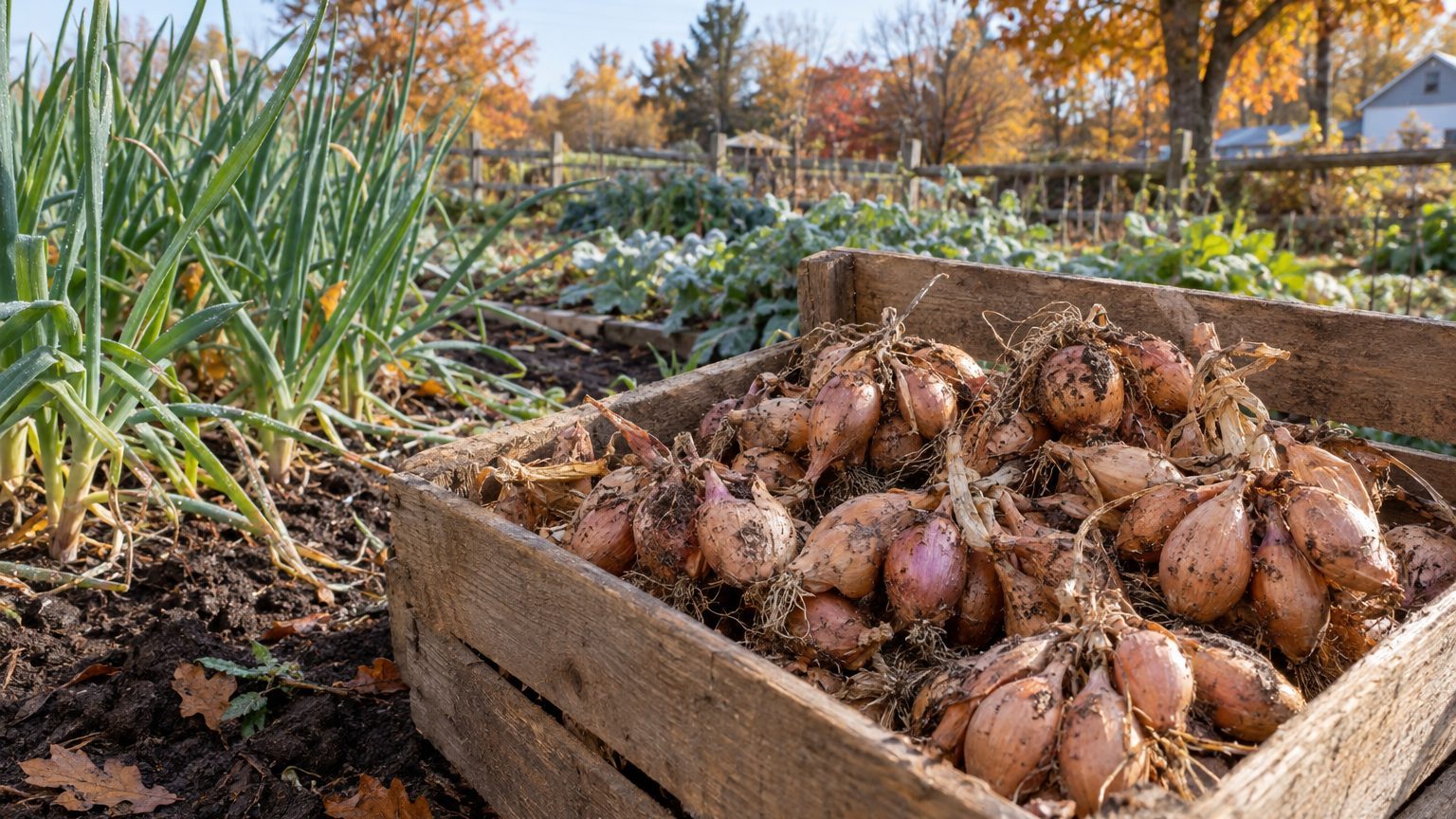

Plant shallots from bulb sets in spring, and pick the earliest-maturing type you can find. Variety names matter less in the Yukon than the type does, because the season rewards a head start and punishes anything slow. A shallot that needs a long, warm runway will not get one.
The short answer for Yukon
Early shallots grown from sets (small bulbs that multiply into a cluster) are the best choice for the territory. Seed-grown shallots come second, and only if you start them indoors and transplant them. The reason is the length of the season: at the Whitehorse reference station, the mean last spring frost falls on June 5 and the mean first fall frost on August 25, which leaves about 81 frost-free days between them.
Both dates are means from the 1981-2010 Canadian Climate Normals, so treat each as the middle of a window. In one year out of two, the last spring frost comes after June 5. In one year out of two, the first fall frost arrives before August 25. A shallot that needs the whole 81 days has no cushion in the bad half of years.
Sets solve most of that problem because the bulb already holds a stored food supply. Growth starts at once, and the plant splits into a cluster of new bulbs without spending weeks as a seedling. Seed-grown types start from nothing, so they lose weeks before they put on any bulb. Shallots also form bulbs as days lengthen, and summer days in the north are very long. Daylight is on your side. Warmth and calendar time are what run short.
| Type | How it is started | Fit for a short northern season |
|---|---|---|
| Early set-grown shallots | Bulbs planted in spring as soon as the soil can be worked | Best choice, with the most margin before fall frost |
| Seed-grown shallots | Sown indoors in late winter, transplanted after frost risk eases | Workable with indoor space and a sheltered bed |
| Late or slow set-grown shallots | Bulbs planted in spring | Risky, because bulbs may still be sizing up when frost arrives |
| Fall-planted sets | Bulbs planted in autumn and mulched | A gamble, worth a small test row only |
When you read a seed or bulb catalog, look for the earliest maturity listed and compare it with the 81 days. Choose something that finishes well inside that window. For exact planting dates, see When to Plant Shallots in Yukon. For the wider picture of the crop, start with Growing Shallots in Yukon.
What will not work here

Direct-sowing shallot seed outdoors is the clearest failure. Seed sown into cold ground in late May or June produces thin seedlings, and with only 81 frost-free days there is no time left to grow them into bulbs. Even indoor-started seedlings need a decent head start, since the plants have to be established before the summer is half gone.
Planting by the calendar date on the seed packet fails too. Packets are written for gardens where the last frost comes in April or May. At Whitehorse the mean last frost is June 5, and half of years run later. Shallot sets tolerate cool soil, but planting them in ground that is still frozen or soaked with meltwater invites rot. Sets planted into a cold snap can also bolt, sending up a flower stalk in place of fattening a bulb. A bolted shallot gives you a hollow stem and a small, poor bulb.
Winter is the other limit. The mean daily minimum of the coldest month is -19.2 °C (-2.6 °F), and that is an average, so many nights run colder. Shallots are not as hardy as garlic. Fall-planted sets can survive under deep snow, but the margin is thin when snow cover is light and the soil freezes hard. Plant a small test row with a heavy mulch if you are curious, and keep your main crop in spring.
Slow varieties also fail. A type bred for a long, warm season may still be putting on bulb when frost arrives. Rather than curing in the field, it spends its last weeks in cold nights, and the bulbs stay small and soft. Late nitrogen makes this worse, because lush green tops delay the point where the plant turns its energy to the bulb.
Finally, do not count on curing outdoors in September. With the mean first frost on August 25, the fall weather is often cool and damp when shallots need warm, dry air. Pull the bulbs once the tops fall over and finish drying them indoors, in a dry, airy spot out of the rain.
What changes across Yukon
The Canadian hardiness zone for the reference city is 1b. That is the Canadian system, built on seven climate variables, and it does not convert to a USDA zone. The figure belongs to one city and not to the whole territory, so there is no single answer for Yukon. Zones inside its borders spread out with latitude, elevation, and whether a garden sits in a river valley or on a bench above it.
The Whitehorse frost dates also describe one station. Northern and upland districts run weeks behind it, so a garden at altitude or far north may have a season much shorter than 81 days. Those gardeners should lean harder on the earliest sets, start any seed-grown shallots indoors earlier, and use a low tunnel or row cover to warm the soil.
Local terrain can shift things in either direction. Cold air pools in low spots and valley bottoms, so a hollow can frost days after a south-facing slope has stayed clear. A raised bed with a sunny, sheltered exposure warms sooner in spring and often gives shallots the extra week or two they need. Dark mulch or plastic laid over the bed before planting helps the soil warm faster.
To find your own zone, use the Natural Resources Canada plant hardiness map and look up your municipality. Do not guess it from a neighbor in another valley.
Where to check this for your own county
Yukon has no counties, but the same principle holds for your own district. Start with Agriculture and Agri-Food Canada, then look for the territorial agriculture office, which publishes guidance for northern growers. Look for two things: a local planting calendar for onion-family crops, and any variety trials run in conditions close to yours.
A trial result from a station with a similar season is worth more than any general rule, because it names the shallots that finished and the ones that did not. A local planting calendar also gives a spring window built from frost records near you, and that beats a dated recommendation from a hundred miles away.
A local recommendation outranks a territorial one. Territory-wide advice averages a huge area with very different growing seasons, and the Whitehorse figures sit at the mild end of that spread. If a local grower, a community garden, or a farm in your district has grown shallots for years, their dates and varieties are the best data you will find.
Checking this against your own garden
Your own observations outrank every date above. Three of them are worth watching, and none needs an instrument.
- Soil warmth by feel. Push your hand into the bed a few inches deep. If it aches within a minute, the soil is still too cold for planting. A bed that warms early is a warm microclimate, and a bed that stays cold is a frost-prone one.
- First green shoots. Note how many days sets take to push up leaves after planting. A quick start points to a sheltered, sunny spot, and a slow one means you should plant earlier next year or add a cover.
- Tops falling over. When the leaves yellow and flop in late summer, the bulbs are close to done. If this happens well before the first frost, your site suits the variety. If frost beats it, choose an earlier type.
Write down the dates each year. After two or three seasons you will have a local calendar more accurate than any published normal, and it will show you which sets and which bed work best.
Common questions
Can shallots survive winter in the Yukon?
Sometimes, but it is a gamble. The mean daily minimum of the coldest month is -19.2 °C (-2.6 °F), and shallots are less hardy than garlic. Deep snow and a thick mulch help. Keep fall planting to a small test row and plant your main crop in spring.
Should I grow shallots from sets or from seed?
Sets are the safer choice. They start with stored energy and mature faster. Seed-grown shallots can work if you start them indoors in late winter and transplant them into a warm, sheltered bed.
How do I choose a variety for a short season?
Pick the earliest maturity listed and compare it with about 81 frost-free days at Whitehorse, remembering that half of years are shorter. Northern and upland gardens usually have even fewer days, so they need the earliest types available.
When is the right time to plant?
Plant in spring as soon as the soil is workable and no longer soggy. The mean last spring frost at Whitehorse is June 5, which is the middle of a window and not a safe date. For a timing guide, see When to Plant Shallots in Yukon.