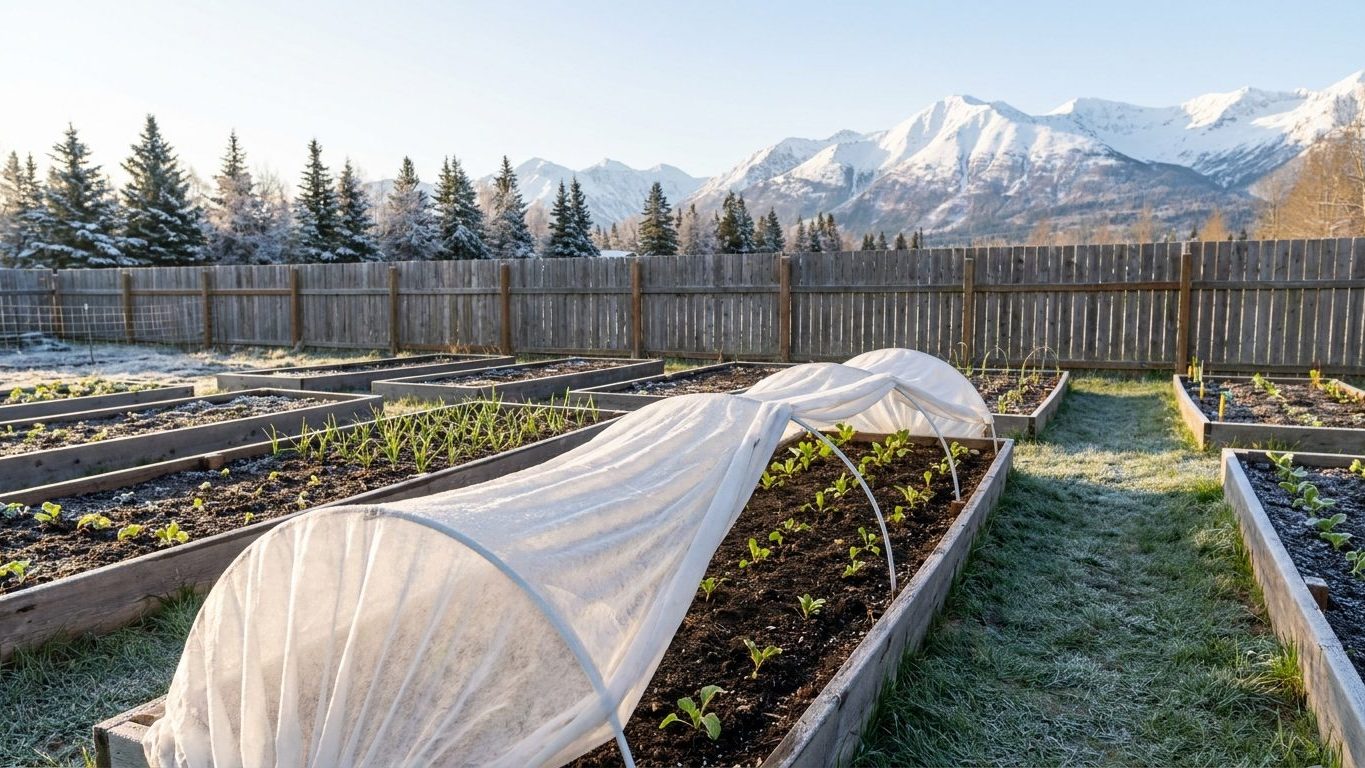

Cover tender plants the evening before any night forecast to reach 32°F, and cover hardy greens only when a harder freeze is coming. In Maryland that rule applies from late October through mid-April, with the exact start and end depending on where the garden sits. The windows below show when a freeze becomes likely, which crops need protection and when, and what to do when the forecast lands right on the line.
The short answer for Maryland
In Maryland, spring covering starts in early April and fall covering starts in late October. At the Baltimore-area reference station, the last spring freeze at 32°F falls between April 3 and April 16, and the first fall freeze falls between October 26 and November 5 (NOAA 1991-2020 Climate Normals). Both ranges are the 30 to 70 percent probability band for a 32°F freeze. Inside a band the odds are close to even, so a freeze after April 16 is less likely but still happens.
That station sits at 39.17 degrees north, and the coldest month there has a mean daily minimum of 25.4°F. Winter nights in central Maryland sit below freezing as a matter of routine. A cover will not make a tomato a winter crop, but it can keep spinach, kale and lettuce going well past the first frost.
When should you cover plants in spring in Maryland?
Start covering whatever is already in the ground as April opens. Hardy crops sown under row cover or a low tunnel do well, which holds a few degrees of warmth on a cold night. Tender transplants such as tomatoes, peppers and eggplant should wait until nights stay reliably above freezing, which comes after the frost band closes. Cover is the safety net for a late freeze. It does not justify planting in March.
Check the forecast every evening in April. If the predicted low is within a few degrees of 32°F, cover. Cold air settles on clear, calm nights, and low spots in a yard often run colder than the forecast for the nearest town. Take the cover off the next morning once the frost has melted and the air has warmed.
When should you cover plants in fall in Maryland?
Start watching the forecast before the window opens. A first light frost often arrives and then gives way to weeks of mild weather, so a single covered night can carry tomatoes, peppers, basil and beans a good while longer. The soil is still warm then, which helps.
Hardy crops follow a different rule. Kale, collards, spinach, carrots and many lettuces handle a light frost uncovered and sweeten in the cold. They need the cover when a hard freeze is forecast, or when you want leaves kept clean. The full range of tools is laid out in Extending the Growing Season in Maryland.
What will not work here

Planting tomatoes on the average last frost date is the most common failure. April 16 is the late edge of a probability band, so a freeze can still follow it, and the soil is usually still too cool for tender crops to grow. A cover protects leaves from a frost night. It does not warm cold soil enough to make a pepper transplant grow.
Sealed plastic is the second failure. A closed low tunnel on a sunny March or April afternoon can run far hotter than the air outside, and Maryland’s spring sun is strong enough to cook seedlings under it. Humid air makes it worse, because a damp, stagnant tunnel invites damping-off and gray mold. Open the ends or lift the sides by mid-morning on any sunny day, and close them again before sunset.
Frost cloth through the summer does nothing useful. Maryland summers are hot and humid, and heavy fabric laid over plants on a warm night traps heat and moisture. Lightweight insect netting has a place in summer. Frost-weight cover does not.
Winter is where expectations break most often. With the coldest month averaging a nightly low of 25.4°F, a cover adds only a few degrees, and that will not carry tender crops through January. A tomato under a sheet in December is a dead tomato. Hardy greens in a cold frame or under a tunnel survive, but they barely grow in midwinter. At this latitude the days are short enough that growth slows to a crawl whatever the temperature underneath, and a cover adds warmth but no light. Sowing greens late for a harvest after the cold sets in fails for that reason. They need to be nearly full size by the time the days shorten.
Two smaller mistakes are worth avoiding. Fabric lying directly on leaves lets cold pass through where it touches, so hold it up on hoops or stakes. And a single thin layer is too little in the mountains or in a hard freeze, where heavier fabric or a double layer is needed. Which Season Extenders Work in Maryland covers fabric weights and structures in more detail.
What changes across Maryland
Maryland has no single answer. The USDA Plant Hardiness Zone Map (2023 edition, built on 1991-2020 normals) runs from 5b to 8a across the state. That is a spread of several zones inside one set of borders. The zone is built on the average annual extreme minimum temperature, so it describes how cold winter gets. Frost dates describe the shoulder seasons, and a garden can differ from the reference city on both.
The dates above belong to the Baltimore-area station. Western Maryland, meaning Garrett and Allegany counties, is mountainous and runs weeks later in spring. A gardener there should expect freezes to linger well past mid-April and to return sooner in autumn. In practice, that means keeping covers on hand for much longer, starting the fall watch earlier, and choosing heavier fabric or a double layer for the colder nights. Tender crops go out later, often by weeks, than the Baltimore band would suggest.
The Eastern Shore runs milder. The spring window closes earlier and the fall window opens later, which gives a longer stretch before covers become necessary. The mildness is a tendency, not a guarantee, and a cold clear night there can still drop to freezing. Southern Maryland and the central Piedmont fall between the extremes.
Elevation and terrain change things within a county as well. Cold air pools in valleys and at the bottom of slopes, and a hillside a few feet higher may see frost a night later.
Do not guess your zone from a neighbor’s or a plant tag. Look up your ZIP code on the USDA Plant Hardiness Zone Map and read the zone it shows, then treat the statewide dates as a starting point.
Where to check this for your own county
The best local source is University of Maryland Extension. It runs county offices across the state and a Master Gardener program, and the staff know how frost behaves in their own area. A call or visit to the county office will often tell you more about your local frost pattern than any statewide table.
Two things are worth looking for. The first is the local planting calendar, which gives frost dates and sowing windows for your county. The second is the list of vegetable varieties that have been trialled in the county, because a variety that does well on the Eastern Shore may sulk in a mountain valley. Ask which row cover weights and low-tunnel setups local growers use through fall and winter, and which crops hold up best in cold frames.
A county recommendation beats a state one every time. A statewide date is an average over very different ground, from mountain ridges to tidewater. The county office knows your local frost pockets, your soil, and what has worked on neighboring plots.
Checking this against your own garden
Your own observations outrank every date above. Two simple checks tell you how your garden behaves.
Soil warmth by feel. Push your hand a couple of inches into the bed in the morning. If the soil feels cold and damp against your skin, tender transplants will sit and do nothing, however mild the air feels. A bed that feels noticeably warmer than a shaded or low-lying one is a warm microclimate, and you can plant there a little earlier.
The first true leaves. A seedling’s first leaves are the seed leaves. The true leaves that follow show the plant is growing on its own. If peas or lettuce under cover have true leaves, the cover is working. If they sit without any, the cover may be too tight, too shaded, or sitting on cold soil.
Write the dates down for a season or two. Over time, your own notes become a better guide than any statewide calendar.
Common questions
Do I need to cover plants every time there is a frost forecast?
Only the tender ones. Tomatoes, peppers, basil, beans and squash need cover when the forecast low nears 32°F. Hardy crops such as kale, spinach, collards and many lettuces handle a light frost uncovered. Cover them when a harder freeze is forecast or when you want faster growth and cleaner leaves.
Is it safe to plant tomatoes after April 16 in Maryland?
April 16 is the late edge of the freeze probability band at the Baltimore-area station, so a freeze after it is less likely but possible. Tomatoes also need warm soil, which comes later than the last frost. Western Maryland runs weeks later. Wait until nights stay reliably above freezing and keep a cover handy as a backup.
What can I use if I do not have row cover?
Old bedsheets, blankets, or lightweight tarps work for a single night if you hold them off the leaves with stakes or tomato cages. Plastic buckets and cardboard boxes work for small plants. Remove them in the morning, since plastic and dark materials overheat quickly in the sun. For regular use, buying frost cloth is worth it, and the options are compared in Which Season Extenders Work in Maryland.
When do I take covers off in the morning?
Once the frost has melted and the air is above freezing, usually by mid-morning. Fabric laid directly on plants can come off then. On a sunny day, vent or open low tunnels and cold frames early, because they heat up fast. Put them back on in the late afternoon, before the temperature falls.