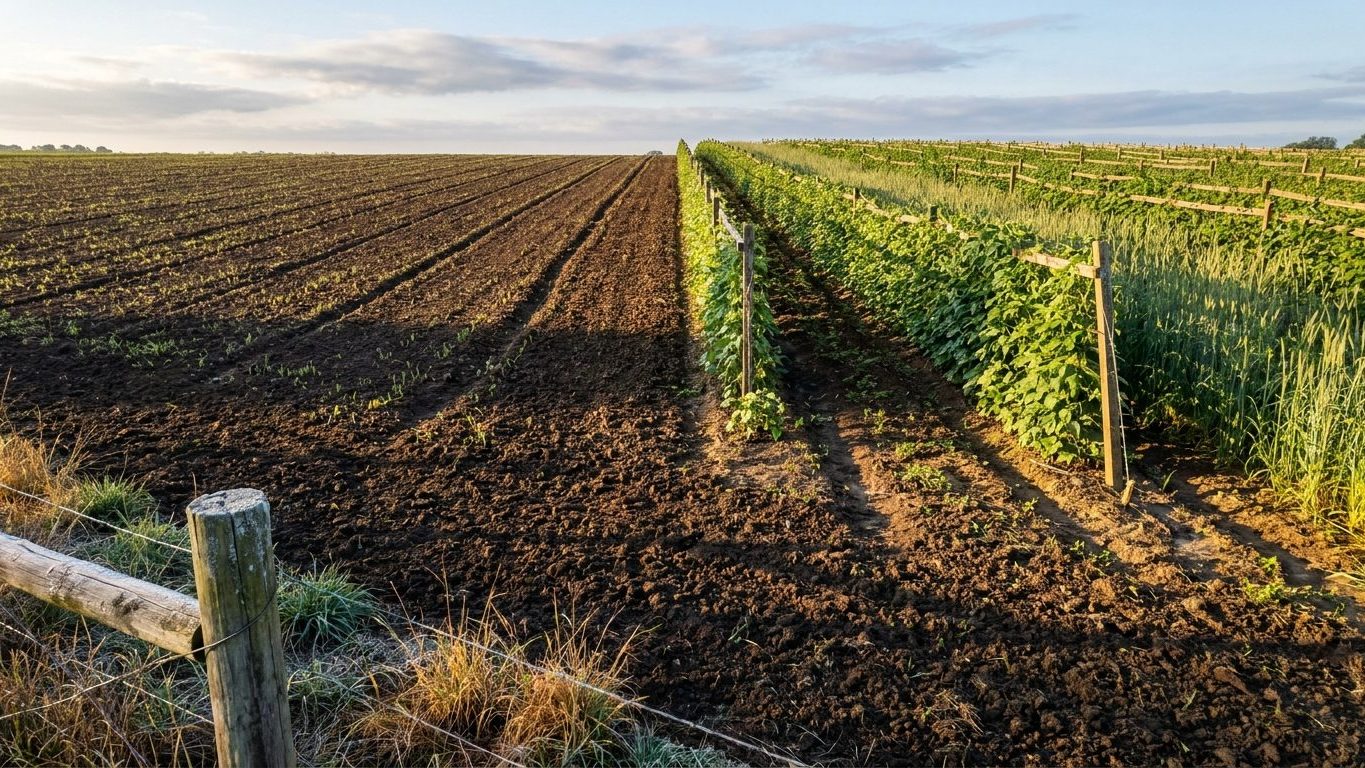

Kansas gardeners and farmers work with two distinct cover-crop windows tied to frost risk: warm-season species go in after the last spring frost clears (April 18 at the earliest reliable point), and cool-season, overwintering species go in before the first fall frost band closes in (October 23 to November 2). Cereal rye is the exception on both ends.
The short answer for Kansas
Two calendars run side by side here, and the frost data from NOAA’s 1991-2020 Climate Normals for the Wichita reference station (USW00003928) sets both. The last spring freeze at 32°F falls somewhere between April 4 and April 18 in a typical year, meaning that window is where the probability of a killing frost drops from 70% down to 30%, not a hard line. For warm-season cover crops such as sorghum-sudangrass, cowpea, buckwheat, and sunn hemp, planting after April 18 clears most of that risk. These species do their real work in the June-through-August fallow gap after wheat comes off, so a lot of growers push planting into late May or June anyway, well clear of any frost concern.
The fall side works the same way in reverse. The first fall freeze at 32°F lands between October 23 and November 2, again a 30-70% probability band rather than a guaranteed date. Cool-season and overwintering species, cereal rye, winter wheat, triticale, hairy vetch, crimson clover, need enough growing time before that window to put down roots and build some canopy. Working backward from late October, most of these should go in the ground by mid-September in the cooler parts of the state and can stretch into early October where it’s milder. Cereal rye breaks this rule: it germinates in cold soil and keeps growing after other species have shut down, so it tolerates drilling right up to, and sometimes past, the average first frost date.
None of these dates are promises. They describe what happens at one airport weather station over a 30-year record. A field forty miles away, especially one sitting in a low spot or at higher elevation, will often see its last spring frost later and its first fall frost earlier than these figures suggest, sometimes by a week or two.
What will not work here

The failure mode that catches people off guard in Kansas has less to do with season length and more to do with what the coldest month actually does. The mean daily minimum in the coldest month here runs 22.5°F, a figure that decides whether a plant simply survives the winter, not what the record low was on the worst night. Species that are marketed as reliable winterkill covers in warmer regions, tillage radish is the common example, are bred to die back cleanly once temperatures drop into the teens or lower. In the milder pockets of Kansas sitting toward zone 7a, that die-back doesn’t always happen on schedule, and a grower expecting a clean, frost-killed residue in spring can instead find live radish plants bolting into a cash crop.
The opposite problem shows up with species pushed too far toward the cold end. Crimson clover is a workhorse cover crop in the Southeast, but its cold tolerance has limits, and in the colder stretch of Kansas’s 5b-7a range it can winterkill unexpectedly when a grower was counting on it to overwinter and contribute nitrogen in spring. Hairy vetch handles that same cold considerably better and is the more dependable legume choice across most of the state for that reason.
Dry heat is the other trap. Kansas summers bring stretches with little rain, and cover crops here are almost never irrigated the way a vegetable garden might be. Any species that needs steady, near-weekly moisture through germination, buckwheat sown into a July dry spell is a common example, can simply fail to come up, leaving bare ground exactly when weed pressure is highest. Timing a summer cover crop to a rain event, rather than a fixed calendar date, matters more than the calendar itself once soil moisture runs short.
What changes across Kansas
Kansas spans hardiness zones 5b through 7a under the USDA system, a range built on one number: the average annual extreme minimum temperature. That’s a wide spread for a single state, and it means there is no single sowing date or variety choice that applies evenly from the Nebraska line to the Oklahoma line.
Growers on the colder end of that range need to treat winter survival more conservatively across the board. That means leaning on cereal rye over crimson clover for overwintering cover, and sowing fall covers earlier rather than later since the growing window before hard freeze closes sooner. It also means the winterkill species that behave predictably farther south are more likely to actually die back on schedule here, which for a species like tillage radish is a feature rather than a problem.
On the warmer end of the range, growers get a longer fall growing window and can afford to delay sowing further into the season, sometimes well into what would be considered late for the colder part of the state. But that same mildness means winterkill species can’t be counted on to die cleanly, and legumes with marginal cold tolerance have a better shot at surviving the winter, for better or worse depending on what the grower wants.
The USDA Plant Hardiness Zone Map is the tool for finding which end of that zone range your own field sits in, and it’s worth checking directly rather than guessing from a county name or a rough sense of “north” or “south” Kansas, since elevation and local terrain shift the picture too.
Where to check this for your own county
Kansas State Research and Extension, at https://www.ksre.k-state.edu/, is the land-grant extension service for the state and the right next stop. What’s on the county extension site is built from local trial plots and local weather records, and that beats a state average every time.
Two things are worth hunting down there specifically. The first is a local or regional planting calendar for cover crops, which will translate the frost-probability bands used here into dates that account for your county’s actual soil types and typical rainfall pattern, something a statewide page can’t do. The second is variety trial results for your area. Extension programs regularly run side-by-side plots comparing cereal rye varieties, vetch types, and warm-season mixes under local conditions, and those results tell you which specific cultivars have actually performed well in soils and weather like yours, rather than which ones perform well somewhere in the broad 5b-7a range.
County agents also field direct questions, and for a decision like whether to risk a crimson clover stand on your specific ground versus falling back on hairy vetch, a phone call to the local office will get you an answer grounded in what’s actually happened in nearby fields recently, not a 30-year climate normal from an airport.
Checking this against your own garden
Calendar dates get you in the right general window, but your own field will tell you more than any date once you know what to look for. Three signs are worth checking by hand before you trust a planting date over what’s actually happening in the soil.
Soil warmth by feel is the first and most reliable. Push a hand a couple of inches into the seedbed in the morning before the sun has warmed the surface. Soil that still feels cold to the touch that early in the day is telling you germination will be slow regardless of what the calendar says, and a warm-season cover crop sown into it will sit rather than sprout.
Weed emergence is the second signal, and it’s a free one. When common warm-season weeds start pushing up through a field that was previously bare, that’s a strong sign the soil has crossed the temperature threshold most warm-season cover crop seeds also need to germinate, often a more current and local indicator than a frost date pulled from an airport thirty or more miles away.
The third is watching your own cover crop stand once it’s up. The appearance of first true leaves, as opposed to the initial seedling leaves, marks the point where the plant has shifted from living off seed reserves to actually establishing itself in your soil. A stand that reaches true leaves quickly and evenly is telling you the timing worked for your specific ground this year, information worth writing down for next season’s decision.
If you follow the almanac, here is when to plant cover crops by the moon. It is a tradition, not a proven method.