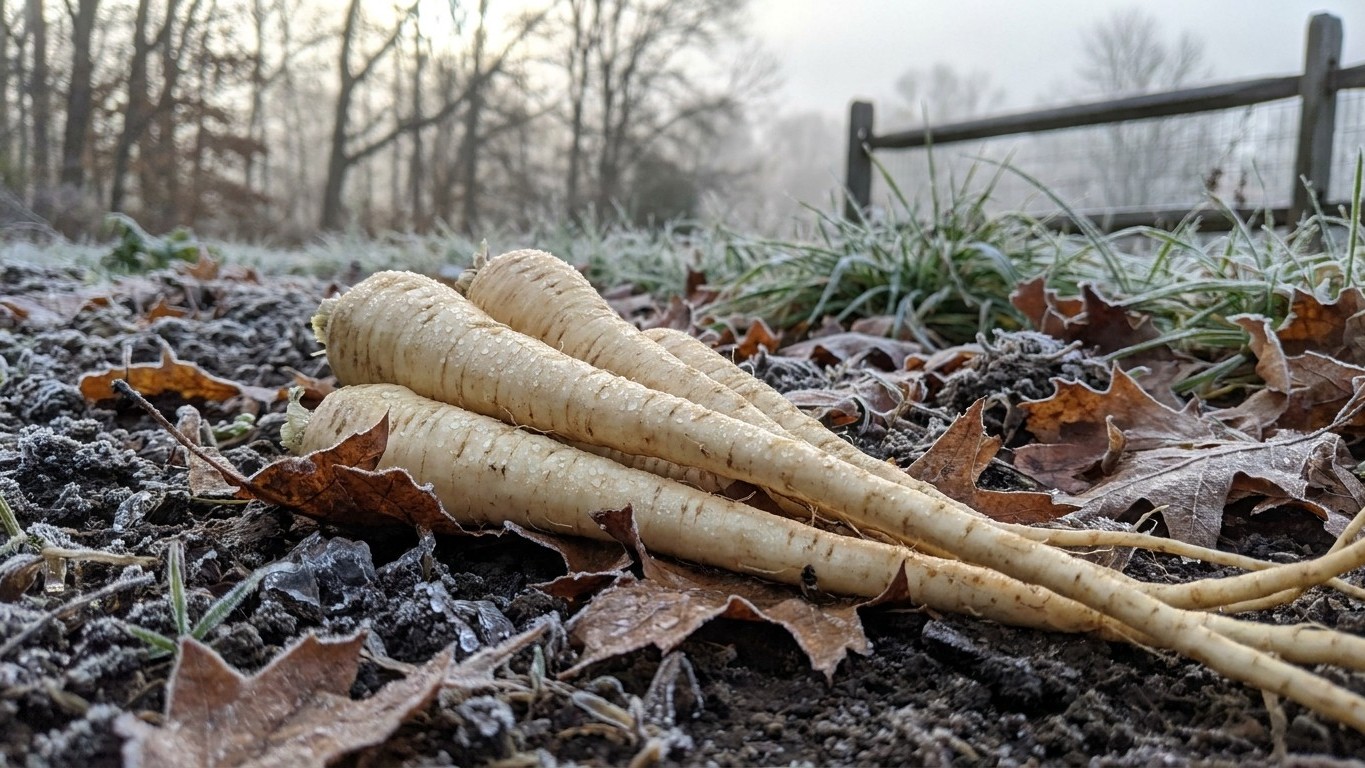

In New York City, lift parsnips after several weeks of frost. Keep digging through winter whenever the ground isn’t frozen solid. Lifted roots keep four to six months, but only in near-freezing, very humid storage and well away from ripening fruit. Upstate gardens get frost sooner and hold it longer, so they can start earlier. The sections below cover the frost count, the season arithmetic, and the failures that ruin a row.
The short answer
Does New York deliver several frosty weeks? At the Central Park station, it does. The mean daily minimum of the coldest month is 27.9°F, so nights run below freezing through the heart of winter. NOAA’s climate normals put the mean first fall frost between November 14 and November 27, and the mean last spring frost between March 23 and April 3. That leaves a long stretch of months in which a root sitting in the ground takes repeated frost. A parsnip grown here will sweeten as well as grow.
Central Park is a dense urban site, and it runs warmer than the countryside. Upstate New York and the Adirondacks frost earlier in fall and later in spring, so those gardens get even more frost exposure. Whatever your zone number says, the sweetening comes from the frost the root actually sits through. Cool, frosty weather converts stored starch to sugar, which is the point Utah State University Extension makes about the crop. The full mechanism is in Will Parsnips Sweeten in New York?
That sets the lifting date. Count several weeks from the first hard frost before you dig. In the city that lands around mid-December, and upstate it can be earlier. After that, lift as you need them. A thick layer of straw or shredded leaves over the row keeps the soil from freezing solid, so a January dig stays possible. Pull the last roots before the tops start regrowing in spring, because the root then turns woody and the sugar drops.
Storage is where most people lose the crop. Parsnip roots can be stored 4 to 6 months at 32 to 34°F with 98 percent relative humidity, according to USDA Agricultural Handbook 66. That is a long keeper by any standard, but the figure assumes those conditions held steady, and almost no house does that. A refrigerator crisper or a cold, damp cellar comes closest, and you should expect fewer months from anything warmer.
Cold itself never hurts a parsnip, since it isn’t chilling sensitive. Ethylene does. A parsnip gives off almost none, but even low levels from ripening fruit in the same space make the root bitter. Keep stored parsnips away from apples, pears and anything else ripening. Top the roots after harvest, and leave the crown uncut.
Does the season fit?
Parsnips are sown in place, and the clock runs from seeding. They need 100 to 120 days, sown two to three weeks before the last spring frost. Here is how that works out for New York City.
- The mean last spring frost falls between March 23 and April 3. Two to three weeks earlier points to early or mid March for sowing, as soon as the soil can be worked without turning to paste.
- Seed takes 14 to 21 days to come up. That is a long wait, and a row that looks bare for two weeks is not a failure. Mark the row and leave it alone, because digging to check or re-sowing wastes seed and disturbs what is already germinating.
- From that March sowing, 100 to 120 days carries the crop to late June or early July. A full-size root exists long before winter. The extra months are for sweetening.
- The mean first fall frost arrives between November 14 and November 27, so the season has a wide margin. The reference station has a frost-free stretch running from early April to mid-November, and the crop needs well under that. In the city, the season fits comfortably.
- Upstate and in the Adirondacks, spring frost lingers and fall frost comes sooner, so the planting window shrinks. A sowing that slips into late spring gets tight, so check the days to maturity against your local frost dates. Sow the first week the ground is workable, and ask your county extension office for local frost dates.
The margin matters because a late, thin crop makes small roots that are not worth the winter wait. Roots that are fat by fall are the ones that reward you in December.
What goes wrong here
Most failures trace back to the ground, the water or the calendar. Each has a fix. The soil on any given lot is a starting point, so check your own bed. Look at the first foot of it with a spade before you sow.
- Forked or stubby roots in heavy or stony ground. The tip hits clay or a stone and splits. Loosen the bed deeply before sowing, and where the soil is heavy, double dig it so the root has a deep, loose column to follow. Pick out stones as you go. Parsnips do best in deep, sandy soil.
- Forked roots from overwatering. This is a separate cause from the soil. Constant wet makes roots branch and split, even in good ground. Water when the top inch of soil has dried, and give a deep soak instead of frequent sprinkles.
- A season that runs out. A late sowing, common upstate after a cold, wet spring, leaves roots too small by fall. Sow as soon as the ground is workable. Do not re-sow too soon, because slow germination is normal.
- A winter too mild to sweeten. A warm stretch, or a pull in early December, gives a perfectly good root that tastes starchy. Leave the roots in until they have had several frosty weeks, then dig as needed through the winter. The city’s warmer, urban nights make this the likeliest problem for a city bed.
- Pests and damage. Tunnels in the root point to insects, and the sort that matter depend on the season. What Eats Parsnip in New York, and When covers them, and the main guide, Growing Parsnips in New York, covers the whole growing year.
Common questions
Can parsnips stay in the ground all winter in New York?
Yes. Frost does not hurt them, and the soil holds them fresh. Mulch the row so you can dig in January, and lift the rest before new top growth begins in spring.
How long do lifted parsnips keep?
Four to six months at 32 to 34°F and 98 percent humidity, held steady. A refrigerator or a cold, damp cellar gets closest. Warmer, drier places shorten that, so use those roots first.
Can I store parsnips next to apples?
No. Ripening fruit releases ethylene, and even a little of it turns parsnips bitter in cold storage. Give them their own container or their own corner of the cellar.
Should I trim the roots before storing them?
Top them after harvest, but do not cut into the crown. A trimmed crown gives rot an easy way in, so leave a small stub of the leaf stalks.