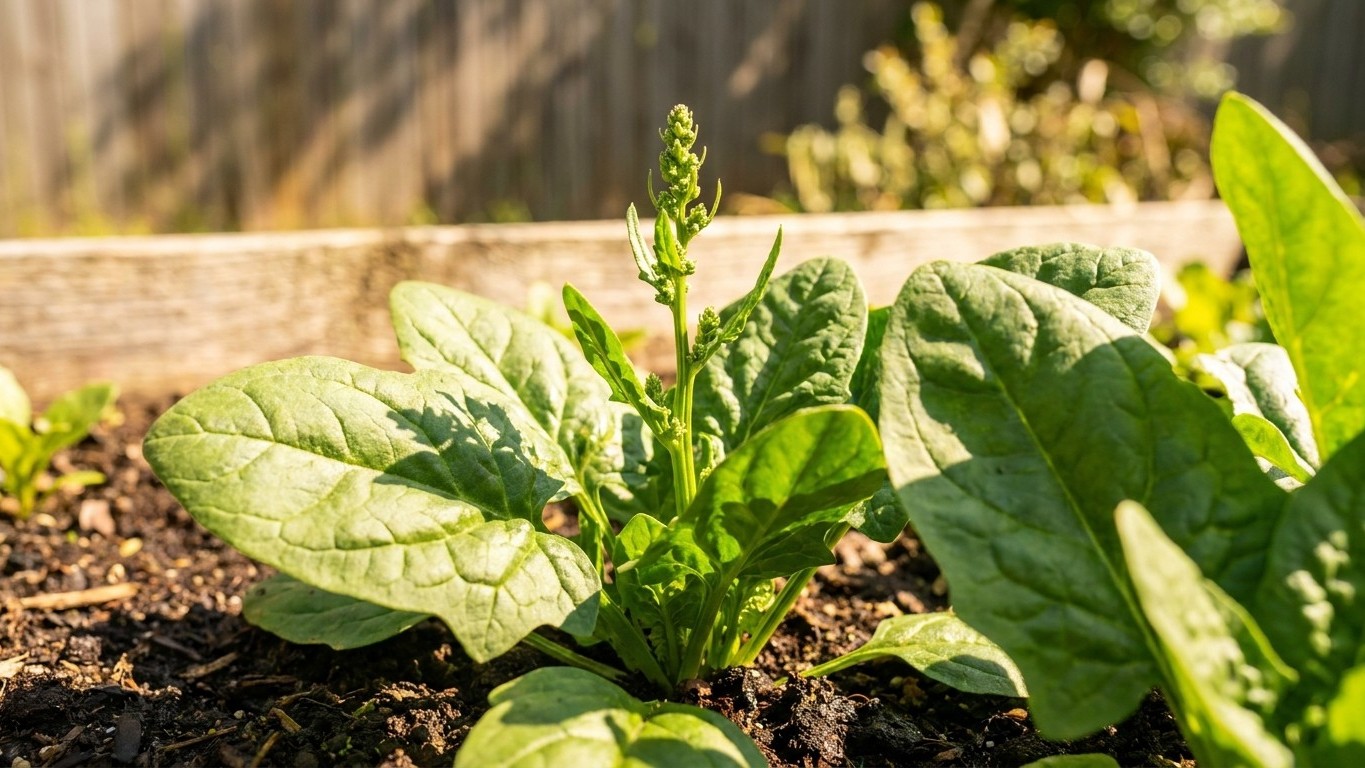

Spinach runs on two clocks. The first is in the garden: a short stretch in spring and another in fall when the plant makes tender leaves before heat or long days send up a seed stalk. The second starts at the cut. Even in a perfect refrigerator the leaves hold for under two weeks, and a home fridge rarely gets that close. Here is how to read both clocks in Kentucky, from frost dates to the right shelf.
When spinach is ready in Kentucky
Cut spinach when the rosette is full and the outer leaves are about as long as your hand, while the center is still flat and leafy with no stalk rising. For a spring crop, the window opens in the weeks after March 24 to April 4, the span in which the last 32°F freeze at the Louisville reference station becomes a coin flip, and it closes when warm days push the center upward.
What should the plant look like before you cut?
Look at the middle of the rosette first. A plant ready for cutting has leaves that fan out low and wide from a tight center. A plant about to bolt has a center that starts to lengthen, with leaves that turn narrower and more pointed as they climb. Watch for that change whichever variety you grow.
You have two ways to cut. Take the outer leaves and leave the center, and the plant keeps making more. Or cut the whole rosette about an inch above the soil line, and a few smaller leaves may regrow. Cut outer leaves while the plant is cool and growing steadily, and cut the whole plant once the center begins to stretch, because those leaves will only get worse.
How do frost dates, heat and day length set the window?
The frost dates come from NOAA NCEI’s 1991-2020 climate normals for the Louisville station. In the middle band of probability, the last spring freeze falls between March 24 and April 4, and the first fall freeze between November 2 and November 12. That station sits in the city, so rural gardens should expect a tighter window and should lean on what the plants show them.
Two things end the spring crop. Utah State University Extension says spinach grows best where temperatures do not exceed 75°F, and that number is also where the leaves turn bitter. Louisville averages 37.2 days a year at 90°F or higher, so a long stretch of summer sits well above the ceiling.
The second is day length, and it surprises people. Spinach bolts during long days as well as warm temperatures. The longest day at the reference city brings 14 hours and 39 minutes of daylight, so a cool spell in June will not save a bed. Long days push spinach to flower, which is why Will Spinach Bolt Early in Kentucky? is worth reading before you sow late.
For fall, plant early enough that the crop matures before the cold sets in. Counting back from early November puts the sowing between mid-August and mid-September. Seed germination drops once soil passes 80°F, and soil in late summer is often that warm. Cold is not what blocks the fall sowing. The window opens when the soil cools, which usually means the later part of that range. For the full sowing plan, see Growing Spinach in Kentucky, and for holes in leaves you were about to cut, see What Eats Spinach in Kentucky, and When.
Keeping it, and for how long
The best storage numbers come from the UC Davis Postharvest Technology Center. Its spinach fact sheet lists the optimum temperature as 0°C (32°F) and the optimum relative humidity as 95 to 98 percent. In its words, spinach “is highly perishable and will not maintain good quality for more than 2 weeks.” So the target to write on the fridge is 32°F with 95 to 98 percent humidity.
What does the two-week figure actually mean?
It is a ceiling under ideal conditions. The same fact sheet says that wilting, yellowing and decay become more likely after 10 to 14 days of storage, and that they come faster at the 5 to 10°C (41 to 50°F) range typical of commercial distribution. That range is also where many home fridges end up, especially the door. At those temperatures the leaves can start to yellow within days, not weeks.
Plan on a few days of good eating and treat anything past that as a bonus. Spinach you cut yourself starts the clock fresh, so it has a head start over a bunch that spent time moving through distribution at 41 to 50°F before it reached your cart.
Why does humidity matter as much as temperature?
A humidity of 95 to 98 percent is almost saturated air. Spinach leaves are thin and lose water quickly, so in the dry air of a standard fridge they go limp long before they spoil. The leaf cells collapse first, and then the yellowing and slime follow. That is why cold alone does not do the job. Cold slows decay, but moisture keeps the leaf crisp.
Keeping that moisture around the leaves without drowning them is the whole trick. Standing water on the leaf speeds rot. A damp environment around a dry leaf keeps it fresh. The next section turns that into steps for an ordinary kitchen.
Where in the house that actually is
No home fridge hits 32°F everywhere. The average runs warmer, and the door, which swings open and shut all day, runs warmer still. A door shelf can easily sit in the 41 to 50°F range where yellowing speeds up. The back of the bottom shelf is the coldest spot in most refrigerators and the closest you can get to the optimum, because cold air sinks and the door’s warm air never reaches it.
A cheap fridge thermometer is worth a few dollars here. Set it on the bottom shelf for a day and read it the next morning. If it shows well above 32°F, you know how much of the two-week ceiling you have lost.
For humidity, you have to build it yourself. Use one of these three approaches:
- Loose leaves go into a bag with a lightly dampened paper towel, with the bag left slightly open for air.
- A whole cut bunch can stand with its cut ends in about an inch of water in a jar, with a loose bag over the top.
- The crisper drawer works if you slide its humidity vent closed and keep the bag inside.
The most important step is the damp wrap or the water at the cut ends. Skip it and the leaves can yellow and wilt in a few days, even on the bottom shelf. Dry the leaves before bagging them, because water sitting on the surface of the blades starts the slime. Take out any yellowing leaf when you see it, since one decaying leaf can spoil the bag.
Cut early in the morning when the leaves are cool and full of water, and get them into the fridge quickly. A warm leaf starts losing its moisture as soon as it is cut, and storage can only slow that, never reverse it. A cut basket sitting in a sunny kitchen for an hour does more damage than a day on the bottom shelf.
Common questions
Can you cut spinach more than once from the same plant?
Yes, as long as the center is flat. Take the outer leaves, leave the growing center alone, and the plant keeps producing for a few weeks. Once the center stretches into a stalk, the plant is putting its energy into seed and the remaining leaves turn bitter. Cut the whole plant at that point.
How do you tell bolting has started?
The center of the rosette lifts and the new leaves are narrower and more pointed than the lower ones. A tasted leaf will be sharper. Long days and warm temperatures both drive this change, and a cooler week will slow it down but will not reverse it. For a closer look at the signs, read the bolting guide.
When should I sow for a fall cut?
Plant early enough to mature before frost, and wait for the soil to fall below 80°F. Where summers are hot and humid, soil can stay above that line into fall, and germination suffers while it does. Counting back from the early-November freeze gives a rough range of mid-August to mid-September, and your local county extension office can narrow it for your soil and elevation.
How long does cut spinach keep in the fridge?
Two weeks is the most it can do, and only at 32°F with very high humidity. In a home fridge, count on a few days of good eating. Storing it on the back of the bottom shelf in a damp wrap, and not in the door, gets you closest to the ceiling.