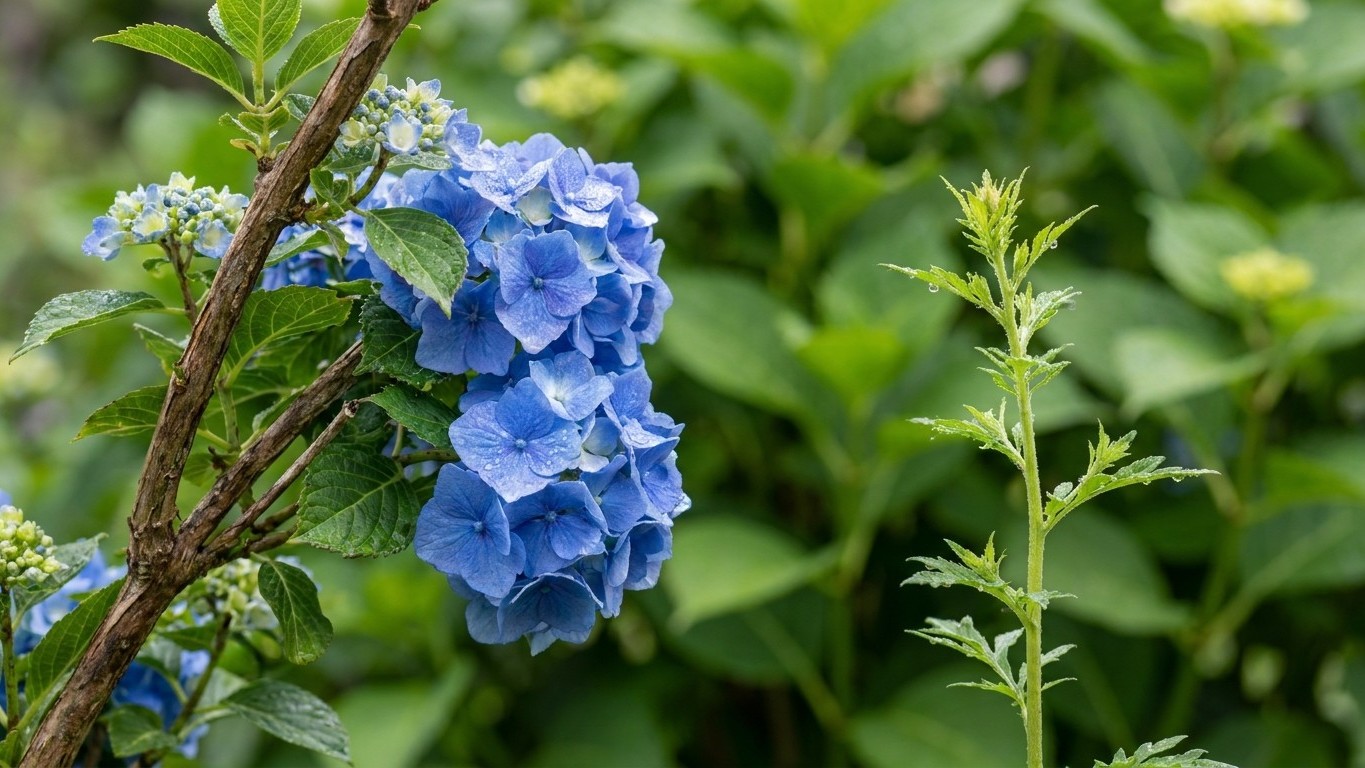

The right month depends on the kind of hydrangea, because some bloom on stems grown last year and others on stems that haven’t grown yet. Bigleaf and oakleaf types get pruned in summer, right after the flowers fade. Panicle and smooth types get pruned in late winter, before the buds swell. Mix those up and the shrub survives, but it often skips a season of flowers. In the Deep South, mild winters stretch the calendar, so the dates below hang on a frost window instead of a fixed week.
What this comes down to in Mississippi

At Jackson’s airport weather station, the last spring frost falls roughly between March 6 and March 22 (the average last freeze is around March 15), so late-winter pruning of new-wood hydrangeas belongs in February and the first days of March, ahead of that window. The first fall frost arrives roughly between November 7 and November 22 (the average first freeze is around November 9), and by then every old-wood hydrangea should have gone untouched since early August.
Those dates are a working window built around NOAA and National Weather Service averages for Jackson, and a 32 F freeze can still come earlier or later in any given year. They describe one reference city. Gardens elsewhere in the state shift, and the later sections cover how.
Frost matters for pruning because a cut wakes the plant up. A hydrangea trimmed during a warm spell pushes tender growth that a later freeze can burn. The wood type matters even more. Bigleaf hydrangeas form next summer’s flower buds in late summer and fall, and those buds sit on the stems all winter. Cut the stems in winter and you cut the flowers. The USDA Plant Hardiness Zone Map, which rates zones by average annual extreme minimum temperature, puts the state in zones 7b to 9a. Roots rarely die in those winters, but a spring freeze after an early warm-up can kill exposed buds on old stems.
Which hydrangeas get pruned in summer?
Bigleaf types (the mopheads and lacecaps) and oakleaf types (lobed leaves shaped like oak leaves, cone-shaped white blooms that age to pink) flower on old wood. Prune them within a few weeks after the blooms fade. Where summers are hot and humid, that usually means June or July. Stop by early August. Cut spent flower heads back to a pair of healthy buds, and remove a few of the oldest, thinnest stems at ground level. Which of these types holds up best through cold snaps is covered in Which Hydrangeas Survive a Mississippi Winter.
Which hydrangeas get pruned in late winter?
Panicle hydrangeas (cone-shaped blooms, white fading to pink or tan) and smooth hydrangeas (large round white heads on soft green stems) flower on new wood. Cut them in February or the first days of March, while the buds are still tight. Panicles take a trim of up to a third of their height. Smooth types tolerate a hard cut down to a low framework of stems a foot or two tall.
| Type | Blooms on | Best time to prune | How much |
|---|---|---|---|
| Bigleaf | Last year’s stems | Right after flowering, finished by early August | Spent blooms and a few old stems |
| Oakleaf | Last year’s stems | Right after flowering | Light shaping only |
| Reblooming bigleaf | Old and new stems | Light trim after the first flush; dead wood in spring | Minimal |
| Panicle | Current year’s growth | February to early March | Up to a third of the height |
| Smooth | Current year’s growth | February to early March | Hard cut to a low framework |
Working it out for your own garden
Start by naming what you have. Look at the leaves and the flowers. Rounded, glossy, toothed leaves with big pom-pom or flat lacy heads mean bigleaf. Leaves with deep lobes like an oak’s mean oakleaf. Cone-shaped blooms mean panicle, and large round white heads on thin green stems mean smooth. If the plant came without a tag, watch it for one year and note when it blooms and on which stems. In late winter, old-wood types show fat, paired buds along woody stems that survived the cold. New-wood types often look like a bundle of bare sticks.
For new-wood types, count backward from the frost window. A last spring frost between March 6 and March 22 gives a pruning window in the weeks before, and your local county extension office can help you time it. Suburban and rural gardens usually see their last frost one to two weeks later than the airport, so slide that window later by the same amount. The plant itself is the better check. If the buds are still tight and no green is showing, you are on time. If leaves have started to open, you are late. The cut still works, but flowering comes later.
Old-wood types run on a different clock. They don’t follow the frost window. They follow the bloom. If a bigleaf finishes flowering in mid-June, cut in the next two to four weeks, so by mid-July. That leaves the rest of summer and fall for the plant to set next year’s buds before the first fall frost window of November 7 to November 22. A shrub that finishes blooming in July still gets its cut, but the job needs to be done before early August.
Spring brings one more task: sorting live stems from dead ones. Bigleaf stems can look lifeless well after the last freeze, so don’t cut on looks alone. Wait until the plant has leafed out on its living wood. Then scrape a thumbnail along a suspect stem. Green and moist underneath means alive. Brown and dry means dead. Cut dead stems back to the first living bud, or to the ground if no buds are left.
What changes across the state
The state spans a large range of winter conditions, and the USDA zone span from 7b to 9a reflects that. Jackson sits in the middle of it, so the dates above are a middle case. They do not hold for the whole state.
In the hill country of the north, around Tupelo and Corinth, winters run colder, spring freezes tend to linger later and fall frost can arrive sooner. Late-winter pruning of panicle and smooth hydrangeas moves toward the end of the pruning window, and gardeners there are wise to let buds on bigleaf types show their condition before cutting anything. Near the Gulf coast, around Gulfport and Biloxi, winters are milder and plants wake up earlier. Panicle hydrangeas can begin to swell in February, so the cut comes earlier too. Bigleaf types there can finish their first flush sooner, which opens the summer pruning window earlier.
Local ground matters as much as latitude. Cold air drains downhill and pools in low spots, so a garden at the bottom of a slope or near a creek can frost a week or more after a hilltop yard a few miles away. Open fields and rural lots lose heat fast on clear nights. Towns and paved areas hold it. If your garden is outside a city, expect later last frosts and earlier first frosts than the reference figures, usually by one to two weeks.
The mistakes this state punishes

One of the costliest is pruning a bigleaf hydrangea in February. A string of 70-degree days makes it feel like time to clean up the garden, and the shrub looks like a mess of brown sticks. Those sticks hold next summer’s flowers. A freeze after the warm spell can also burn buds that swelled early. Leave the stems alone until leaves open, then remove only what the scratch test proves dead.
A fall tidy-up causes the same trouble from the other side. Cutting back in October or early November, just ahead of the first fall frost window, removes buds on old-wood types and can push soft growth that the first hard freeze kills. Leave the stems standing through winter. Panicle and smooth types can keep their dried flower heads too, and the late-winter cut takes care of them.
Pruning new-wood types late is a quieter problem. A panicle cut in May, after leaves have opened, still blooms, but later and on a smaller scale than one cut in February. Finish before the buds break.
Cutting every hydrangea to the ground “to be safe” works for smooth types and often for panicles, but it can wipe out bloom on a bigleaf for the year. Treat each shrub by its type. Pruning also has no effect on flower color. Pink or blue is a soil question, covered in Why Hydrangeas Are Pink in Mississippi, and How to Turn Them Blue.
Checking this against your county
The Jackson figures are a starting point. A garden in the northern hills or near the coast, or one sitting low on a slope, will see different dates. Your county office of Mississippi State University Extension can tell you when frost typically ends and begins where you live, and what local growers do with each hydrangea type. For the rest of the basics, including planting and care, see the state guide to growing hydrangeas in Mississippi.
Common questions
Can I cut all my hydrangeas to the ground in winter?
Smooth hydrangeas can take it, and panicle hydrangeas usually do fine with a hard cut, though a trim of up to a third keeps a sturdier frame. Bigleaf and oakleaf hydrangeas should not be cut to the ground in winter, since they carry next summer’s buds on last year’s stems. Reblooming bigleaf types can still bloom on new growth, but the first flush is usually lost.
When is it too late to prune a bigleaf hydrangea?
After early August, the cut starts removing buds that are forming for next year. Late summer, fall and winter pruning all carry that risk. The one exception is dead wood, which you can remove in spring once the shrub has leafed out.
How do I fix an overgrown hydrangea?
For old-wood types, remove about a third of the oldest stems at ground level right after flowering, and repeat for up to three years. For panicle and smooth types, a hard cut in late winter renews the whole plant in one season.
Should I deadhead hydrangeas, and when?
Deadheading is optional. On bigleaf types, snip faded blooms back to a healthy pair of buds soon after flowering. On reblooming bigleafs, this encourages a second flush. Panicle and smooth types can keep their dried heads through winter, then lose them in the late-winter cut.