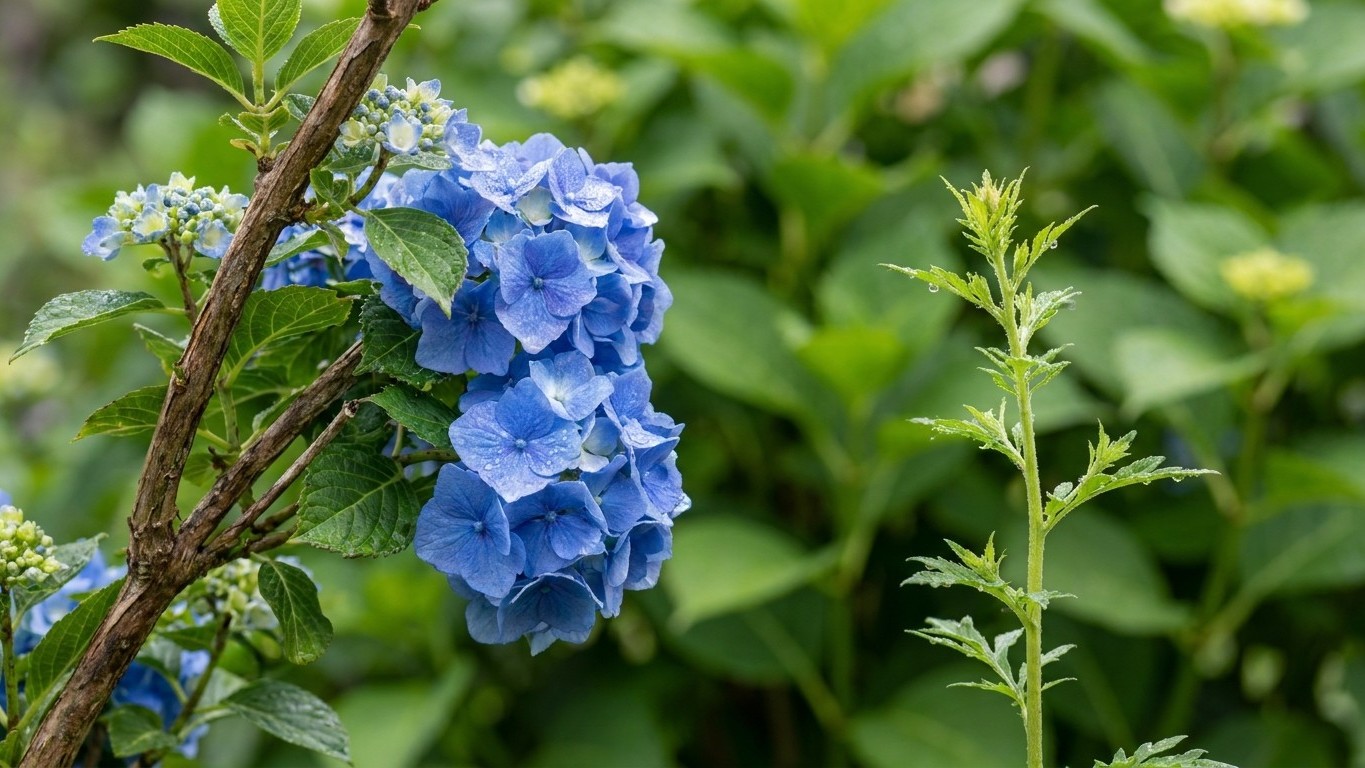

Bigleaf hydrangeas flower pink when the soil is near neutral or when the plant can’t take up aluminum, and blue when the soil is acidic enough to release it. The pigment is the same either way. Aluminum availability decides the color, and soil pH decides aluminum availability. A pink shrub in a New Brunswick yard can usually be pushed toward blue with a soil test, sulfur or aluminum sulfate, and a different fertilizer. It takes a season or more, and some hydrangeas will never change.
What this comes down to in New Brunswick

Around Moncton, the average last spring frost falls on May 23 and the average first fall frost on October 2, and every color adjustment has to fit inside that stretch. Both dates are midpoints: in one year out of two the last frost comes later than May 23, and in one year out of two the first fall frost arrives earlier than October 2.
Moncton has about 132 frost-free days between those two dates. Moncton sits in Canadian hardiness zone 5a. That is a rating from the Canadian system, which uses seven climate variables and does not convert to a USDA zone. Northern and upland districts of the province run weeks behind the Moncton dates, so a gardener in the Miramichi or the highlands has a shorter working season than the numbers suggest.
What decides whether a hydrangea is pink or blue?
Bigleaf hydrangeas (the mopheads and lacecaps) respond to soil chemistry. Aluminum is present in most soils, but it dissolves and becomes available to roots only when the soil is acidic. Acid soil tends to give blue flowers. Less acid soil turns the flowers pink, and the range in between gives purple or a mix of both on one shrub.
Phosphorus matters too. A fertilizer with a high middle number (the phosphorus figure on the bag) nudges flowers toward pink. A bloom-booster product can undo a good acidifying program in a single summer.
Why do so many hydrangeas here end up pink?
Where the native soil is acidic, as it is under much of the region’s conifer forest, pink often points to something that was added to the bed. Lime spread on a nearby lawn is a common cause. Concrete foundations leach lime into the soil beside them, wood ash raises pH, and alkaline well water does the same over several seasons. Many gardeners also simply bought a cultivar bred for pink. Garden centers sell some varieties as pink or red, and those tend to hold their color across a wide pH range.
Frost enters the picture in two ways. Emerging shoots can be nipped by a cold snap after May 23, and the window for treating the soil closes well before the first fall frost. The rest of this guide works inside that window. For general growing advice, see growing hydrangeas in New Brunswick.
Working it out for your own garden
The method is the same whether you move, inherit a bed, or have an odd year. Find out why the plant is pink, then match the treatment to the plant’s bloom habit and the frost window.
How can you tell why your hydrangea is pink?
Run through five quick checks before buying anything.
- Read the plant tag or look up the cultivar. White hydrangeas, including smooth and panicle types, will not turn blue.
- Test the soil pH in the root zone, not just anywhere in the yard.
- Check the fertilizer bag for a high middle number.
- Look for lime sources: a lawn program, a concrete wall, a gravel path, or wood ash dumped in the bed.
- Think about the water. Well water that leaves scale on kettles is alkaline.
A soil test result on the alkaline side likely explains why the shrub is not getting aluminum. A reading already near 5.5 with pink flowers suggests phosphorus or a cultivar that stays pink.
How do you time the treatment around the frost window?
Start when new leaves open, which around Moncton usually means late May into June, depending on how the spring runs. Because the last frost comes later than May 23 in half of years, watch the forecast and hold off while a cold night is still possible. Elemental sulfur lowers pH slowly and is the gentler choice, so it goes on early and needs months to work. Aluminum sulfate acts faster. Follow the package rate, and water the plant well first so the roots don’t burn. Repeat every few weeks into midsummer, then stop. Fall frost arrives earlier than October 2 in half of years, and soft late growth is better left alone.
Take a reblooming bigleaf, which blooms on both old and new wood. New shoots start in late May or June and flower by midsummer, so treatment started when leaves open can show up in that same year’s flowers, at least partly. An old-wood mophead set its buds the previous late summer. The first summer’s treatment often gives a patchy blue-and-pink result, and the full change appears the following year.
Then take a shrub where winter or a late frost killed the flower buds. It will not bloom at all, and no color treatment fixes that. Fixing the winter losses comes first, and Protecting Hydrangeas Through a New Brunswick Winter covers it.
What changes across the province
The province is not one climate, and the Moncton dates are one reference point. Soil and season both shift as you move around.
The coast along the Bay of Fundy stays cool and foggy in summer, which slows spring growth. The Northumberland Strait shore warms earlier in the season. The Saint John River valley tends to be milder than the uplands above it. The northern part of the province and the high ground around it run weeks behind Moncton, so shoots leaf out later and the safe time to start treatments moves later too. The same shift trims the end of the season. Gardeners in those districts get fewer weeks to finish applications before fall frost, and old-wood bigleafs are more likely to lose buds to winter cold.
Soil changes as well, and that matters more for color than the weather does. Forested uplands tend to have acidic soil that favors blue. Farmland that has been limed for decades, and districts with limestone-rich ground, lean toward higher pH and pink flowers. Even within one neighborhood, a bed against a foundation can read higher than one beside a spruce hedge. That is why a soil test in your own bed beats any regional rule of thumb.
Common mistakes in New Brunswick
Planting into cold soil after a warm spell is one common mistake. A string of mild days in May can tempt you to set out and treat plants, and a frost after May 23 then hits tender new growth. Wait until the forecast is clear, since the average last frost date is only the middle of the range.
Adding aluminum sulfate to soil that keeps getting lime comes next. If lawn lime or foundation runoff keeps raising the pH, the treatment loses ground every year. Move the source, or grow the shrub in a raised bed with acidic mix.
Overdoing it is a real risk too. Heavy doses of aluminum sulfate can burn roots and leave brown leaf edges. Small, repeated applications on moist soil are safer than one big dose.
Feeding with a bloom booster undoes the work. Choose a fertilizer with low phosphorus. Pruning at the wrong time also costs flowers, since old-wood types set buds in late summer. See When to Prune Hydrangeas in New Brunswick before reaching for the shears.
Expecting a white or green-flowered cultivar to turn blue is another common mistake. It won’t. Spend the effort on a bigleaf instead.
Checking this against your area
A province-wide set of dates and a pH rule is a starting point for your yard. Your local agricultural office can tell you how your district’s frost dates and soils compare with Moncton’s, and can point you to a soil testing lab. Agriculture and Agri-Food Canada has federal resources, and the provincial agriculture department can fill in the rest. For everything beyond color, go back to growing hydrangeas in New Brunswick.
Common questions
Do coffee grounds turn hydrangeas blue?
Not reliably. Used grounds do little to the pH. Sulfur or aluminum sulfate, applied to a soil you’ve tested, gives far more predictable results.
Can you turn a white hydrangea blue?
No. White flowers lack the pigment that reacts with aluminum. Only pink, blue, and purple bigleaf types change with soil chemistry.
How long does it take to turn hydrangeas blue?
Often a full season, sometimes two. Reblooming types show a partial shift the same summer. Old-wood mopheads usually show the full change the next year, because their buds were already set.
Can you turn blue hydrangeas back to pink?
Yes. Raise the pH toward neutral with garden lime, based on a soil test, and switch to a fertilizer with more phosphorus. Go slowly, because liming too hard can leave the leaves yellow.