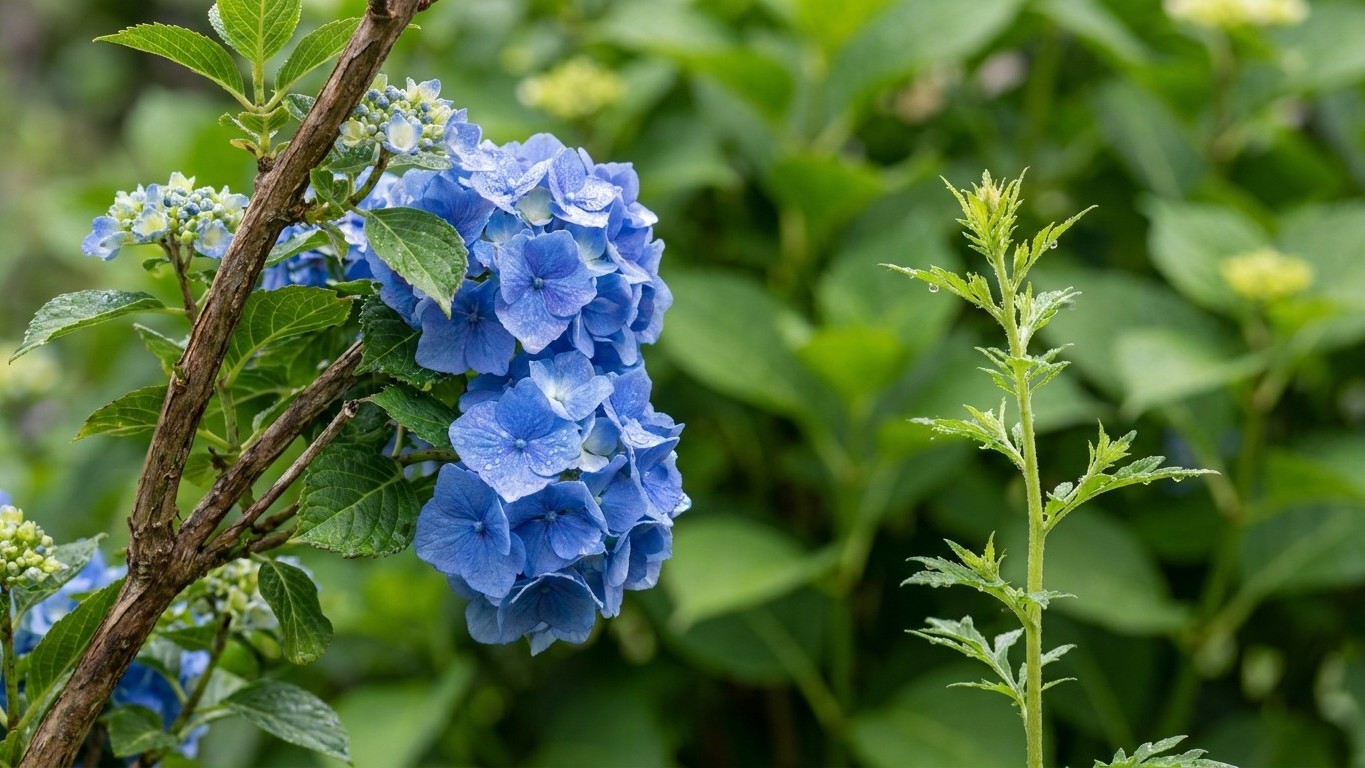

Hydrangeas come out pink in much of Oklahoma because the soil is not acidic enough. Bigleaf hydrangea flowers turn blue only when the plant can take up aluminum, and aluminum dissolves mainly in acidic ground. In neutral to alkaline soil it stays locked up, and the blooms go pink. You can push a plant toward blue by lowering the soil pH, but it takes months, it works on only some species, and some yards will fight you the whole way.
What this comes down to in Oklahoma

The window to start turning a pink hydrangea blue opens with spring growth, and at the Oklahoma City reference station the last spring frost falls between March 28 and April 10. Time your first soil treatment to that stretch, when roots wake up and begin pulling in whatever the soil offers. Gardens outside the city often see the last frost a week or two later, so a rural yard should start a little behind that range.
Why does soil pH change hydrangea color?
The pigment in a bigleaf flower is the same in pink and blue plants. What differs is whether aluminum reaches the petals. Blue generally needs an acidic soil, pink shows up as the soil becomes less acidic, and purple or two-toned blooms appear in between. Phosphorus matters too, because a lot of it in the soil binds aluminum and keeps it away from the roots.
Many Oklahoma soils sit at or above neutral, especially in the central and western parts of the state. Hard water from the hose adds lime a little at every watering. A bed beside a concrete foundation gets lime leaching out of the concrete. Any of these alone can hold a plant in the pink range.
| Condition | Pink blooms | Blue blooms |
|---|---|---|
| Soil pH | About 6.5 and above | About 5.5 and below |
| Aluminum | Locked up in the soil | Dissolved and available |
| Phosphorus | High is fine | Keep it low |
| Common amendment | Garden lime | Aluminum sulfate, sulfur |
Which hydrangeas can actually turn blue?
Only bigleaf hydrangeas (Hydrangea macrophylla), the mopheads and lacecaps, and their close relative the mountain hydrangea respond to pH. Panicle, smooth, oakleaf and climbing hydrangeas keep their color whatever you do to the soil. White bigleaf cultivars stay white. If your pink shrub is a panicle type that fades from white to pink as the season goes on, no amount of soil work will turn it blue.
Working it out for your own garden
A fixed recipe fails the first time your water, soil or weather differs from the writer’s. A short method holds up better: measure the soil, count back from the frost window, and treat on a schedule.
How do you find your soil pH?
Start with a soil test. Your county extension office can explain how to send a sample to a lab, and a home kit gives a rough check in the meantime. Take small scoops from several spots a few inches deep near the root zone, mix them, and test the blend.
Here is how to read the result. Suppose the test shows 7.4. Dropping the pH means a real change, and because the scale is logarithmic, that is a big change. In clay holding free lime, it can take years of repeat treatments, so a large container filled with acidic potting mix is usually the better route. A reading close to your target needs only a modest nudge, and consistent treatment may be enough.
When do you apply treatments?
Count backward from the frost window. You want the test result in hand and the amendment on the shelf before buds swell, which is about when the last spring frost range of March 28 to April 10 opens. Allow time to collect a sample, get results and buy supplies. That puts the soil sample in a window before the frost window opens.
Apply the first dose as new growth starts, water it in well, and repeat at the interval on the product label through spring. Ease off in summer heat, when stressed roots burn more easily. By the time the first fall frost range of October 29 to November 8 arrives at the reference station, there is nothing left to apply. Spread mulch and retest the following late winter to see whether the pH held.
What changes across the state
Oklahoma runs from damp, wooded hills in the east to dry plains in the west, and the soil follows the rain. Eastern and southeastern parts get more rainfall, which washes lime out of the topsoil over time, so soils there lean acidic and blue comes more easily, sometimes with no help at all. Toward the west, rainfall drops, lime stays near the surface, and the soil often tests alkaline. Turning blooms blue there means constant effort, and containers become more attractive.
Frost timing shifts too. The reference-city dates apply to the Oklahoma City airport station. Northern counties and the higher ground of the Panhandle usually see their last spring frost later and their first fall frost sooner. Suburban and rural gardens commonly sit a week or two behind the city’s numbers, and more at elevation. The current (2023) USDA Plant Hardiness Zone Map runs from roughly zone 6b to 8a across the state, and that spread reflects the same north-to-south and east-to-west differences in winter cold.
For color work, this means the start date for treatment slides later as you go north or west, and the effort required grows as you move toward drier, more alkaline soil. A gardener in the east may only need to keep the pH from drifting up. A gardener in the west may be fighting the soil every season.
The mistakes this state punishes

The first is treating a plant too early. A warm spell in March can coax bigleaf buds open, and a freeze can follow in early April, inside the reference city’s last-frost range. Frost-burned buds mean no flowers at all, pink or blue. Keep a sheet or frost cloth handy through the end of that window, and rural gardeners should keep it another week or two.
The second is overdoing the amendment. Aluminum sulfate burns roots when applied heavily or onto dry soil. Water the bed well before and after, follow the label rate, and spread smaller doses over several weeks rather than one big one.
Third, many gardeners plant against a concrete foundation or walkway and then wonder why the soil keeps bouncing back to alkaline. Lime from the concrete raises the pH nearby, so give the shrub a few feet of clearance or switch to a container. Fourth, a high-phosphorus fertilizer ties up the aluminum you just added. Choose one with a low middle number on the bag.
Fifth, pruning in spring to tidy the shrub removes the old wood that carries this year’s buds on most bigleaf types. Wait until the buds show and the winter-killed stems are obvious. Last, a single treatment rarely lasts. Hard water and alkaline soil pull the pH back up, so retest each late winter and repeat as needed.
Checking this against your county
The frost dates here come from one airport station, and your soil pH could be nothing like the neighbor’s. Your county extension office can tell you what a typical last frost looks like where you live and help you submit a soil sample. Oklahoma State University Extension offers further horticulture guidance for the state. For the basics of planting and care that sit behind all of this, read the state guide to growing hydrangeas in Oklahoma.
Common questions
How long does it take to turn a pink hydrangea blue?
Plan on a full growing season for a visible shift. Flowers that open this year may show some purple tint if you start in early spring, but a clean blue usually appears later. Soil that starts well above neutral takes longer.
Can white, panicle or oakleaf hydrangeas turn blue?
No. Only bigleaf and mountain hydrangeas shift color with soil pH. White bigleaf cultivars lack the pigment to change, and the other species follow their own color schedule, whatever the soil does.
Why did my blue hydrangea fade back to pink?
The soil pH most likely crept back up. Alkaline soil, hard tap water, nearby concrete or a phosphorus-heavy fertilizer can all do it. Retest the soil, repeat the acidifying treatment on schedule and consider watering with collected rainwater when you can.
Is aluminum sulfate safe for the plant?
It is safe at label rates on moist soil and harmful when overapplied or put down on dry ground. Smaller, repeated doses are gentler than one heavy dose. Soil sulfur is a slower option that works through soil microbes, which is one reason some gardeners start it before the frost window opens.