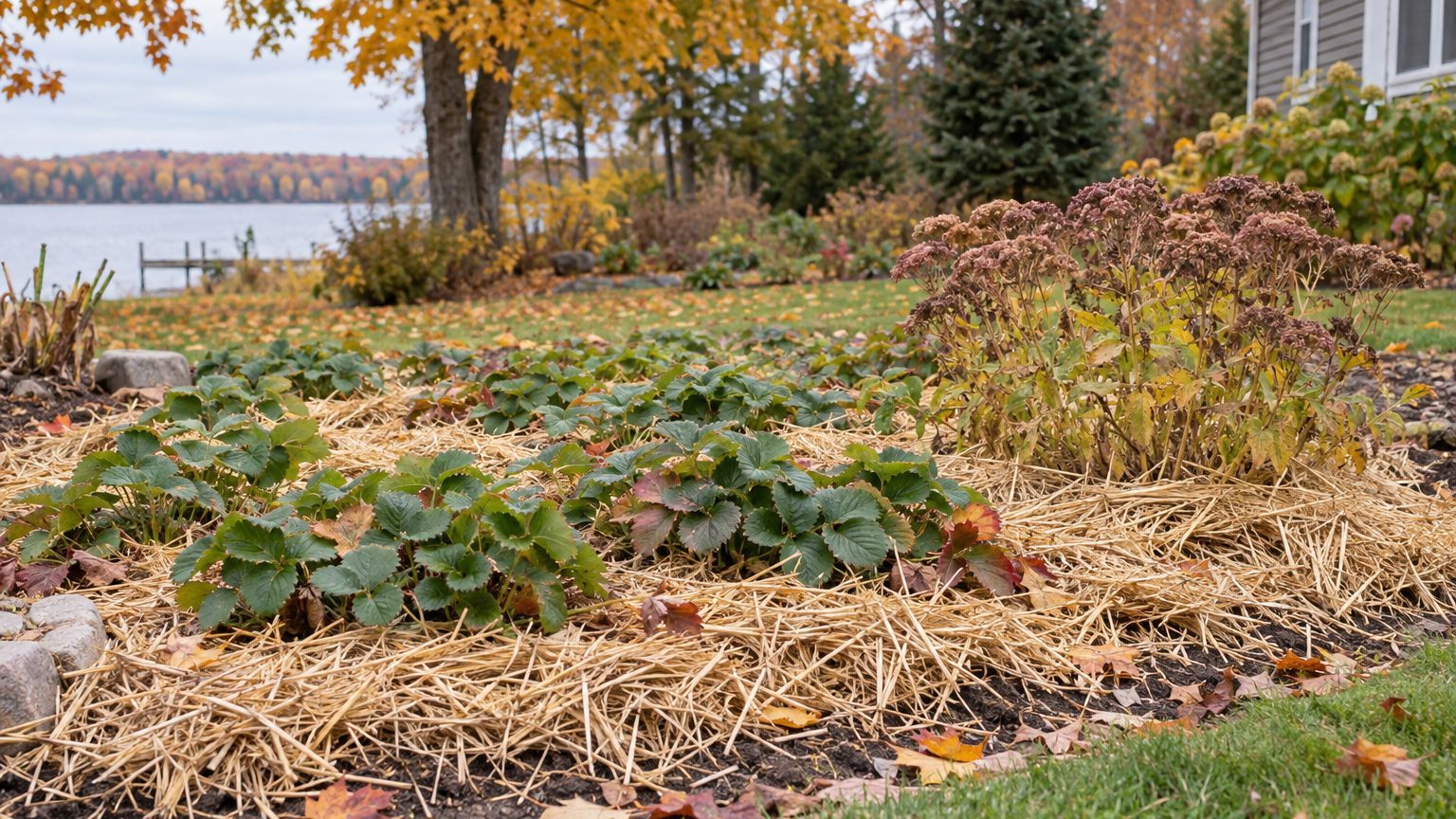

Winter mulch in Texas goes down after the first hard freeze, and in the southern and coastal parts of the state that freeze comes late or barely at all. At Houston’s Intercontinental Airport station (IAH), NOAA’s 1991-2020 Climate Normals put the 30-to-70-percent probability band for the first 32°F reading between December 1 and December 19. Mulch spread after the first freeze shields strawberries and borderline perennials from the odd cold snap. In the Panhandle and North Texas the window opens earlier, and the job changes to keeping frozen ground from thawing and refreezing.
When to put winter mulch down in Texas
Gardeners in cold states learn a rule that sounds backward: winter mulch goes on after the ground starts to freeze. Its job is to keep soil frozen once it is frozen, which stops the freeze-thaw swings that push shallow roots out of the ground. Spread it in October over warm, damp soil and the layer holds that warmth and moisture instead. Plants stay soft, and mice and voles find a cozy place to nest. Texas gardeners can use that logic only in the colder part of the state, because most of the state does not behave like Minnesota.
Take Houston, the Gulf end of the range. The mean daily minimum of its coldest month is 43.7°F, according to NOAA’s NCEI Climate Normals for 1991-2020. That is well above freezing, and the soil there does not lock up in a typical winter. Freeze nights still happen. NOAA’s 1991-2020 normals for the IAH station put the 30-to-70-percent probability band for a first 32°F reading from December 1 to December 19 (the station data are public). A single night at 32°F chills the air and the top of the plant, but it does not freeze the ground to any depth.
Does Houston need winter mulch at all?
Not for frost protection of the soil, no. Where the ground stays unfrozen, mulch earns its place in three other ways. It holds moisture through the dry spells that wander through a Gulf Coast winter. It shades out cool-season weeds that sprout all winter in mild weather. And it works as a ready cover on the nights a freeze is forecast: pile loose straw over strawberry crowns or tender perennials that evening, then rake it back once temperatures climb the next day. The decision to write down: wait until after the first fall freeze, which in Houston typically lands between December 1 and December 19, before you lay a standing winter layer. Anything spread earlier works against you, since the soil is still warm and the plants are still growing.
When should you mulch in North Texas and the Panhandle?
Colder country gets its first fall frost earlier than Houston does, so winter mulching moves earlier too. Houston’s December window is not a calendar for the Panhandle, where freezes arrive well ahead of it and stay later in spring. North Texas and the Hill Country fall in between and differ from each other again. In those places, watch the ground, not the date: lay the mulch after the first hard freeze, once the soil surface stays stiff in the morning, and before a long deep-freeze settles in.
The first and last frost dates in Texas help you pin down your own area’s pattern, and your county extension office knows the local microclimate better than any statewide chart. The Texas guides cover regional differences in more depth. The table sums up how the logic shifts across the state.
| Part of Texas | Does the ground freeze? | What winter mulch does | When it goes on |
|---|---|---|---|
| Houston area (IAH reference) | Rarely, and shallowly | Holds moisture, blocks weeds, covers plants on frost nights | After the first fall freeze, typically December 1 to December 19 |
| North Texas | Yes, in colder winters | Evens out freeze and thaw swings around shallow roots | After the first hard freeze, earlier than Houston |
| Panhandle | Yes, for longer stretches | Keeps frozen soil frozen, protects crowns from bare cold | After the first hard freeze, well ahead of Houston’s dates |
| Hill Country | Varies by site and elevation | Depends on the winter; check local conditions | Follow your own freeze, ask the county extension office |
Strawberries
A strawberry plant keeps its growing point in the crown, a short, thick stem that sits right at the soil line. Everything rides on that crown: new leaves, flower trusses, runners. Bare, hard cold can injure it, and in places where the ground freezes and thaws repeatedly, the soil heaves and lifts the plant partly out of the ground. Roots snap, the crown dries, and the plant often does not recover. That is the northern story, and it applies in the Panhandle and the colder parts of North Texas.
Along the Upper Gulf Coast, where the coldest month’s mean minimum is 43.7°F per NOAA’s 1991-2020 normals, nothing is heaving the soil. Straw there serves other purposes. It keeps ripening berries off damp dirt, retains moisture, and holds down weeds. It is also a frost-night blanket for the plants. Growing strawberries covers variety choice and planting in more detail.
What is the best mulch for strawberries?
Clean straw, meaning wheat or oat straw that was baled without a seed crop. Hay often carries seed heads and can bring a fresh crop of weeds into the bed. Fresh grass clippings mat down, heat up, and rot, so they stay out. Pine needles, common in East Texas, also work if you have them, though they are lighter and shift in wind. Buy the straw and fluff the bales apart before you spread it, so air can move through the layer.
How deep should strawberry mulch be?
Stay inside the range that NC State Extension gives for mulch layers in general: “A 2-inch to 3-inch layer of mulch suppresses most annual weed seeds and makes it easy to hand-pull any that do germinate.” Loose straw settles after a few rains, so spread it fluffy to that depth and let it compress rather than packing it down. Tuck it between plants and lightly over the crowns in colder areas after the hard freeze. In Houston, keep the straw handy at the bed’s edge and pull it over the crowns on the night a 32°F reading is forecast.
When do you pull strawberry mulch back in spring?
Straw left over the crowns smothers them once growth resumes. Pull the straw back from the crowns as soon as new leaves begin to push through in late winter, and leave it tucked between the rows as a clean bed for the fruit. Watch for pale, yellowish growth under the cover, which tells you the plant has started to reach for light. If a late freeze threatens after you have uncovered, throw the straw back over for the night and pull it off again in the morning. Your area’s last spring frost sets the outer limit, so check the frost dates for your part of the state.
Perennials and borderline plants
Which perennials need winter mulch depends on how close they sit to the edge of their hardiness. The USDA Plant Hardiness Zone Map 2023 spans roughly zones 6 through 10 for Texas, built on the average annual extreme minimum temperature. That range is statewide. For Houston, the mild reference point, the mean daily minimum of the coldest month is 43.7°F, so most hardy perennials there never need winter protection. The plants that do are tender perennials at the limit of their range, such as cannas, gingers, and lantana. They typically show the damage of a hard freeze first. Newly planted perennials with shallow, unestablished roots also benefit from the same cover.
In North Texas and the Panhandle, the same ring of mulch does a different job. It buffers the crown and upper roots against the freeze-thaw cycle that heaves young plants. It is worth putting down around anything planted in fall, since those roots have had the least time to anchor.
How deep should perennial mulch be?
Keep it within the range NC State Extension Gardener Handbook gives. On weeds: “A 2-inch to 3-inch layer of mulch suppresses most annual weed seeds and makes it easy to hand-pull any that do germinate.” And on moisture, writing about trees: “Provide a 3-inch layer of mulch to reduce water loss and maintain uniform soil moisture and temperature around roots.” Two purposes, one order of depth. More is not better. Past 3 inches, more is not better, and a ring turns into a volcano.
How do you mulch around a perennial’s crown?
Make a ring, not a pile. Spread a ring 2 to 3 inches deep around the plant, and keep it pulled back from the crown itself, leaving a gap of an inch or two at the stems so air reaches the base and moisture does not sit on the tissue. Shredded leaves, bark, or straw all work. The details on avoiding mulch problems are in mulching without killing the plant. Perennial herbs such as rosemary, lavender, and thyme follow similar logic, and getting perennial herbs through the winter lays out how they differ.
What goes wrong
Winter mulch fails in a handful of predictable ways, and each one leaves a visible sign you can catch early.
What does mulching too early look like?
A bed mulched while the soil is still warm stays warm and wet. Strawberry crowns go soft and brown at the base, perennials keep making tender growth that the next freeze burns, and the layer starts to smell sour. The fix is patience: mulch after the first freeze, December 1 to December 19 as the Houston window, and earlier in colder parts of the state once the soil is stiff in the morning. If you spread too soon, rake the layer back until the cold arrives.
How do you avoid mats, voles, and forgotten mulch?
Wet leaves and fine, packed material form a mat that sheds water and starves the crown of air. Matted mulch looks gray and slimy, and plants beneath it yellow. Fluffy straw, shredded leaves, or coarse bark resist it, and a rake loosens a layer that has settled.
Voles can nest in thick mulch, and they are more likely to move in where winters are cold enough that they look for shelter, such as North Texas and the Panhandle. Their tunnels and chewed crowns show up when the cover comes off. Keep the layer within 2 to 3 inches, hold it clear of stems, and delay spreading until the ground has started to freeze, since that leaves rodents less time to move in.
The last failure is the quietest. Mulch left on through spring smothers new growth and keeps the soil cool and damp as plants try to wake. Strawberries give the clearest warning, as pale new leaves under a straw lid. Set a reminder for late winter, and pull the cover back when growth begins.
Common questions
Do I need to mulch strawberries for winter in Houston?
Not for frozen ground, since the coldest month’s mean daily minimum is 43.7°F per NOAA’s 1991-2020 normals. A layer of clean straw still helps with moisture, weeds, and clean fruit, and you can pull it over the crowns on a night when a freeze is forecast.
What material works best for winter mulch?
Clean, seed-free straw is the standard for strawberries, and shredded leaves, bark, or pine needles suit perennials. Avoid hay, which carries seed, and fresh grass clippings, which mat and rot.
How deep should winter mulch be?
NC State Extension describes “a 2-inch to 3-inch layer of mulch” for weed suppression and “a 3-inch layer of mulch” for moisture around tree roots. Stay within that order of depth and keep it off the crown.
Do the dates change within Houston itself?
Yes. The December 1 to December 19 window comes from the IAH station, and gardens nearer the coast or the urban core often see their first freeze later or less often, so check your local conditions.