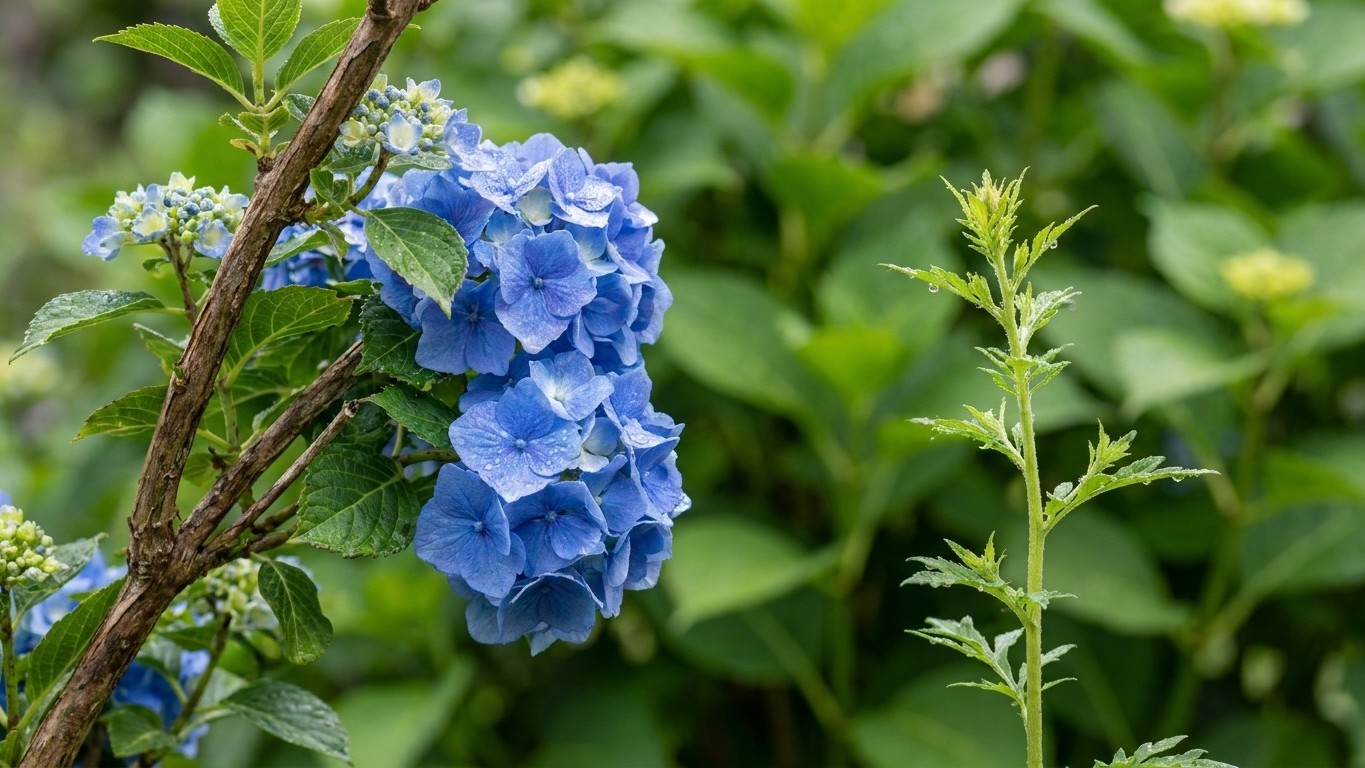

Bigleaf hydrangea flowers work like a pH switch. In acid soil, they turn blue. In alkaline or near-neutral soil, they turn pink, and in the slightly acid range between the two they come out purple or two-toned. Rhode Island soil often leans acidic, so a pink shrub usually points to lime near the foundation, a phosphorus-heavy fertilizer, or a variety bred for pink. Turning it blue means acidifying the soil around the roots and waiting out a season or two.
What this comes down to in Rhode Island

In Providence, the reference city, the last spring frost falls between April 7 and April 17 and the first fall frost between October 24 and November 3, and bloom color is set during the growing season by how much aluminum the roots can absorb. Pink flowers mean the aluminum is there but locked up, usually because the soil pH is too high or phosphorus is binding it. Those frost dates come from the NOAA NCEI U.S. Climate Normals for an airport weather station. Suburban and rural gardens can see the last spring frost later and the first fall frost earlier, so treat them as a starting point.
Why are my hydrangeas pink if the soil is acidic?
The pigment in the sepals is the same in both colors. The difference is whether the plant can take up aluminum, and that depends on pH. Rhode Island’s glacial soils often test acidic, which should favor blue. Pink shows up anyway for a handful of reasons. Concrete foundations, mortar, and stone walks leach lime into the nearby soil. Crushed shell mulch, wood ash, and lawn lime do the same. Fertilizers high in phosphorus (the middle number on the bag) tie up aluminum even when the pH is right. Hard tap water, used for watering over several summers, nudges the pH up. And some varieties are simply bred to run pink and resist turning blue.
Which hydrangeas can actually turn blue?
Only some species respond to soil chemistry. A white bigleaf won’t turn blue either, because it has no pigment to switch.
| Type | Color follows soil pH? |
|---|---|
| Bigleaf (Hydrangea macrophylla) | Yes, blue to pink |
| Mountain (Hydrangea serrata) | Yes, blue to pink |
| Panicle (Hydrangea paniculata) | No, white fading to pink with age |
| Smooth (Hydrangea arborescens) | No, white or pink by variety |
| Oakleaf (Hydrangea quercifolia) | No, white fading to pink or brown |
A panicle that blushes pink in September is reacting to age and cool nights. No amount of sulfur will turn it blue. For the broader care routine, see the state guide to growing hydrangeas in Rhode Island.
Working it out for your own garden
Start with a soil test. A home pH kit works, but a lab test through your extension office also reports phosphorus, and that number often explains stubborn pink. If the soil is acid and the flowers are still pink, look at the fertilizer and the variety. If the soil is neutral or alkaline, acidify.
How do you plan planting and bloom timing around frost?
Work backward from your hardiness zone and your last spring frost. Rhode Island spans USDA hardiness zones 6b to 7b, so the zone is the first thing to look up for your own address. At the reference city, the last frost lands April 7 to April 17. A suburban or inland yard may run a week or two later.
Take ‘Endless Summer’, a bigleaf that blooms on both old and new wood and shows blue or pink depending on soil. Planted in that window, it should settle in and flower in its own time. First fall frost is still a long way off, October 24 to November 3 at the reference city, so it has a full season. Now take ‘Nikko Blue’, a classic bigleaf that blooms only on old wood. Its buds formed the previous late summer, so what matters is whether they survive winter and the April warm-spell-then-freeze pattern. At the zone 6b end of the state, that is where the line falls. The first fall frost hardly matters to its bloom. A hard winter or a late freeze does.
How do you tell old wood from new wood before pruning?
Watch what the shrub does in spring. If last year’s woody stems leaf out and carry flower buds, it blooms on old wood, and cutting those stems back removes the flowers. If the plant dies back to the ground and flowers on fresh green shoots, it blooms on new wood and tolerates a hard cut in late winter. Rebloomers like ‘Endless Summer’ tolerate both, which is why they are forgiving. For old-wood types, prune right after flowering, and only to remove dead wood or shape it.
How do you tell a color problem from a nutrient problem?
Look at the leaves. New leaves that are yellow with green veins suggest the soil pH is too high for iron uptake, which fits with pink flowers. Brown, crispy leaf edges after you apply aluminum sulfate suggest you overdid it or applied it to dry soil. Healthy green leaves with pink flowers point to phosphorus or the variety.
To shift pink toward blue, many gardeners apply aluminum sulfate dissolved in water, following the label. Elemental sulfur works too, more slowly. Switch to a low-phosphorus fertilizer. Expect the change over a season or two, since the flowers already forming won’t change color.
What changes across the state
Rhode Island is small, but its climate is not uniform. Narragansett Bay and the Atlantic moderate winter lows along the coast and on the islands, so the warm end of the 6b to 7b range sits near the water. Inland and in the higher northwest corner, winters are colder and spring frost lingers longer. The same ‘Nikko Blue’ that sets buds reliably in a Newport garden may lose them in a northwest-corner yard during the same winter.
The Providence frost window sits between those two settings. Coastal gardens may run close to it, while inland, higher ground, and low frost pockets run later in spring and earlier in fall. Soil changes too. Sandy outwash near the shore drains fast and loses applied sulfur quickly, so acidifying treatments need repeating. Heavier inland soils hold amendments longer but may sit on stone walls, old foundations, or limed lawns that quietly push pH up. Wherever you are, test the exact bed rather than guessing from the town.
The mistakes this state punishes

The first is planting into cold soil after a warm spell. April can hand Rhode Island a week of mild weather followed by a freeze, and a hydrangea that has leafed out early gets burned, especially an old-wood type whose buds are already swelling. Wait until the frost window has clearly passed for your location, and keep a sheet or burlap handy.
The second is pruning an old-wood bigleaf hard in late winter. Many gardeners do this to “tidy up” and then wonder why a healthy shrub has no flowers. Cut only dead stems after leaf-out, when you can tell live wood from dead.
The third is feeding a pink-leaning shrub with an all-purpose fertilizer that is high in phosphorus and then adding sulfur on top. The sulfur fights the phosphorus. Switch to a low-phosphorus formula first.
The fourth is putting aluminum sulfate on dry soil or at heavy rates. Water the bed well, apply the amount on the label, and rinse it in. Burned roots set a shrub back more than pink flowers ever will.
The fifth is planting a hydrangea against a concrete foundation and expecting blue. Move it a few feet out, or add a raised bed of acidic soil and pine bark mulch.
Checking this against your own area
The Providence dates are a reference point for one airport weather station, and your own yard may run a week or two off. Contact the University of Rhode Island Cooperative Extension for local frost guidance, soil testing, and its own hydrangea guidance. Take the test result and your zone to the extension office before buying amendments.
Common questions
Can I turn pink hydrangeas blue in one season?
Usually not fully. Flower buds that are already formed keep their color, so the change tends to show up the following year after the soil pH has dropped and the roots have taken up aluminum. Apply as growth starts, following the label.
Why are my hydrangeas pink when my neighbor’s are blue?
Soil pH can differ over a few feet. A lime source such as a foundation, walkway, or limed lawn raises it. The varieties may differ too, and one of you may be using a high-phosphorus fertilizer.
Do coffee grounds or pine needles turn hydrangeas blue?
They help only slightly. Pine bark mulch and compost add organic matter, but a measurable pH drop usually takes sulfur or aluminum sulfate. Test the soil to see whether it is working.
Will white hydrangeas change color if I acidify the soil?
No. White bigleaf varieties lack the pigment, and panicle, smooth, and oakleaf types don’t respond to soil pH. Only blue-to-pink bigleaf and mountain hydrangeas do.