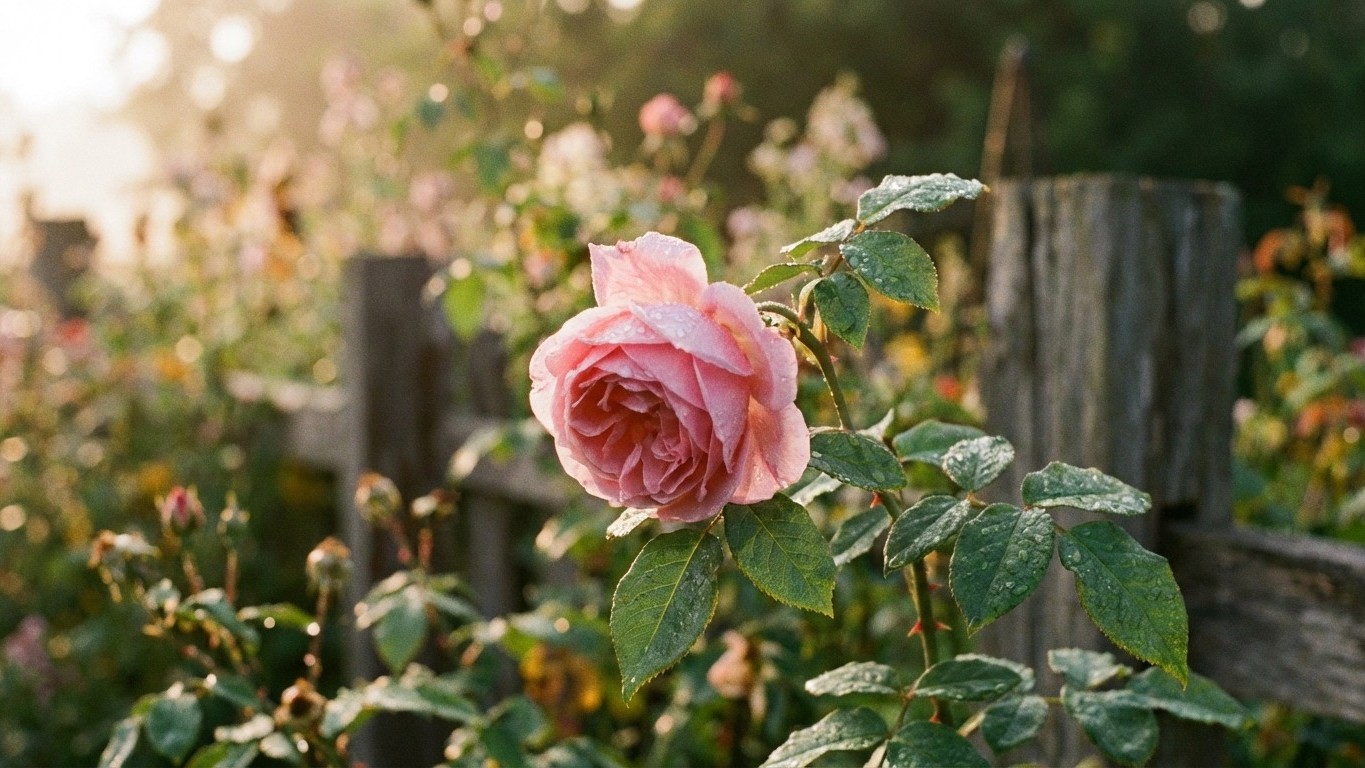

Powdery mildew is one of the three rose diseases Saskatchewan gardeners meet most. Black spot arrives in wet summers, and downy mildew turns up during cool, damp spells. Rose rosette, which has no cure, is not known to be a common garden problem here. Dry prairie air keeps most fungal diseases in check in a normal year. A rainy July or a run of hot days and cold nights can undo that, and those two weather patterns decide how bad a season gets.
Which rose diseases Saskatchewan’s climate brings
Fungal spores are everywhere on the prairies. What varies from year to year is whether the weather gives them what they need. Each of the three common diseases wants a different kind of weather, so the forecast tells you which one to watch for. Saskatoon sits in Canadian hardiness zone 3a on Natural Resources Canada’s 1991–2020 map. That is a Canadian rating, not a USDA one, and the two systems are not equivalent. Roses that survive zone 3a winters still have to get through the summer, and summer is when these diseases do their damage.
How does black spot get going on prairie roses?
Black spot is a fungus that leaves round black spots with feathery edges on the leaves, usually with a yellow halo around them. Affected leaves yellow and drop, starting at the bottom of the plant. The spores travel in splashing water and need a film of moisture on the leaf to take hold. A stretch of warm, humid, showery weather in July or August is what sets it off. In a dry summer it can be nearly absent, unless a sprinkler is wetting the leaves every evening. The fungus survives winter on fallen leaves and old canes, so rake up and bag every fallen leaf before the snow comes.
Why does powdery mildew show up in dry weather?
Most leaf fungi need wet leaves, but powdery mildew does not. It does best where days are warm and dry and nights are cool and damp near the ground. That describes a prairie late summer very well. The first sign is a white or gray powdery coating on young leaves, buds and soft stems. The leaves often curl and twist. Mildew rarely kills a rose outright, but it weakens the plant and ruins the flowers, and a weak plant goes into winter in poor shape.
What does downy mildew look like, and when does it strike?
Downy mildew likes cool, wet weather. It leaves purplish-red to brown blotches on the upper leaf surface, with edges that follow the veins. In damp conditions a gray fuzz forms on the underside of the leaf. Leaves yellow and fall within days, which is faster than black spot works. Gardeners often mistake it for black spot or for spray burn. It is usually not the main problem here, but a cold, rainy spell in late spring or early fall can bring it on quickly.
When each one shows up here
The disease calendar follows the growing season. At the Saskatoon reference station, the mean last spring frost is May 18 and the mean first fall frost is September 18. Those are averages from Environment and Climate Change Canada’s climate normals. An average is the midpoint of a window. In one year out of two the last frost comes later than May 18, and in one year out of two the first fall frost comes before September 18. Northern and upland districts run weeks behind Saskatoon, so shift everything below accordingly.
Roses leaf out in May, and the first disease problems show up in the weeks after. The table gives the usual order of events for a district near Saskatoon.
| Problem | Usual months | What you see first |
|---|---|---|
| Stem cankers | April and May, as plants leaf out | Sunken brown or black patches on canes, with the growth above them dying |
| Downy mildew | Late May and June, then again in September, in cool wet spells | Purple-brown blotches on top of leaves, gray fuzz underneath |
| Black spot | July and August after wet weather, earlier in a rainy June | Black spots with yellow halos on the lowest leaves |
| Powdery mildew | July through September, worst as August nights cool | White powder on new leaves and buds |
Stem cankers are worth a word. They are fungal infections that move into canes damaged by winter cold, and they appear in spring when you see how much wood survived. Cut canes back to healthy wood that is green with a white center. Brown pith means the cane is still damaged.
Cold ends the season for the leaf diseases, but the spores stay on fallen leaves and old canes. A fall frost does not clean the garden. It only stops the infection for the year, and spring wetness picks it up again.
What this changes about spacing and watering
Air movement and dry leaves are the main defence. Black spot and downy mildew need the leaf surface to stay damp for a long stretch, and powdery mildew favours humid air around crowded plants. Roses planted so the wind can pass through them dry out quickly after rain or dew. Roses packed together hold humidity for hours.
Plant most shrub roses 3 feet apart, measured from the center of one plant to the next. Give large, sprawling shrub roses 4 to 5 feet. Keep a rose about a foot away from a wall or solid fence, because the space behind a plant is where still air collects. Dense shelterbelt rows close to the bed can block the airflow you need, so give roses a clear gap. Inside the plant, thin out crossing canes and the crowded center so that a hand can pass through the shrub. For site selection and planting itself, see growing roses in Saskatchewan.
Water in the early morning, between sunrise and about 9 a.m. The sun and wind then dry any splashed leaves before noon. Evening watering is a bad habit for roses because the foliage stays wet all night, which is exactly what black spot and downy mildew want. Water at the base of the plant, with a soaker hose or a watering can held low, and give a deep soaking once or twice a week rather than a light sprinkle daily. A layer of mulch over the soil keeps spores from splashing up from the ground onto the lowest leaves, and those lowest leaves are where black spot starts.
Rose rosette: the one that means digging the plant up
Rose rosette is a virus carried by a tiny mite that drifts on the wind from plant to plant. It is widespread in the United States, where it has killed large numbers of roses, and it was first described in Manitoba in the 1940s. It is not known to be a common problem in Saskatchewan gardens. Native wild roses such as Rosa woodsii can host it, so it is worth knowing the symptoms.
A rosette-infected plant puts out unusually red, crinkled new shoots. Canes grow thick and soft, and they are covered in far more thorns than normal. Shoots bunch into a dense tangle called a witches’ broom, and flowers distort or fail. No spray or treatment cures the virus. The plant usually declines and dies within two to five years, and it can pass the disease to its neighbors.
If a rose shows these symptoms, dig out the whole plant, roots included. Leftover root pieces can send up new infected shoots. Bag the plant and put it in the trash. Do not compost it, and do not leave it lying in the garden. Photograph the plant before you dig it out, and report it to the provincial agriculture office so the diagnosis can be confirmed.
Checking this against your own county
Saskatchewan is organized into rural municipalities rather than counties, and disease pressure varies across them. A shelterbelt-protected yard near Saskatoon is a different climate from an exposed upland farm or a northern town. Saskatchewan Agriculture is the provincial department to start with to find a regional contact; its pages are aimed at farmers and ranchers, so expect to be pointed to the right office. If a rose has symptoms you cannot name, bring a fresh sample with clear photos of the whole plant, not just one spotted leaf. Natural Resources Canada also lists the Canadian hardiness zone by municipality, which helps you see how far your garden sits from the Saskatoon reference.
Common questions
How can I tell black spot from downy mildew?
Black spot makes round spots with fringed edges and a yellow halo, mostly on the lower leaves. Downy mildew makes angular purple-brown blotches that stop at the leaf veins, and a gray fuzz forms on the underside in damp weather. Downy mildew also drops leaves much faster, within days.
Do I have to spray roses in Saskatchewan?
Often not. Good spacing, morning watering, and raking up fallen leaves reduce most trouble in a normal summer. If a plant loses most of its leaves to black spot two summers in a row, ask the provincial agriculture office about fungicides labeled for roses and the timing that suits your district.
Does a cold prairie winter kill the spores?
Not reliably. Black spot and other leaf fungi overwinter on fallen leaves and old canes, and the cold does not reliably destroy them. This is why removing the leaves in fall matters. Snow cover can even shelter the spores.
Can I save leaves already coated in powdery mildew?
Leaves that are already coated usually stay marked. Remove the worst of them, open up the plant for air, and keep watering at the base in the morning. New growth can stay clean when the leaf surface is dry and the air moves.