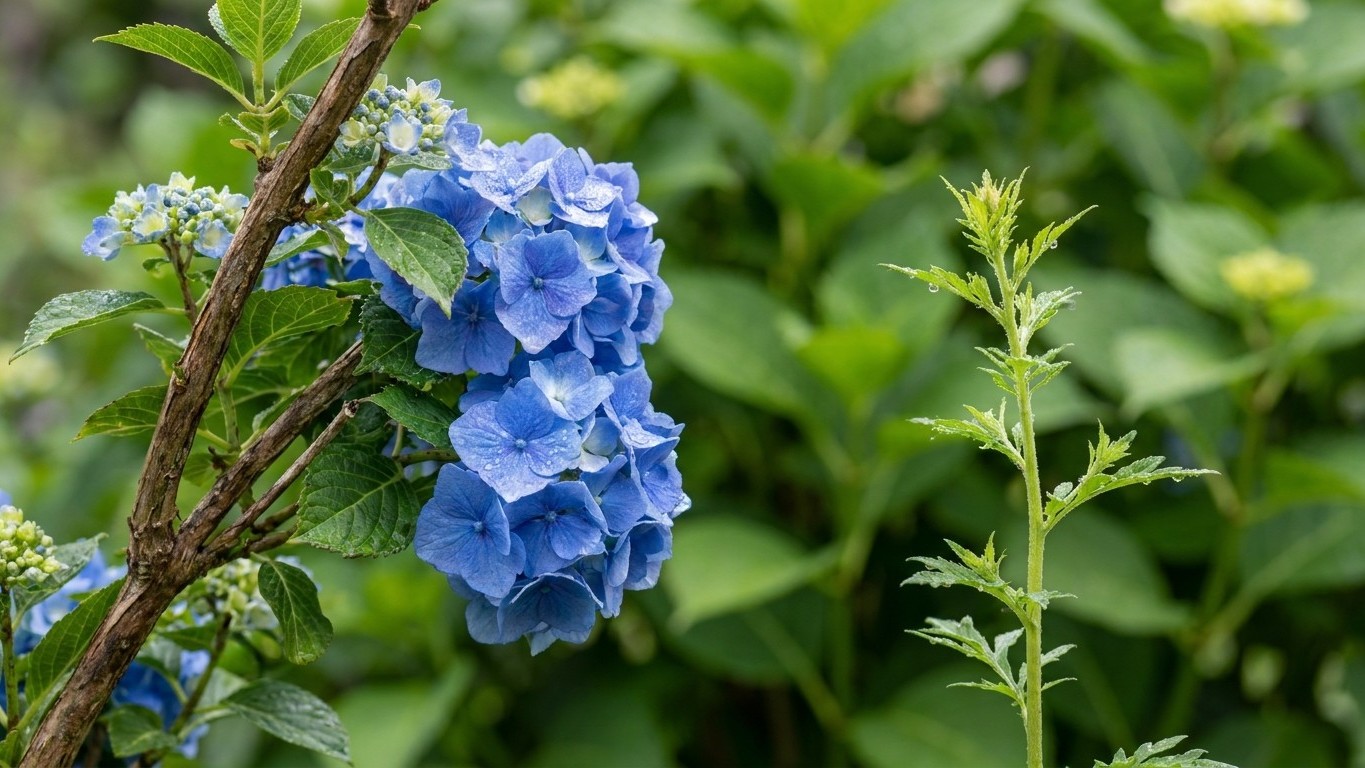

Hydrangeas flower pink on the Prairies because the soil is alkaline, and alkaline soil locks up the aluminum that produces blue petals. Blue needs acidic soil, plus aluminum the roots can actually take up. In a garden bed that is an uphill fight against prairie ground. In Saskatchewan, blue hydrangeas are most realistic in containers of acidic potting mix. Only bigleaf hydrangeas and their close relative the mountain hydrangea can change color at all.
What this comes down to in Saskatchewan

The color question and the season question arrive together: at the Saskatoon SRC station, the mean last spring frost is May 18 and the mean first fall frost is September 18, and everything a color-changing hydrangea does has to fit between them. The reference station has about 123 frost-free days between those two mean dates, and Saskatoon sits in Canadian hardiness zone 3a (the Canadian system, which does not convert to a USDA zone).
Both dates are means. In one year out of two the last spring frost falls after May 18, and in one year out of two the first fall frost arrives before September 18. Treat each as the middle of a window, and expect northern and upland districts to run weeks behind Saskatoon.
What makes a hydrangea flower pink or blue?
The petal-like sepals of bigleaf hydrangeas carry a pigment that shows pink or red on its own. When the plant takes up aluminum, the pigment shifts to blue. Aluminum dissolves in the soil water only when the soil is acidic. When the soil is less acidic it stays bound to soil particles and the flowers come out pink. Between the two, you get purple.
Much of the province has neutral to alkaline soil, and in many places lime sits close to the surface. Municipal and well water is often hard and alkaline too, so even a watering can works against blue. A bed can be amended with sulfur or aluminum sulfate, but the surrounding soil pulls the pH back up within a season or two.
Which hydrangeas can actually turn blue?
Only bigleaf hydrangeas (Hydrangea macrophylla), including the mophead and lacecap forms, and their close relative the mountain hydrangea. Smooth hydrangeas such as Annabelle and panicle types such as Limelight are white or green and stay that way. When a panicle hydrangea blushes pink in late summer, that is the flower aging, and no soil treatment changes it.
Winter hardiness decides whether the question matters. Traditional bigleaf types form next year’s flower buds on old wood in late summer, and a hard winter often kills those stems to the snow line. Reblooming selections such as Endless Summer flower on new growth as well, which is why they are the usual choice for color experiments here. The provincial guide to growing hydrangeas in Saskatchewan covers general care and winter protection.
Working it out for your own garden
Start with a soil test. A garden-center kit gives a rough pH reading, and a lab test gives a more reliable one. Take the sample from the root zone where the plant will sit. If the reading is near 7 or higher, a bed will fight you every year, and a large container makes more sense. If it already reads close to 6, a bed can be shifted toward blue with much less effort.
Then read the flowers against the pH, because the root zone at the time buds develop sets the color:
- Around 5.5 or lower: blue flowers, as long as aluminum is available.
- Between about 5.5 and 6.5: purple, or a mix of pink and blue on one plant.
- Around 6.5 or higher: pink to red.
Next, work out the timing from the frost window. Take the mean last frost of May 18 and add a week or two, because frost comes after that date in half of all years. That puts planting in late May to early June. A reblooming bigleaf sets buds on the new growth it makes after planting and typically opens its first flowers in midsummer. That is well ahead of the September 18 mean first frost. Treatments go on as growth starts and continue through the summer at the interval the product label gives. Expect a first summer of purple tones, with fuller blue the following year as the potting mix and your watering habits settle in.
An old-wood bigleaf shows where the line falls. Its buds form the previous fall and sit above the snow line through winter. If the stems die back, the plant grows leaves and no flowers, and every pound of aluminum sulfate is wasted. Zone 3a gardeners growing these types need to wrap, mulch deeply, or treat the plant as a container shrub that winters in a cool, protected space.
If the color stays pink after you have lowered the pH, check the fertilizer. High phosphorus ties up aluminum in the soil, so switch to a low-phosphorus fertilizer. Also check your water. Hard tap water raises the pH of the pot with every watering, and rainwater or melted snow does not.
What changes across the province
Saskatchewan runs from open southern grassland to boreal forest, and soil chemistry shifts along that line as much as the frost dates do. The southern plains have some of the driest, most alkaline ground, with lime near the surface and salty patches in low spots. Pink is the default there, and a bed treated for blue will revert quickly. Gardeners in that region will do better with containers than with amended beds.
Moving north through the parkland belt, soils are darker and richer in organic matter, and they are often closer to neutral. Farther north, in the boreal forest, the ground is naturally more acidic, sometimes sandy and low in lime. In principle that favors blue, but the season is shorter and winters are harder. Districts north of it, and higher ground such as the Cypress Hills, run weeks behind on the frost dates.
Water matters as much as soil. Town supplies and wells differ from one community to the next, so a gardener in one town may be fighting alkaline water and a neighbor two hours away may not. Shelter counts too. A plant against a sheltered wall, under snow cover, often gets through winters that kill the same plant in the open.
The mistakes this province punishes
A common error is planting out during a warm spell in early May. A mean last frost of May 18 means frost still arrives after that date in half of all years, and new growth on a bigleaf hydrangea blackens at the first one. Wait for the weather to settle, and keep a sheet or pail handy for a surprise cold night.
The second is treating the bed and ignoring the source of the problem. Adding aluminum sulfate to alkaline soil buys a few weeks, then the pH drifts back. Heavy doses burn roots and leaf edges, so follow the label rate and spread smaller applications over the season rather than one big one. Putting the plant in a large pot with peat-based mix, and watering with collected rainwater, avoids the whole cycle.
Third, pruning old-wood types in fall or spring. Removing last year’s stems removes this year’s flowers. Cut only stems that are clearly dead after growth resumes in late spring.
Fourth, expecting the wrong plant to change. A white smooth or panicle hydrangea will never turn blue, and no amount of treatment alters that. Check the label for macrophylla before buying.
Last, starting treatments too late. Flower color is set as buds develop, so a first application in August does little for this year’s bloom. Start in spring, when growth begins.
Checking this against your area
A frost date from one station and a hardiness zone from one city are starting points. Your soil, your water, and your shelter may all differ from Saskatoon’s. Saskatchewan Agriculture’s page for farmers and ranchers lists regional offices and services aimed at producers, so as a home gardener you may need a commercial soil-testing lab and local garden groups for advice on the soil and water in your area, since the province is organized by rural municipality rather than county. For the rest of the growing picture, including winter protection, the provincial hydrangea guide is the next stop.
Common questions
Can I turn a pink hydrangea blue in one season?
Usually only partway. A first summer of acidifying a bigleaf in a container often gives purple or mixed-color blooms. Full blue tends to appear the following year, once the root zone has held a low pH through a whole bud-forming cycle.
Will white hydrangeas change color?
No. White flowers lack the pigment that responds to aluminum. Smooth hydrangeas such as Annabelle stay white. Panicle types often fade to pink in fall, but that comes with age and has nothing to do with soil.
Do coffee grounds or rusty nails make hydrangeas blue?
Neither does much. Coffee grounds barely change the pH of a bed, and nails release iron rather than aluminum. Aluminum sulfate, or sulfur plus an aluminum source, in acidic potting mix works better. Use the label rate, because strong doses injure roots.
Why is my hydrangea still pink after I added aluminum sulfate?
The likeliest causes are alkaline soil or hard water pulling the pH back up, too much phosphorus in the fertilizer, or a plant that is not a bigleaf type. Test the pH of the root zone, switch to a low-phosphorus fertilizer, and consider moving the plant into a container with peat-based mix.