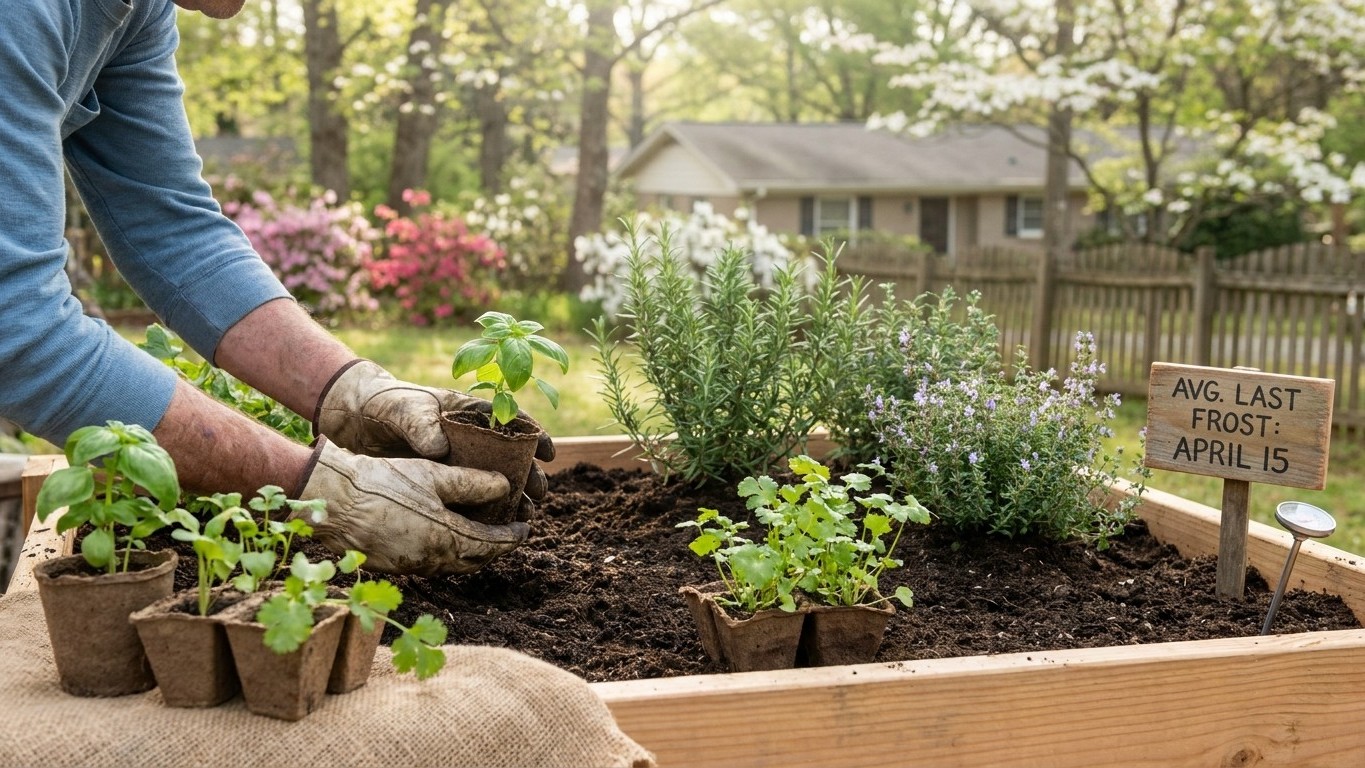

In Huntsville, Alabama, tender herbs like basil and cilantro go into the ground after March 19 to April 3, the window when the last spring frost has a 30-70% chance of happening. Cold-hardy perennials such as rosemary and thyme can go in earlier, since Alabama’s mild winters rarely threaten them once established.
The short answer for Alabama
Alabama gardeners work from one benchmark: the Huntsville station’s frost probability window of March 19 to April 3 for the last spring freeze, and November 2 to November 16 for the first fall freeze. Those dates come from NOAA’s 1991-2020 Climate Normals, and they mark a 30-70% probability band, not a guarantee. Half the years on record still see frost fall outside that window in one direction or the other.
For tender annual herbs like basil, that means direct-seeding or transplanting after the window closes, once the risk of a 32°F night has dropped low. Basil is famously unforgiving of cold soil; a late frost that slips past mid-March can wipe out a tray of seedlings overnight. Cilantro, dill, and parsley behave differently. They tolerate a light frost and actually prefer cooler soil to germinate, so they can go in a few weeks before the spring window closes, or again in late summer for a fall crop that finishes before the November frost arrives.
Perennial herbs follow a separate logic tied to winter survival rather than spring timing. The coldest month’s mean daily minimum at the Huntsville reference station sits at 33.1°F, just above freezing on average. That figure describes the typical cold snap, not the occasional hard freeze, and it explains why rosemary, sage, thyme, and oregano generally overwinter outdoors across most of Alabama without special protection. They are not fighting brutal, sustained cold; they are fighting occasional dips below that average, which is a much easier fight for an established, woody perennial than for a tender seedling.
The state’s hardiness zone range, 7a to 9a on the USDA map, reinforces that perennial herbs have real staying power here. A plant rated hardy to zone 7 survives average annual extreme minimums into the single digits Fahrenheit, well below what Alabama typically delivers even in its coldest pockets. That’s the reason Alabama gardeners can treat rosemary and lavender as multi-year plantings rather than annual replacements, something gardeners in colder states can’t count on.
So the calendar splits cleanly: tender annuals wait for the spring frost window to pass and get pulled or replaced before the fall one arrives; hardy perennials go in almost any time the ground is workable and then settle in for the long haul.
What will not work here

The temptation in Alabama is to treat the long stretch between the spring and fall frost dates, roughly late March through early November, as one uniform planting season. It isn’t. Cool-season herbs like cilantro, chervil, and dill are built for temperatures well below what an Alabama summer delivers for weeks at a stretch. Once daytime heat settles in, these herbs bolt: they send up a flower stalk and turn bitter within days, regardless of how much water they get. Planting cilantro in May and expecting a June harvest is planning for a plant that has already quit before the calendar says it should.
The fix isn’t more water or more shade cloth. It’s timing the planting so the harvest window falls before the heat arrives, or shifting it to late summer so the crop matures as temperatures ease toward that November frost date. A gardener who plants cilantro right after the spring frost risk drops and expects a full season of leaves is fighting the plant’s own biology, not the weather.
Humidity changes the spacing math
Alabama’s growing season isn’t just long, it’s humid for most of its length. That matters more for herbs than most vegetable crops because so many of the popular ones, basil and oregano especially, are dense, bushy plants that trap moisture in their foliage when planted close together. Powdery mildew and basil downy mildew both spread fastest in still, damp air between crowded plants. A spacing chart written for a drier climate will read as too generous here; in Alabama, tighter spacing that looks fine on paper often becomes a fungal problem by midsummer.
The opposite failure shows up with rosemary and other Mediterranean natives. These herbs evolved in dry, well-drained soil and don’t tolerate wet feet. Alabama’s clay-heavy soils in many counties hold water longer than these plants expect, and a rosemary planted in a low spot with poor drainage can rot at the roots during a wet stretch, even though the air temperature never threatened it. The coldest-month minimum of 33.1°F tells you rosemary can handle Alabama winters; it says nothing about whether Alabama’s soil drainage will let it survive them.
What changes across Alabama
A hardiness range of 7a to 9a is not a small spread. It covers the difference between a garden that sees the average annual extreme minimum drop into the single digits and one where it barely dips below 20°F. That gap changes which perennial herbs survive winter without help and which need mulch, a container that can be moved indoors, or replacement each spring.
| Zone within Alabama | Shift from the Huntsville reference window | Herb strategy implication |
|---|---|---|
| Zone 7a (colder pockets, generally north Alabama and higher elevations) | Last spring frost likely later than March 19 to April 3; first fall frost likely earlier than November 2 to November 16 | Give tender annuals a shorter runway; lean on cold-hardy perennials like thyme and sage, with mulch on marginal plants like rosemary |
| Zone 9a (warmest areas, generally the Gulf Coast) | Last spring frost likely earlier than the Huntsville window; first fall frost likely later than it | Longer season for tender herbs like basil; woody perennials such as rosemary and bay laurel can be treated as permanent plantings with little winter risk |
The practical takeaway isn’t which zone number applies to any one reader’s yard, since that depends on local geography. It’s that a planting date built around the Huntsville station will run early for someone gardening in a colder north Alabama valley and late for someone gardening near Mobile Bay. Elevation compounds this inside the state too. A garden a few hundred feet higher than a nearby valley floor can see frost settle in earlier in fall and linger later in spring, even at the same latitude, because cold air drains downhill and pools in low spots overnight.
None of this changes the underlying biology from the section above, cool-season herbs still bolt in summer heat and rosemary still needs drainage everywhere in the state. What shifts is the calendar’s edges: how early spring planting can safely start, and how late a fall crop can be pushed before frost cuts it short.
Where to check this for your own county
This page describes Alabama using one weather station’s frost data and the state’s full hardiness zone range. Neither number is precise enough to plan a specific county’s garden around. The Alabama Cooperative Extension System, at aces.edu, publishes county-level guidance that narrows this down using local weather stations and years of trial results from county agents working with actual Alabama soil and microclimates, not an airport tarmac’s readings.
Two things are worth looking for once there. First, a local planting calendar for vegetables and herbs, which will give sowing windows tied to the extension office nearest the reader’s actual garden rather than a statewide range. These calendars typically break planting into direct-seed and transplant dates for both spring and fall, which matters given how differently basil and cilantro behave across those two windows. Second, look for variety trial results or recommended cultivar lists specific to the reader’s region of the state. Extension offices often test which basil varieties resist downy mildew best in humid conditions, or which rosemary cultivars have proven reliably winter-hardy in a given county’s actual cold snaps, information no statewide page can responsibly claim to have.
A county recommendation will always outrank a state-level one, because it’s built from data closer to the reader’s own soil and sky. This page exists to explain the mechanics behind the dates and the reasoning behind the failures; the extension office exists to put an actual date on the reader’s own calendar. Treat this page as the reasoning and the county office as the number to act on.
Checking this against your own garden
Frost dates and hardiness zones describe averages built from decades of data. A reader’s own garden, on any given year, might not match either. Three simple checks, none requiring equipment beyond a hand and an eye, tell more about a specific yard’s timing than any regional average.
Soil warmth by feel is the first. Basil and other tender herbs germinate and transplant poorly into cold soil, even if the air temperature reads warm enough. Pushing a finger a few inches into the planting bed and feeling for warmth, not just checking that frost risk has passed, catches the gap between air temperature and root-zone temperature that a calendar date can’t.
The first true leaves on a cool-season herb like cilantro or dill are the second signal. The initial pair of leaves that emerges from a seed looks nothing like the plant’s mature foliage; the true leaves that follow, with their characteristic shape, tell a gardener the seedling has moved past its most fragile stage and into active growth. Seeing them appear quickly after sowing is a good sign the soil was cool enough for that particular herb’s comfort.
New growth on overwintered perennials is the third. A rosemary, thyme, or sage plant that pushes out fresh green shoots along its stems in early spring has survived winter in that spot, full stop, regardless of what the zone map says about the area in general. A plant that stays bare and brittle into April, even after nearby plants have leafed out, is a sign that particular microclimate ran colder than the neighborhood average, information worth remembering for next year’s planting.
Some gardeners also time this by the Moon: when to plant herbs by the moon, as almanac tradition rather than fact.